
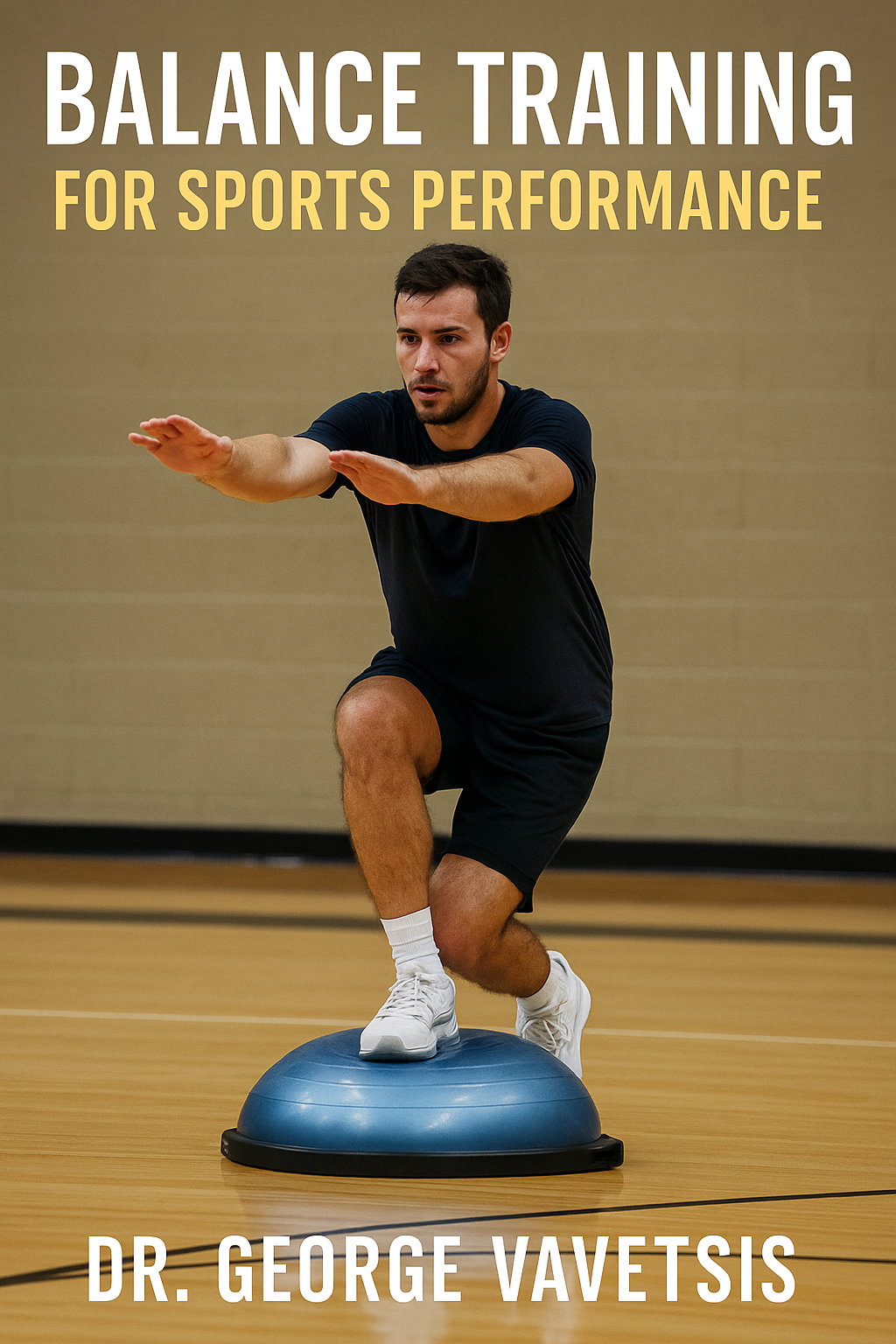
Balance Training For Sports Performance
Pages: 553
Balance Training for Sports Performance represents the convergence of modern sports science, applied biomechanics, and advanced neuromuscular conditioning. Across all high-performance environments—whether volleyball, basketball, soccer, handball, tennis, combat sports, or elite youth academies—balance is no longer regarded as a secondary physical quality. Instead, it is a primary performance determinant, a controlling variable that dictates movement efficiency, injury resilience, and the athlete’s capacity to express force under high-speed, high-pressure, and unpredictable competitive scenarios.
In contemporary athletics, balance is not simply the ability to “stand on one leg.” It is a dynamic, multi-system integration of sensory input, motor output, and biomechanical organization. Research in neurophysiology demonstrates that postural control emerges from a continuous negotiation between visual, vestibular, and proprioceptive systems, each weighted according to task demands and environmental constraints. When one input becomes unreliable—such as vision during rapid head movements, vestibular load under fatigue, or proprioception during multi-directional landings—the central nervous system reweights the remaining inputs to maintain stability. This adaptive reweighting forms the foundation for effective agility, reactive deceleration, unilateral power, and technical precision during sport-specific actions such as cutting, blocking, striking, or serving.
Equally important is the biomechanical interplay between Center of Mass (COM) and Center of Pressure (COP). Elite athletes do not simply “stay balanced”; they control the COM–COP relationship under constraints that change millisecond by millisecond. Force-plate research shows that athletes attempt to minimize excessive COM motion while strategically allowing predictable COP oscillations that reflect anticipatory readiness for perturbations. This ability to regulate COM–COP dynamics—especially in the frontal and transverse planes—distinguishes high-level movers from the rest.
The modern strength and conditioning coach must therefore approach balance not as a static quality, but as a trainable expression of sensorimotor intelligence, multi-joint stiffness modulation, segmental interdependence, and adaptive variability. As the chapters of this book reveal, balance exists on a spectrum:
- From quiet stance control with minimal COP sway
- To perturbation-driven postural corrections
- To reactive agility and late braking in chaotic sport environments
- To position-specific balance requirements, such as a libero's low-stance reactive stability or a tennis player’s split-step force redirection
- To rehabilitation contexts, where balance determines readiness for deceleration, landing, and eventual return to performance
Balance is both mechanical and perceptual. It is the ability to resist perturbation, but also the ability to use perturbation as information. Elite performers do not only stabilize—they anticipate, redirect, and reorganize movement strategies faster than opponents.
This book also emphasizes balance as a critical element in injury prevention and rehabilitation. Non-contact injuries—ACL ruptures, ankle sprains, patellofemoral dysfunction—often emerge from deficits in neuromuscular timing, faulty AP/ML control, or delayed reactive postural adjustments under fatigue. Balance training that incorporates unpredictable perturbations, proprioceptive noise stimulation, sensory reweighting, and eccentric braking improves joint stability and enhances the athlete’s readiness to meet the demands of high-speed deceleration, landing, and change of direction.
Furthermore, the content presented in these chapters integrates advanced methodologies that align with the evolving landscape of applied sports science:
- Perturbation-based balance training using elastic cords, mechanical platforms, or harness systems
- Vision-occlusion approaches that manipulate sensory reliability and promote vestibular/proprioceptive dominance
- Velocity-based balance strengthening (VBT) integrating force–time metrics with instability demands
- Dual-task balance under cognitive load, simulating tactical decision-making under competitive constraints
- Chaos-stimulus training, leveraging unpredictable acoustic or visual cues for APA/RPA refinement
- Entropic COP-complexity methods, using instability devices to shape motor variability and robustness
Coaches will find that balance is inseparable from other physical qualities. It is embedded in strength (through bracing and stiffness control), mobility (through end-range proprioception), plyometrics (through landing mechanics), speed (through COM redirection), agility (through footwork precision), and even endurance (through fatigue-state postural maintenance). As such, balance training must be integrated—not isolated—within strength sessions, technical practices, micro-dosing strategies, and return-to-play protocols.
One of the most critical themes in this book is the shift from reductionist drills to game-like movement solutions. While isolated balance tasks build foundational capacity, it is integration—linking balance with skill, decision-making, and tactical execution—that leads to true performance transfer. This book guides the coach from fundamental sensory-motor progressions to advanced, position-specific, sport-specific, and fatigue-specific balance applications.
Ultimately, this book serves three purposes:
- To provide the scientific foundations of balance from neurophysiology, biomechanics, and motor control research.
- To translate that science into elite-level training methodology, equipping strength and conditioning coaches with practical tools that enhance on-field performance.
- To redefine balance as a performance quality, not a rehabilitation afterthought nor a static circus trick, but a decisive factor in competitive readiness, injury resilience, and athletic mastery.
As you progress through the chapters, you will find not only the theory behind balance but a complete applied system—capable of elevating athletes across sports, positions, and performance levels.