
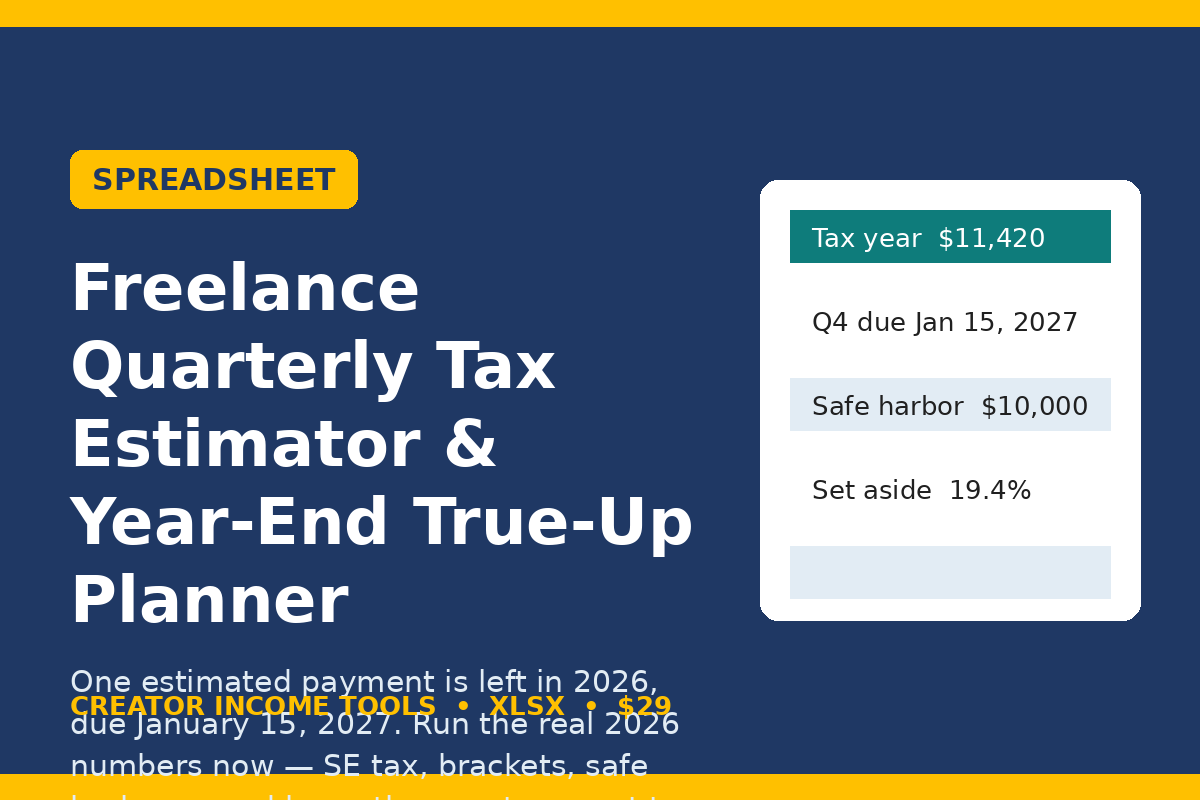
Freelance Quarterly Tax Estimator & Year-End True-Up Planner
There is one estimated tax payment left in 2026 — and six weeks to get it right.
The final 2026 payment is due January 15, 2027 in the US (December 15, 2026 in Canada), and it is the one that catches freelancers off guard. November is the month to deal with it: not January, when the money is already spent on the holidays — right now, while you can still fix the number.
A November 2026 walkthrough of the same true-up puts it plainly: $68,000 received, $9,000 in expenses, $59,000 net profit, about $16,500 of tax at a 28% rule of thumb. If $11,000 was already paid in estimates, the final payment should be roughly $5,500 — not a guess, not a panic number. Do it in November and you still have six weeks to set the cash aside. Do it in January and you are finding $5,500 in the most expensive month of the year.
This planner replaces the rule of thumb with the actual 2026 numbers.
WHAT YOU GET
A formula-driven Excel workbook with 5 sheets:
1. Start Here — the method, the worked example, and the November true-up playbook.
2. Income & Expenses — one row per quarter: income actually received (not invoiced) and business expenses. Net profit per quarter is formula-driven, and the totals row is your full-year profit. Q4 is a forecast — update it in December and everything downstream re-computes.
3. Tax Estimate — the whole calculation, step by step, all formula-driven: the self-employment taxable base (profit × 92.35%), self-employment tax (15.3%, with the Social Security part capped at the 2026 wage base of $184,500), half of self-employment tax as a deduction, the 20% qualified business income deduction, the $16,100 single standard deduction, taxable income, federal income tax from the 2026 single-filer brackets (10% to $12,400, 12% to $50,400, 22% to $105,700, 24% to $201,775, 32% to $256,225, 35% to $640,600, 37% above), total 2026 tax, and the safe-harbor comparison: the smaller of 90% of this year's tax or 100%/110% of last year's tax is your required total, divided by four for the quarterly payment. The set-aside rate tells you what share of every dollar you earn belongs to tax.
4. Payments Log — one row per quarter with the IRS due dates (April 15, June 15, September 15, 2026, and January 15, 2027). Enter what you actually paid; required, shortfall and status are formula-driven. The true-up box below the table shows what you have paid so far, the Q4 payment that reaches the safe harbor, and the balance still due when you file in April.
5. Dashboard — change the as-of date or any input and everything re-computes. Headline numbers: full-year net profit, self-employment tax, federal income tax, total 2026 tax, set-aside rate, safe-harbor target, required estimates, what you have paid, the Q4 payment due January 15, 2027, the April balance, and one next action — the payment to make now.
WORKED EXAMPLE INCLUDED
$68,000 income, $9,000 expenses, $59,000 net profit. Self-employment tax $8,336.43, federal income tax $3,083.85, total 2026 tax $11,420.28. Last year's total tax $10,000, so the safe-harbor target is $10,000 and the quarterly payment is $2,500. Q1–Q3 paid $2,500 each ($7,500 total) — the true-up is a $2,500 Q4 payment due January 15, 2027, and the balance due at filing is $1,420.28. Delete the example rows and start with your own numbers.
WHAT IT IS NOT
Federal tax only, single filer, tax year 2026, using the IRS figures in Revenue Procedure 2025-32. State estimated tax is not included — most states have their own estimated payments on similar dates, so check your state revenue department. The 0.9% additional Medicare tax above $200,000 of self-employment income is not included.
This planner is general information and a planning estimate, explicitly not tax advice. It does not file anything and it does not pay anything — you pay through IRS Direct Pay or EFTPS yourself, and your actual return may differ. If your situation includes a spouse's income, rental income, capital gains, or a state with its own rules, talk to a tax professional.
Run it in November, re-run it in December when Q4 actuals land, and again in January before you pay.