
Room to Choose: Whole-child PDA Package
Room to Choose: A Whole-Child PDA Package of Support
Empowering Young People, Parents, Carers, and Educators with a Neuro-Affirmative Approach to PDA.
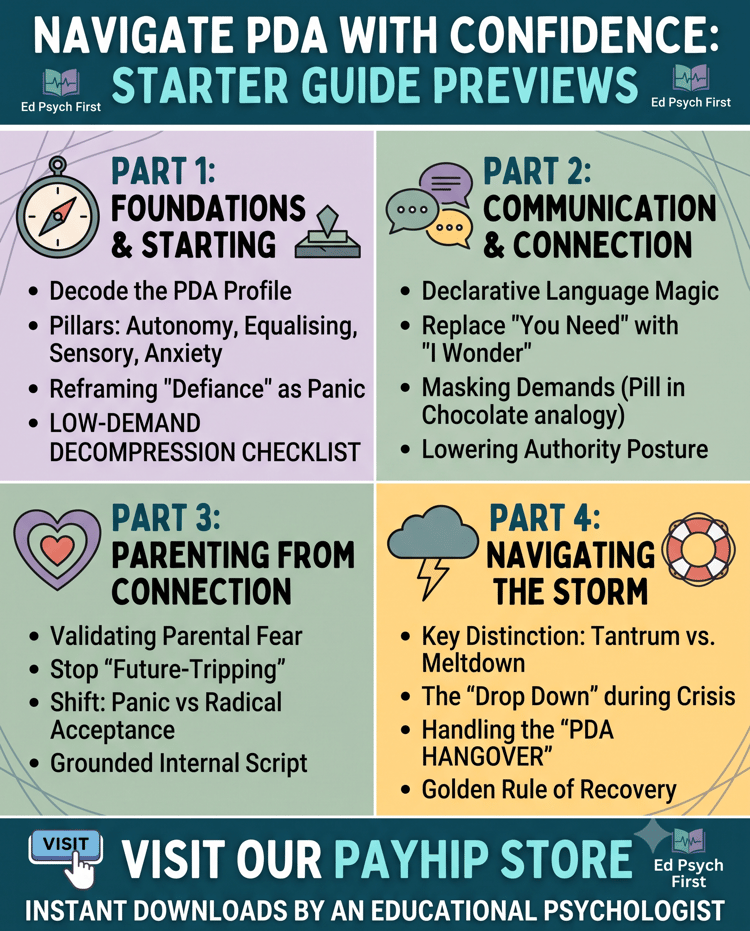
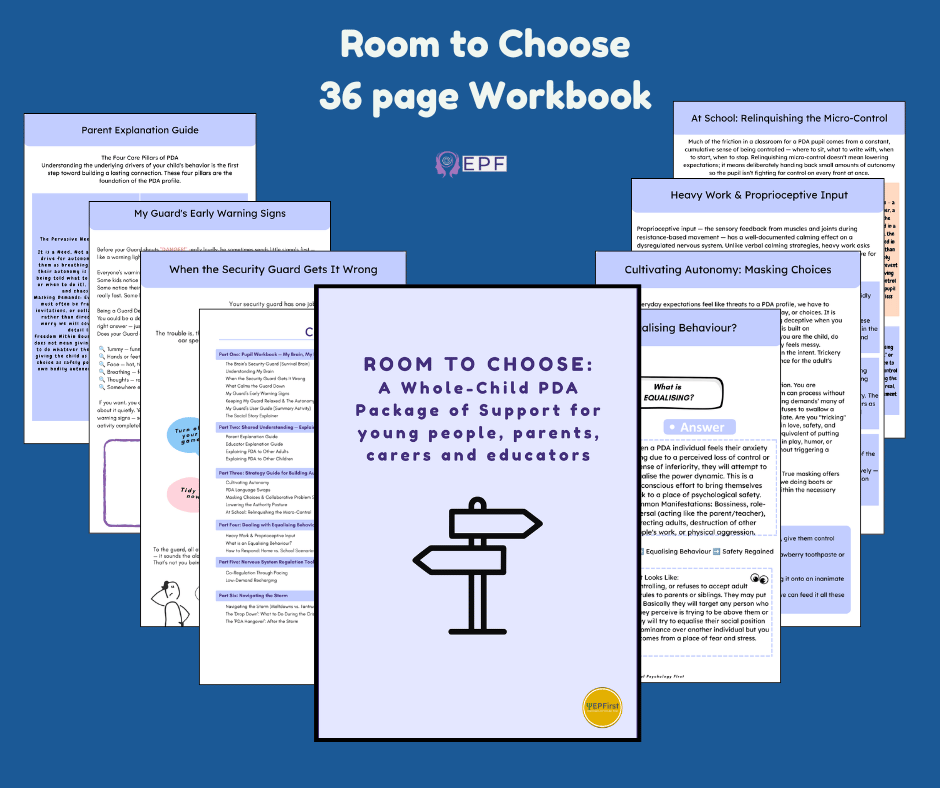
Is traditional behavior management causing meltdowns or power struggles? Room to Choose is a comprehensive, 36-page psychoeducational workbook and strategy guide designed to transform how we understand and support children with a Pathological Demand Avoidance (PDA) profile—conceptualised as a Pervasive Drive for Autonomy.
Rooted in neuroscience, co-regulation, and relational safety, this resource bridges the gap between home and school. It re-frames demand avoidance from "defiance" into what it truly is: a neurological threat response driven by extreme anxiety.
🌟 What’s Inside the Package?
The package is thoughtfully divided into practical, accessible sections designed for both the young person and the adults supporting them:
🧠 Part 1: My Brain, My Rules (Interactive Pupil Workbook)
- The Brain’s Security Guard: Uses relatable metaphors (the Security Guard and Autonomy Battery) to help children understand their survival brain and threat detection.
- Early Warning Signal Trackers: Helps young people spot their body's early alarm signs before overload happens.
- Interactive & Low-Demand Design: Gentle drawing and circling activities with explicit, pressure-free choices ("Or skip this bit entirely — that's okay too!").
- My Guard’s User Guide: A one-page summary tool the young person can fill in to tell adults what helps them feel safe.
🤝 Part 2: Shared Understanding & Explaining PDA
- Child-Friendly Social Story: "When Demands Feel Like Monsters" — a story explaining PDA to peers, siblings, or the young person themselves.
- Parent Explanation Guide: Breaks down the 4 Core Pillars of PDA (Autonomy, Equalising, Sensory, and Anxiety).
- Educator Pedagogical Matrix: Clear side-by-side comparisons showing why traditional autistic strategies trigger PDA and how to adapt them instantly.
- Script & Reframe Guides: Easy 30-second elevator pitches and reframing charts to explain PDA to extended family, teachers, or observers.
🛠️ Part 3–6: Strategy & De-escalation Guides for Adults
- The Magic of Declarative Language: Direct "Language Swap" examples to replace imperatives ("You need to...") with inviting observations ("I wonder if...").
- Masking Demands & Collaborative Problem-Solving: How to wrap daily expectations in play, choice, and low-authority posture without manipulative trickery.
- Navigating Equalising Behaviours: Practical de-escalation steps for home and classroom when a child tries to regain safety by exerting control.
- Somatic Regulation Tools: Heavy work, proprioceptive input, and low-demand "recharging" strategies.
- Meltdowns vs. Tantrums: A crucial guide to surviving the storm, using in-crisis "Drop Down" protocols, and supporting the child through the "PDA Hangover" with unconditional acceptance.
📦 What You Will Receive:
- 1x High-Resolution, Printable PDF Document (36 Portrait Pages)
- Suitable for home printing, digital tablet annotation, or classroom binder insert.
- Bonus content of 10 PDA Bitesize guides is also included covering topics from equalising to meltdowns.
🎯 Who is This Package For?
- Parents & Carers looking for compassionate, low-demand strategies that actually work at home.
- Teachers, SENCOs, & TAs needing practical classroom adaptations, language swaps, and de-escalation tools.
- Educational Psychologists & Therapists looking for a ready-to-use psychoeducational tool to share with families and schools.
"Progress with PDA is not linear. When anxiety peaks, we drop expectations and return to our baseline of pure safety, connection, and trust."