

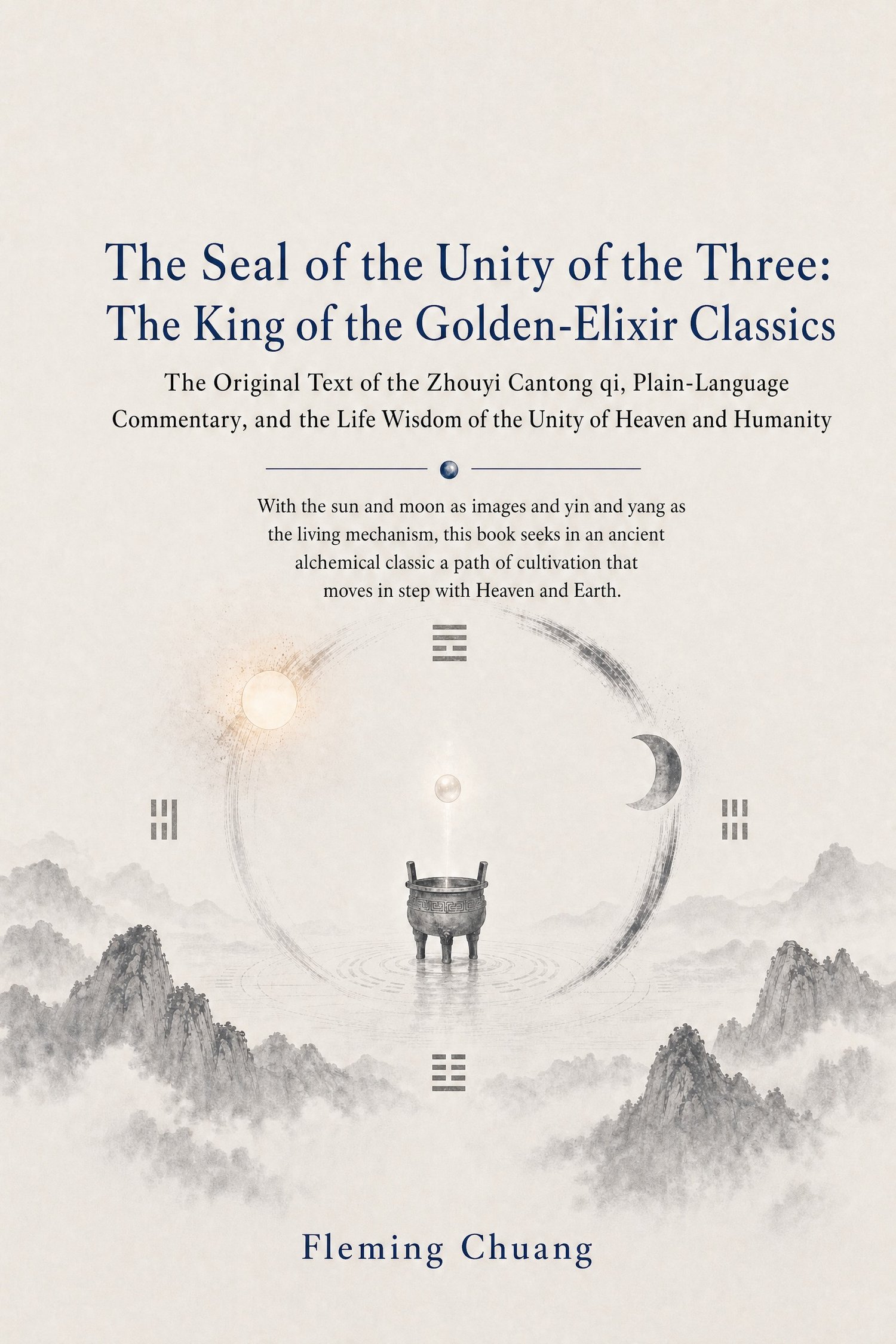
The Seal of the Unity of the Three: The King of the Golden-Elixir Classics
What does an ancient Chinese alchemical classic have to say about the transformation of a human life?
The Seal of the Unity of the Three offers an accessible English doorway into the Zhouyi Cantong qi, traditionally attributed to Wei Boyang and honored in Daoist tradition as the King of the Golden-Elixir Classics. Rather than treating its mysterious language as a literal recipe, Fleming Chuang reads the text as a symbolic map of inner cultivation, philosophical inquiry, and the search for harmony between the human being and the cosmos.
Across thirty-five chapters, the book brings together selected classical passages, plain-language commentary, and interpretive essays on the text’s central images: Qian and Kun, Kan and Li, the sun and moon, yin and yang, the Four Images, the Five Phases, the dragon and tiger, lead and mercury, and the returned Golden Elixir. The recurring movement is from division toward integration—from scattered energies and restless thought toward a centered, balanced, and quietly transformative way of living.
The book also places Daoist alchemical symbolism in conversation with modern ideas such as rhythm, homeostasis, systems thinking, neuroplasticity, emergence, and mind-body regulation. These comparisons are offered as bridges for reflection, not as claims that ancient metaphors constitute modern scientific proof. Practical applications at the end of each chapter invite readers to consider how the classical principles of balance, timing, restraint, inner attention, and returning to one’s roots might illuminate contemporary work, relationships, creativity, and personal growth.
Part commentary, part philosophical meditation, and part introduction to one of China’s most enigmatic classics, this volume is for readers who want to approach Daoist alchemy without being trapped by its coded vocabulary. It clarifies the difference between outer and inner readings, explains why the text uses images of furnace, medicine, chamber, and union, and emphasizes the author’s own warning that symbols must not be mistaken for literal instructions. For students, seekers, and intellectually curious readers alike, The Seal of the Unity of the Three presents an ancient vision of life as a dynamic movement between stillness and motion, form and emptiness, individuality and the greater order of Heaven and Earth.