
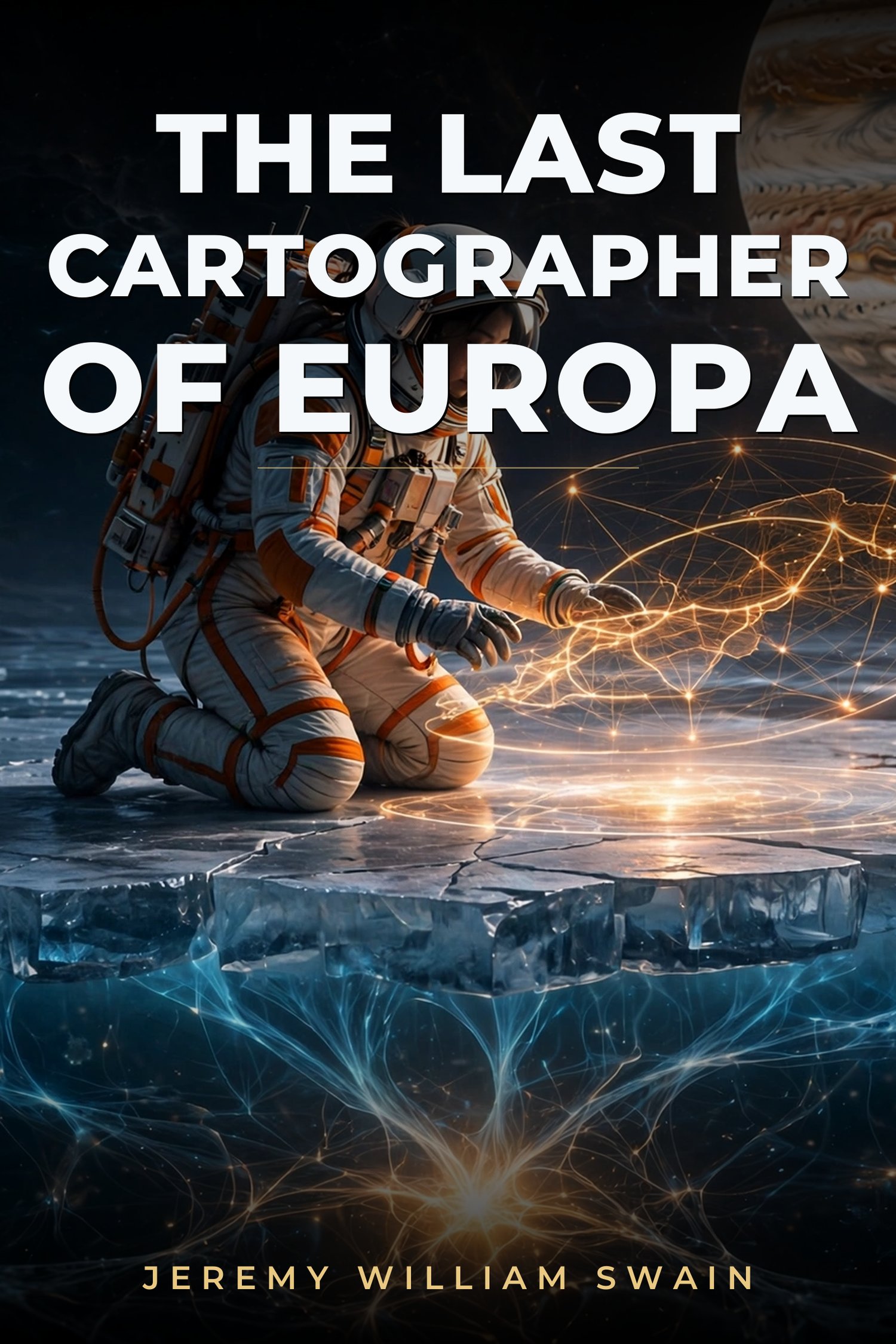
The Last Cartographer of Europa
The map changes every time someone dies.
On Europa, ninety million miles from the nearest help that matters, the Ariadne Survey is drawing the first true chart of the ice — fourteen kilometres of frozen ocean above a black sea, mapped by a survey instrument with one impossible property: it keeps changing. Routes narrow. Channels vanish. New lines appear where none were sounded. And the changes are not noise. They follow a rule the crew learns the way you learn a word in a language you didn't know you were speaking: every time a signature stops — every time someone dies — the map redraws itself around the loss, because the map is not only a picture of the ice. It is a picture of something in the ocean below it, and the thing below notices.
Rhea Tanaka is the expedition's chief cartographer, the best reader of redraws alive, and the woman who signed the route — against a chart five hours old — that killed Pavel Novak on his morning traverse. Her redemption and her punishment are the same job: read the changes, name what makes them, and finish the chart before the ice does something worse. Because the deaths are drawing something. Under the retraction fans and the bright knots where the ocean answers a loss, an older pattern is showing through — roads in the deep ice that no human made, converging on a place the first survey was told not to chart.
The Last Cartographer of Europa is a standalone novel of exploration and survival — a story about a living map, a crew of ten learning its price one name at a time, and the difference between a chart that is accurate and a chart that is true. When the way home is erased by the death of the man who held it open, four people at the bottom of the ice will have to navigate by the only map that has never lied to them: what the dead wrote down.
Created with AI assistance under the direction of its author, Jeremy William Swain.