

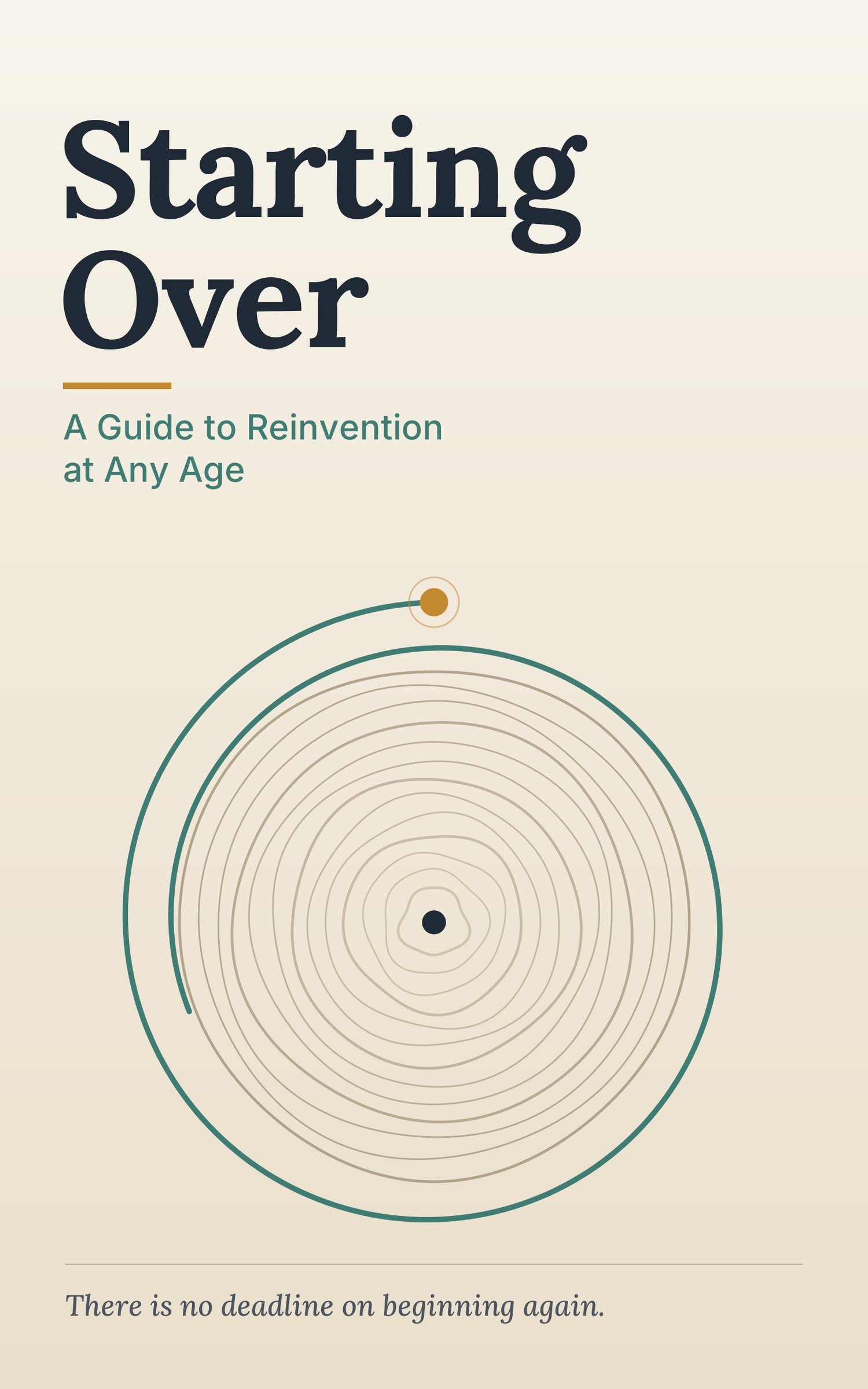
Starting Over: A Guide to Reinvention at Any Age
Has a career ended, a relationship changed, children left home, or retirement not turned out the way you expected? Starting Over is a warm, honest 27-page guide for anyone at the edge of a new beginning, whatever their age. It explains why the “closing window” is a myth, helps you grieve what you are leaving, shows you how much you already carry forward, and turns big fears into small, practical experiments. It includes worksheets, scripts, a 90-day plan, and reflection prompt
What this book is about
Starting over can arrive at 24, 45, 60, or 70, and it can come from a business collapsing, a relationship ending, a career disappearing, or a loss that changes everything. The question underneath is usually the same: is it too late to begin again?
Starting Over answers that honestly. It does not rely on forced positivity or pretend that every situation is the same. It looks clearly at what reinvention actually requires: grieving the old identity, recognizing what you already have, naming the real fear underneath "it's too late," making small sequenced moves, planning around your real constraints, and rebuilding a circle of support.
What is inside
A note before you begin
Who the book is for, how to use it, and a clear statement that it is reflection and planning, not therapy or professional advice.
Chapter 1: The myth of the closing window
Why the belief that reinvention has a deadline appears at every age, a table showing the same fear across your twenties to your sixties and beyond, and how to find real examples of people who changed course. Includes a worksheet to separate facts from fears.
Chapter 2: What you're actually grieving
The identities that need grieving before a new one can take root, losses people rarely name, what grief looks like, what helps and what does not, and when to get more support. Includes a farewell exercise for your old identity and a pointer to free crisis helplines by country for anyone in danger.
Chapter 3: Starting over isn't starting from zero
What actually transfers: judgment, relationships, self-knowledge, resilience, and skills. Includes a table showing how everyday experience, such as running a household, caregiving, or a long career, translates into new settings, and a "what I carry" inventory.
Chapter 4: The fear underneath the fear
What "too late" often really means, a table that turns each fear into a fair question and a small step, common thought traps, advice on feeling like an impostor, and scripts for when people question your choice.
Chapter 5: Small reinventions, not total overhauls
A four-stage path (explore, test, build, commit), example experiments for work, creative life, relationships, place, health, learning, and money, a 30-day experiment planner, and clear go and no-go signals before any big move.
Chapter 6: Your real constraints, not someone else's
A constraint map across money, time, energy, family, housing, skills, and support, a plain-language runway calculation with a worked example, a way to test your "I cannot" assumptions, the small, medium, and big versions of a change, and practical guidance for people who are caring for others.
Chapter 7: Who's in your corner now
Six kinds of support (cheerleader, truth-teller, practical helper, fellow traveler, guide, professional), a map to fill in, scripts for asking for help, how to handle doubters, and where to find new connections.
Chapter 8: Your 90-day starting over plan
A month-by-month plan with a weekly check-in and advice for when progress feels slow.
Chapter 9: A letter to someone starting over
The emotional heart of the book, with an exercise to write your own letter to yourself.
Bonus tools
- 15 reflection prompts
- A one-page cheat sheet
- Fill-in tables and worksheets throughout
How you will benefit
- Let go of the "it's too late" story. See where it comes from and what is really behind it.
- Grieve what needs grieving. Make room for the new without rushing or ignoring the old.
- Recognize your real assets. Discover how much of what you built, learned, and survived carries forward.
- Turn fear into action. Replace a vague wall with specific, manageable steps.
- Change safely. Use small experiments and clear signals instead of risky all-or-nothing leaps.
- Plan around your real life. Work with your actual money, time, health, and responsibilities.
- Build a circle of support. Find the right people and learn how to ask them for help.
- Move forward with a plan. Follow a simple 90-day path and review your progress each week.
Why you should buy it
- It is written for every age. The questions and tools apply whether you are in your twenties or your seventies.
- It is honest. No forced positivity, no promises of overnight transformation, and no pretending that constraints do not exist.
- It is practical. Every chapter ends with a step you can take this week, and the book includes worksheets, scripts, and a plan.
- It treats grief with respect. It recognizes that starting over usually involves loss, and gives that real space.
- It is gentle and short. You can read it in an evening and use it for a season.
- It is useful for many kinds of change. Career, relationship, retirement, empty nest, relocation, or loss.
- It is yours to reuse. The prompts and tables can be revisited whenever life changes again.
Who it is for
- People whose career, business, or plans have ended or stalled
- People after a breakup, divorce, or the loss of a partner
- Parents whose children have grown up and left home
- People approaching or in retirement who want a new sense of purpose
- People who have moved to a new city or country and are rebuilding
- People who feel they have outgrown the life they built
- Anyone who has quietly wondered, "Is it too late for me?"
Who it is not for
This book is general reflection and planning, not therapy, medical advice, financial advice, or legal advice. If you feel hopeless or are thinking about harming yourself, please contact your local emergency number or a crisis line in your country. The book explains how. For decisions involving money, pensions, health, or legal matters, please speak to a qualified professional.
What you get
- 1 digital PDF guide (27 pages)
- Instant download after purchase
- Works on phone, tablet, and computer
- Printable worksheets, reflection prompts, and cheat sheet
Common questions
Is this only for people in midlife? No. It is written for any age, from young adults to people in their seventies and beyond.
Is it only about careers? No. It covers many kinds of starting over, including relationships, loss, retirement, relocation, and identity changes.
Will it tell me what to do next? It will not choose your path for you. It helps you get clear, test ideas safely, and build a plan that fits your life.
I am grieving right now. Is this book appropriate? Yes. Chapter 2 is about grief, and the book encourages you to go at your own pace and to seek support if you need it.
Is it a substitute for therapy or professional advice? No. It is a gentle companion. It tells you when and how to seek more help.
How long does it take to read? About 1 to 1.5 hours. The exercises and the 90-day plan take about 10 to 15 minutes a day.
Closing line
It's not too late. It's just a new beginning, wherever you're standing.