
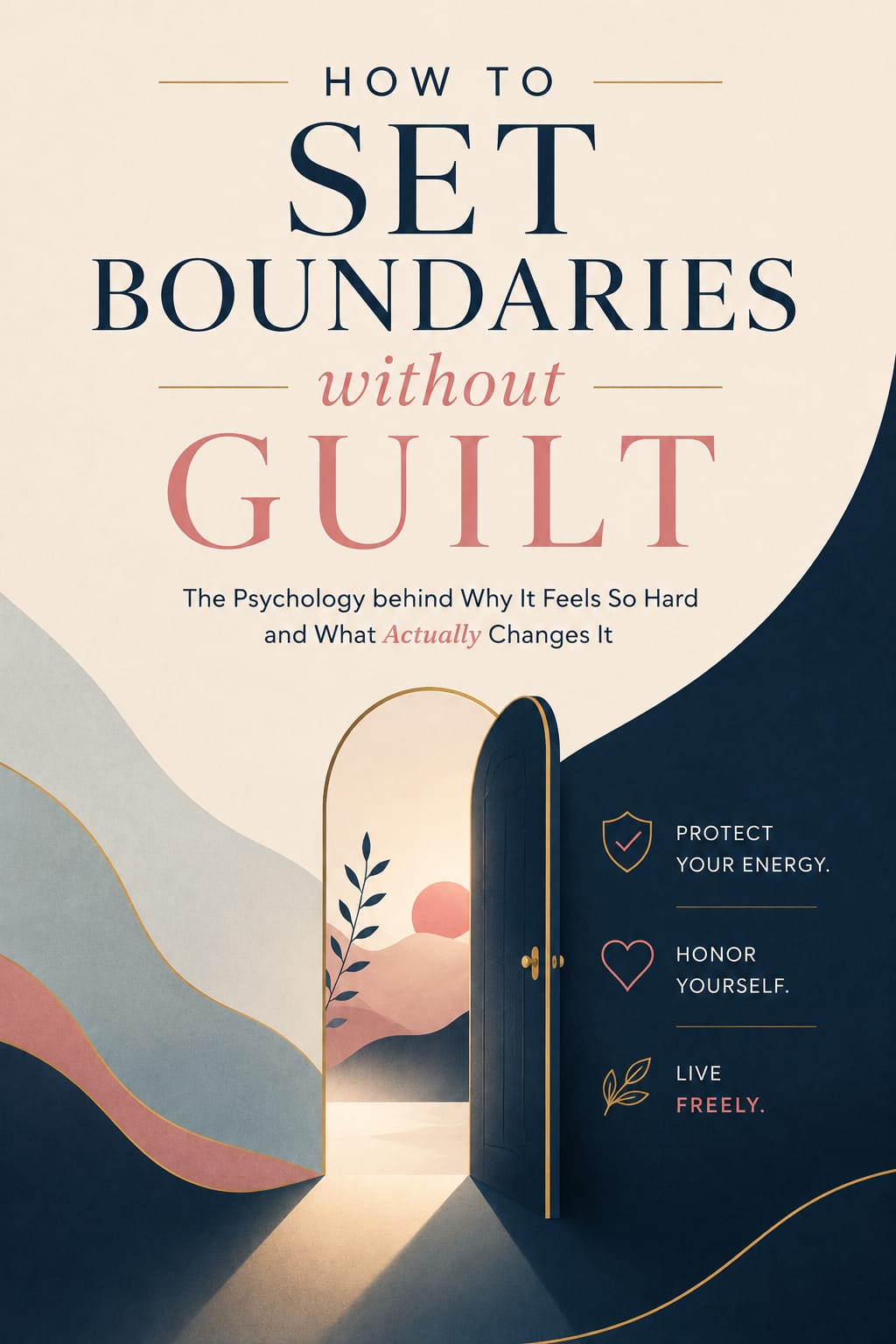
How to Set Boundaries without Guilt: The Psychology behind Why It Feels So Hard and What Actually Changes It
📘 [Format: Instant PDF Ebook Download]
You already know you need better boundaries.
You have known for a while.
Maybe years.
And yet every time you try — every time the request arrives and you prepare the no and feel almost ready — something happens. Not a decision. A collapse. The guilt arrives before the other person has even responded. Before any consequence has materialised. Before there is any evidence whatsoever that the boundary has caused harm.
And it feels like evidence anyway.
That is the problem this book solves.
Not the knowledge of what boundaries are. You have that. Not the understanding that your needs matter. You have heard that too. The specific, neurological, entirely addressable mechanism that turns every attempted boundary into a guilt spiral — and the precise tools that dismantle it permanently.
The guilt you feel when you set a boundary is not your conscience.
It is not evidence that you are selfish, unkind, or asking for too much.
It is a conditioned response. A nervous system running a programme it learned — in a specific environment, at a specific time — that having needs carried costs and saying no produced consequences.
That environment is gone.
The programme is still running.
And until that programme is addressed directly — at the neurological level where it actually lives — no amount of boundary-setting advice, self-worth affirmations, or fresh resolve will produce lasting change.
This guide addresses it directly.
What is inside:
— What boundaries actually are — and the specific misunderstandings that make the guilt worse before it gets better
— The origin of boundary guilt — the childhood environments, attachment patterns, and cultural amplifiers that installed the conditioned response in the first place
— The real cost — the psychological exhaustion, the relational loneliness, the resentment accumulation, and the physical toll of living without adequate limits
— Your specific boundary profile — the four profiles with a personal audit to identify your exact pattern and the tools most relevant to your recovery
— The guilt response — the neuroscience of what actually happens when boundary guilt fires, how to distinguish genuine guilt from conditioned guilt, and the complete guilt interrupt protocol
— The practical toolkit — the direct statement, the broken record, the pushback protocol, and the evidence collection practice that gradually recalibrates the nervous system's threat assessment of boundary-setting
— Boundaries in specific relationships — family, workplace, and intimate partnerships — with specific scripts and strategies for each context
— The boundary-keeping identity — the identity-level shift that makes every specific boundary tool sustainable
— The long game — five daily anchor practices, the early warning system for boundary erosion, and the honest picture of what genuine boundary freedom looks like
Who this guide is for:
Anyone who knows they need better limits and cannot understand why they cannot seem to have them. Anyone who says yes when they mean no so consistently that the yes has stopped feeling like a choice. Anyone who has tried setting boundaries and watched them collapse under the first sign of pressure — and concluded, incorrectly, that something is fundamentally wrong with them.
Nothing is fundamentally wrong with you.
Your nervous system was trained to treat boundary-setting as danger.
This guide retrains it.
Your needs are legitimate.
Your limits are real.
Your yes means something because your no is also real.
📥 Buy your ebook now and instantly download your digital copy tonight to set your boundaries without guilt.
Disclaimer
The information contained in this book is for educational and informational purposes only. It is not intended to serve as medical advice, psychological treatment, or a substitute for professional healthcare.
The content reflects the author's research and understanding of publicly available scientific literature and is presented for general self-improvement purposes. If you are experiencing severe anxiety, depression, or any other mental health symptoms, please consult a qualified healthcare professional before making any changes to your lifestyle, routine, or behaviour.
The strategies and tools presented in this book are evidence-informed but are not a replacement for professional medical or psychological care. Results vary between individuals and no specific outcome is guaranteed. Pretty Minds and the author accept no liability for any loss, injury, or damage arising from the application of information contained in this book.