

Coaching Your Child Through Big Feelings
Be the calm they can lean on.
When kids are overwhelmed, their thinking brain goes offline, and they borrow regulation from the adults around them. Your job in the moment isn’t to fix the feeling or stop it fast. It’s to be the calm they can lean on, help them understand what they feel and need, and save the teaching for later. This two-page emotion coaching guide shows parents exactly how.
What’s inside
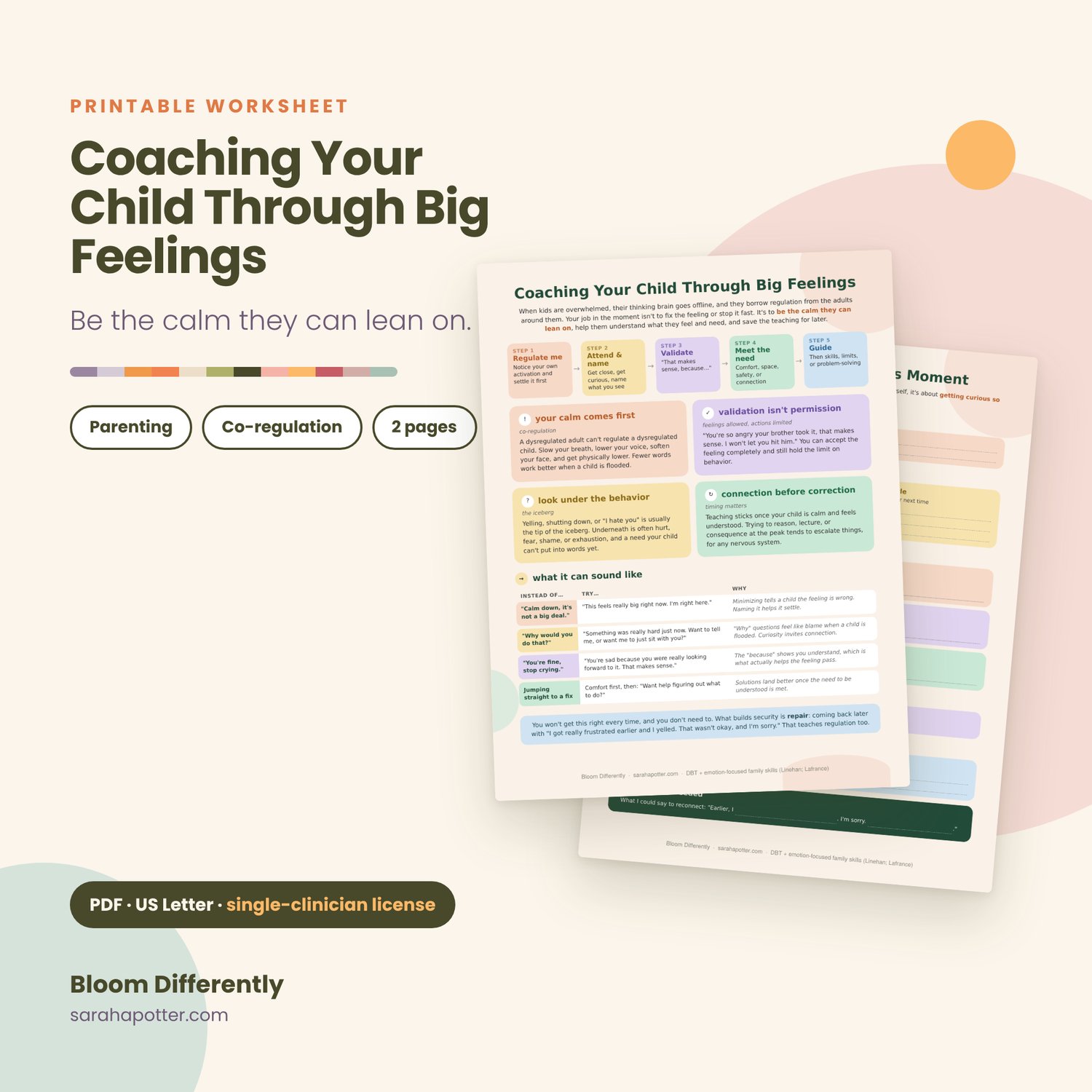
Page 1: The coaching steps
- Five steps: Regulate me, Attend and name, Validate (“That makes sense, because...”), Meet the need, and Guide (skills, limits or problem-solving come last).
- Four key ideas:
- Your calm comes first: co-regulation.
- Validation isn’t permission: “I won’t let you hit him.”
- Look under the behavior: the iceberg.
- Connection before correction: why timing matters.
- What it can sound like: a side-by-side table of common phrases like “Calm down, it’s not a big deal,” what to try instead, and why it works.
- Repair: you won’t get it right every time, and coming back to say “I’m sorry” teaches regulation too.
Page 2: Reflecting on a Big Feelings Moment
- Me first: what you felt, how activated you were (0 to 10), and your own calm-down plan.
- My child’s iceberg: what you saw on top, what might be underneath, and what they might have needed.
- My validation script, plus the limit if one was needed.
- Next time: one thing to keep, one thing to try differently, and a repair script.
Who it’s for
Parents and caregivers of kids and teens, plus the therapists, parent coaches and school counselors who support them.
Ways to use it
- Use it in parent coaching sessions to teach emotion coaching step by step.
- Have parents complete the reflection page after a hard moment and bring it to session.
- Keep the “what it can sound like” table on the fridge for in-the-moment reminders.
- Share it with grandparents, teachers or babysitters so everyone responds the same way.
Why it’s different
It’s shame-free for parents, too. The reflection page is about getting curious, not grading yourself. It holds limits on behavior while fully accepting feelings, and it names that reasoning or giving consequences at the peak escalates things “for any nervous system,” which makes it a strong fit for neurodivergent families.
What you get
A two-page printable PDF, US Letter, available as an instant download. It’s grounded in DBT and emotion-focused family skills (Linehan; Lafrance). Single-clinician license included.
Pairs well with: Emotions 101 for Kids: Be a Feelings Detective, Wise Mind Parenting, Big Feelings, Growing Brains