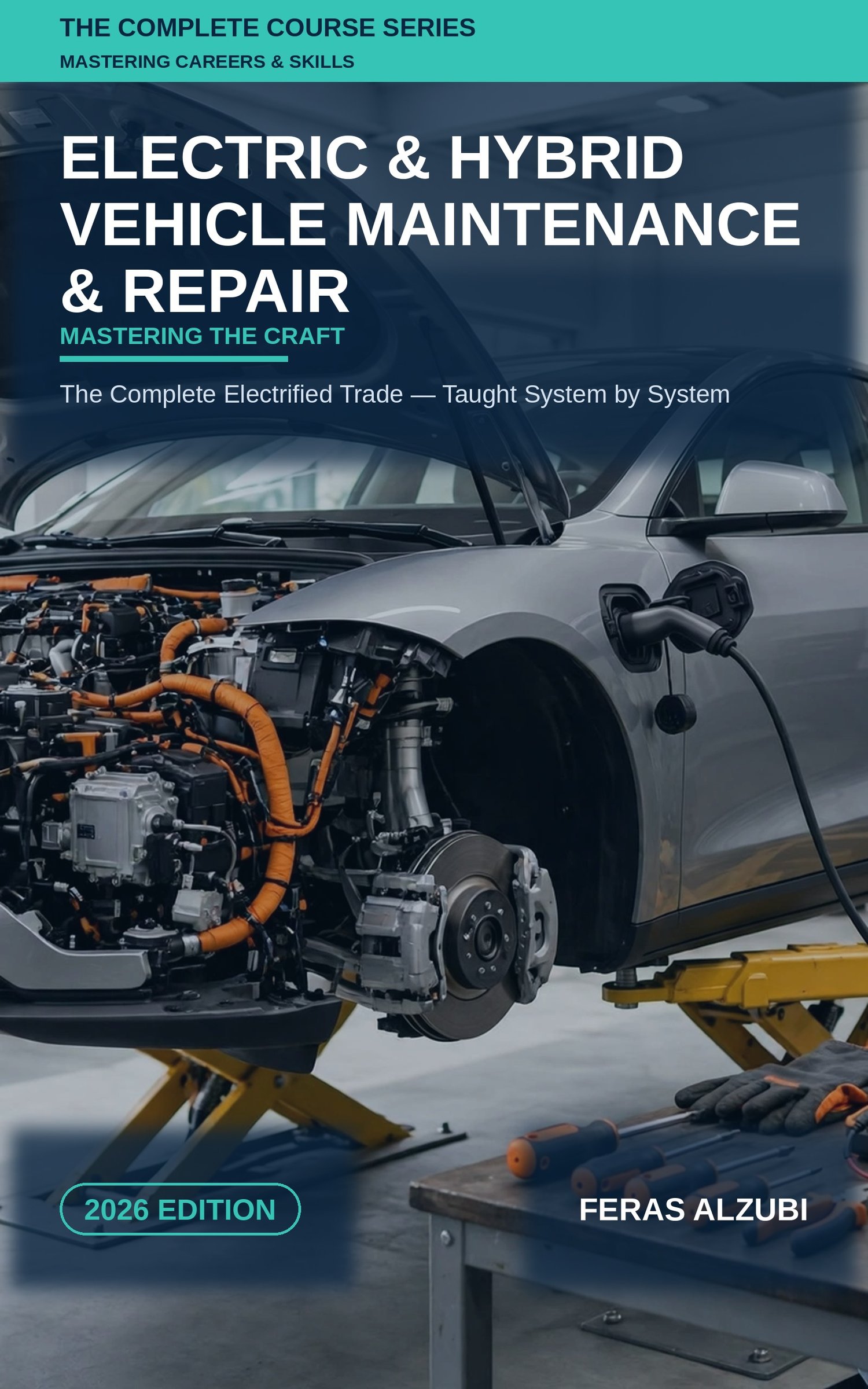
Electric & Hybrid Vehicle Maintenance & Repair: Mastering the Craft
Electric & Hybrid Vehicle Maintenance & Repair: Mastering the Craft
**What this book teaches.** The electrified layer of the vehicle trade — the high-voltage specialty every road-vehicle technician now meets sooner or later — taught A to Z in one volume, from first principles to proved, documented work. The foundations come first: the electrified vehicle world and the shops that serve it; high-voltage safety, the discipline that comes before all others, because a traction battery's energy cannot be switched off at the cell; the vehicle understood as one connected system of battery, power electronics, electric machine, and controls; and the standards and authority — ASE, SAE, NFPA 70E, and above all the manufacturer's documentation — that decide what correct means. Then the systems in the order the energy flows: the traction battery — cells, modules, and the pack — and its management and service; power electronics — inverters, converters, and the onboard charger; electric machines, e-axles, and regenerative braking; and thermal management for cells and electronics. Then the systems around the drivetrain: charging in all its forms and connectors; the 12-volt system, networks, and software; climate systems — heat pumps and electric air conditioning; and chassis and body, where much carries over and some things change. The book closes with the working technician's craft: preventive maintenance programs for electrified vehicles, the high-voltage troubleshooter's diagnostic method, damaged and end-of-life batteries — quarantine, storage, and recycling — shop setup for high-voltage work, the service business across dealers, independents, and fleets, documentation, recalls, and warranty, and the career itself — ASE xEV electrical-safety certifications, the L3 specialist credential, and manufacturer training. Every system is taught so you can explain it, test it, and trust your conclusion — and the manufacturer's documentation for the specific vehicle always governs its values and procedures.
**Who it is for.** Working automotive technicians crossing into electrified work, who want the whole specialty — safety, systems, charging, diagnosis — in one place and in the order the vehicle itself is built; apprentices and students of the vehicle trades who intend to qualify for high-voltage work, with names, systems, and reasoning for what their hands will learn under supervision; shop owners, service managers, and fleet maintenance leads preparing their operations for electrified vehicles — the bay, the equipment, the procedures, the training; and the mechanically minded reader weighing this specialty, who wants an honest picture of the work and the career. No general book replaces the manufacturer's documentation for the vehicle in front of you — the book teaches the systems, the method, and the discipline.
**What's inside** (every count verified against the actual book):
- Complete course — 20 chapters in five parts, foundations to the career
- 340 practice questions — every answer explained, right and wrong
- 40-question diagnostic — scored by domain, with a routing worksheet
- 240 chapter questions — a 12-question check closes every chapter
- 60-question final review — sampling the whole specialty, with routed re-study
- 40 labeled figures — system diagrams and vehicle maps, two in every chapter
- 28 tables — system data, sequences and reference data for the shop
- 150-term glossary · 8 cheat sheets · 3 study plans — the twelve-week full read, the six-week working-technician crossover, and the eight-week fleet and shop readiness plan
- Safety taught as structure — de-energize, wait, prove zero, and respect the quarantine throughout
Every one of the 340 questions is original, written for this book, and every explained answer tells you why the right answer is right and why each wrong answer is wrong. The book's facts rest on verified sources, listed in a Sources & Verification Note at the back of the book: the ASE certification frame including the xEV electrical-safety certifications and the L3 specialist test, SAE charging standards J1772 and J3400, the PPE and instrument ratings, EPA Section 609, and the rule that manufacturer documentation governs. Safety is structural throughout — no procedure in the book outranks the safety discipline, and no item teaches touching an unproved circuit, working high voltage without rated PPE and insulated tools, charging a suspect pack, or jumpering an interlock as correct.
Read the first chapter free — the sample on this page is Chapter 1 of this book, exactly as it appears in the full edition.
From the **Mastering Careers & Skills** library — complete A-to-Z professional teaching books for careers, trades, and certifications.
This book is an independent teaching work. ASE — the National Institute for Automotive Service Excellence — and the EPA are named as the public credentialing and regulatory bodies they are; this book is not published by, endorsed by, or affiliated with them or with any vehicle manufacturer. It teaches the specialty — there is no single universal license for high-voltage vehicle work, and no credential comes from this book: qualification is layered through high-voltage safety training, ASE certification, and manufacturer training, each earned from its own body under its own requirements, and EPA Section 609 certification for refrigerant work comes only from its issuing program; this book does not itself confer a license or a certification.
**Refunds:** Please read the free sample chapter before you buy. This is a digital ebook, delivered instantly by download. If the file is defective, or you cannot open or download it and we cannot fix the problem, you will receive a full refund — email us within 14 days of purchase. Because the book is delivered instantly as a downloadable file, all other sales are final.
**How to read this book (EPUB format):** After checkout, download the EPUB file, then open it in any free ebook reader app. On iPhone or iPad: Apple Books — it is already on your device. On Android phones and tablets: Google Play Books (free: https://play.google.com/store/apps/details?id=com.google.android.apps.books) — upload the file in the app — or ReadEra (free). On a Windows or Mac computer: Thorium Reader (free: https://thorium.edrlab.org) or Adobe Digital Editions (free). On Kindle: use Amazon's free Send to Kindle (https://www.amazon.com/sendtokindle) to add the file to your Kindle library.