
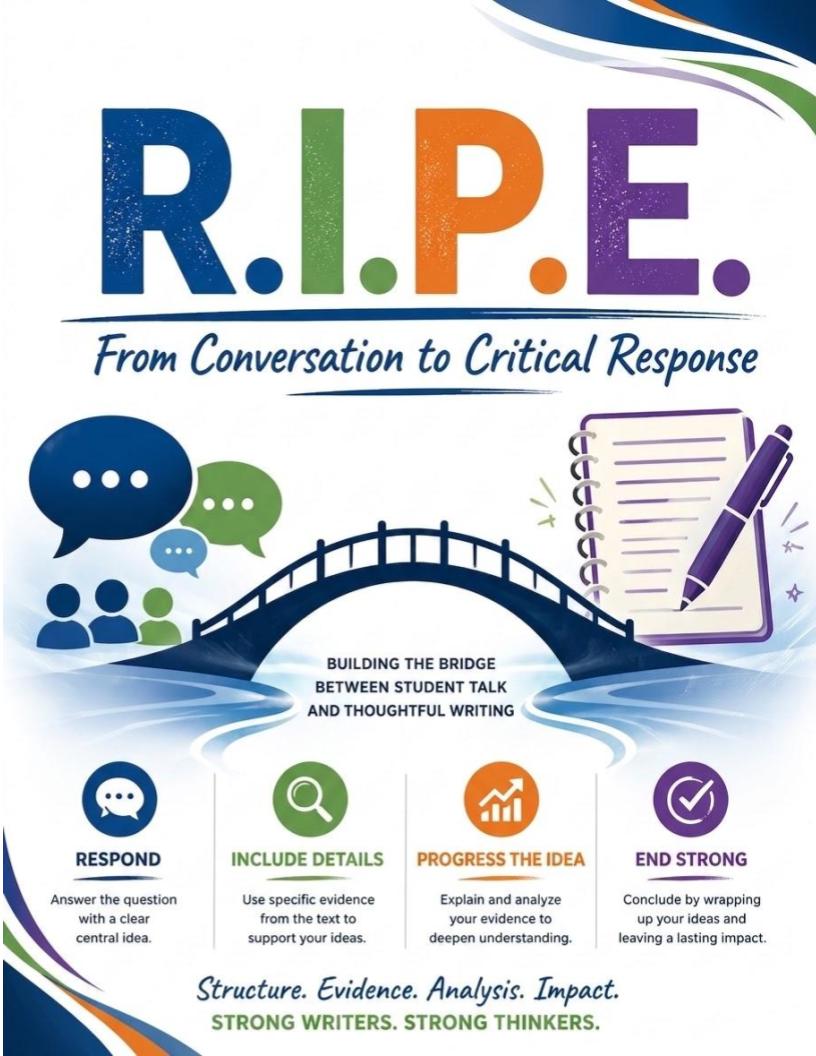
R.I.P.E.: Extended Constructed Responses
R.I.P.E.: From Conversation to Critical Response
Help students move from simply discussing a text to writing clear, organized, and well-supported extended constructed responses. The R.I.P.E. framework gives students a repeatable process for responding to a prompt, including relevant evidence, progressing their ideas through explanation and connection, and ending with a purposeful conclusion.
Rather than using one generic organizer for every ECR, this resource provides prompt-specific graphic organizers and color-coded exemplars that show students how their writing should change depending on the task. Students learn how to approach informational texts, fictional selections, plot-based questions, argumentative prompts, character change, and paired-text comparisons.
Included in the Resource
- Informational–Info organizer and exemplar
- Informational–Fiction organizer and character-trait exemplar
- Informational–Plot organizer and exemplar
- Cause-and-Effect organizer
- Argumentative–Info organizer
- Paired-text argumentative exemplar
- Dissenting-opinion argumentative exemplar
- Literary Character Change organizer and exemplar
- Paired Text–Similar organizer and exemplar
- Paired Text–Different organizer and exemplar
- Student-friendly sentence stems, bridge language, evidence prompts, and conclusion support
The modeled responses use authentic reading situations to demonstrate how students can answer the prompt, incorporate evidence, explain what the evidence means, connect ideas across paragraphs, and reinforce the central idea in the conclusion.
This resource is ideal for:
- Whole-group ECR instruction
- Teacher modeling and think-alouds
- Small-group intervention
- Guided writing practice
- STAAR review and preparation
- Multilingual learners and students who benefit from explicit structure
- Classroom anchor charts and student reference pages
With R.I.P.E., students are not simply filling in a formula. They are learning how to make their thinking visible, develop their ideas with intention, and adjust their responses to match the prompt type.
Structure. Evidence. Analysis. Impact.
Strong writers. Strong thinkers.