
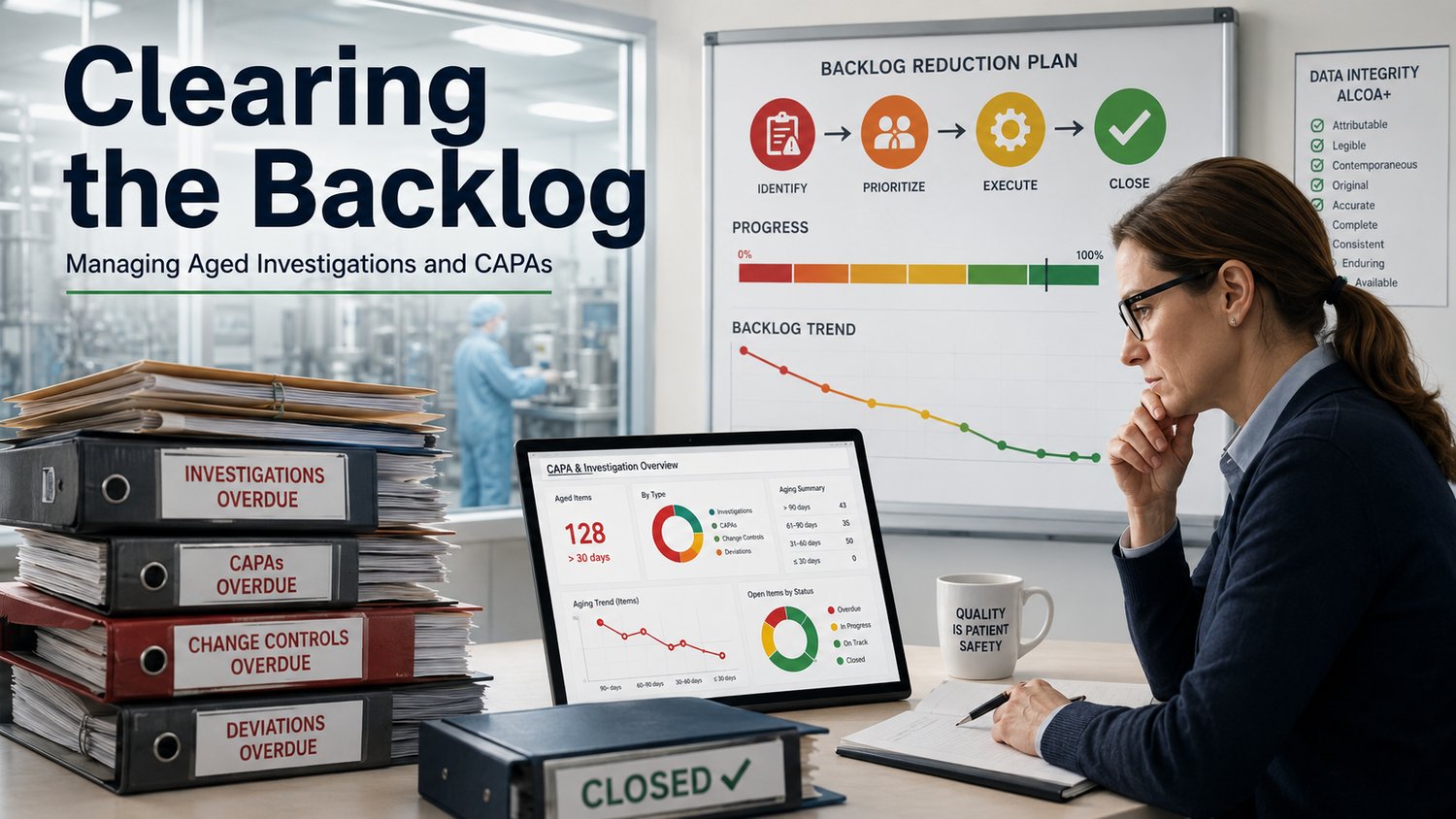
Clearing the Backlog: How to Manage Aged Investigations and CAPAs Without a Root Cause
Clearing the Backlog: How to Manage Aged Investigations and CAPAs Without a Root Cause
A practical, inspection-ready framework from FD-AID LLC for resolving aging CAPAs and unsubstantiated investigations before FDA finds them first.
Every quality organization eventually looks at its CAPA log and sees the same thing: a queue of investigations that will not close, some of them years old, sitting next to quality events where a root cause never materialized no matter how many times the file was reopened. Neither problem is primarily technical. Both are management failures, and both respond to the same discipline.
[This is an employer-reimbursable professional compliance resource. Send this page to your Quality Director, Site Head, Regulatory Affairs leader or Learning and Development department for approval.]
This guide covers both halves of the problem in full:
Part One: The Aged CAPA Backlog
- Why CAPAs actually go stale (the mundane organizational reasons, not the ones in training decks) and why an Investigator will ask to see your open CAPA log before discussing a single batch record
- A complete inventory framework covering every place a backlog hides, including trackers outside your official QMS
- Risk-based triage that separates urgent items from ones that can be closed quickly
- How to structure a CAPA Review Committee that actually removes bottlenecks in real time, plus the exact metrics it should track weekly
- Why accelerated executive reporting changes organizational behavior faster than any SOP revision, and what Investigators specifically look for in management review minutes
- The compensation lever most quality programs are afraid to pull, and how to design it so gaming the metric requires doing the actual work
- Five defensible closure categories for every open item, so nothing sits waiting for a "perfect" answer that was never coming
- Controls to keep the backlog from silently rebuilding after it's cleared
Part Two: When You Cannot Find a Root Cause
- What "no root cause" actually means, and the three (or four) categories every unresolved event actually falls into
- How to document a "most likely root cause" as a fully defensible finding, including the three labeled sections FDA Investigators expect to see
- What to do when evidence is legitimately unavailable, and how to document the gap so it protects you later
- How to tell whether the review simply didn't go far enough, and how a fresh-eyes review catches what the original team normalized
- The exact structure for closing a quality event without a root cause, the right way
- The systemic pattern play: how to recognize when repeated "most likely root cause" findings across events are themselves a finding, and when to open a dedicated systemic CAPA
Built directly from FDA Investigator experience, this is the framework for keeping a CAPA record moving forward and defensible, whether the finding is confirmed, most likely, or rigorously documented as inconclusive.
For informational purposes only. Does not constitute legal advice.