
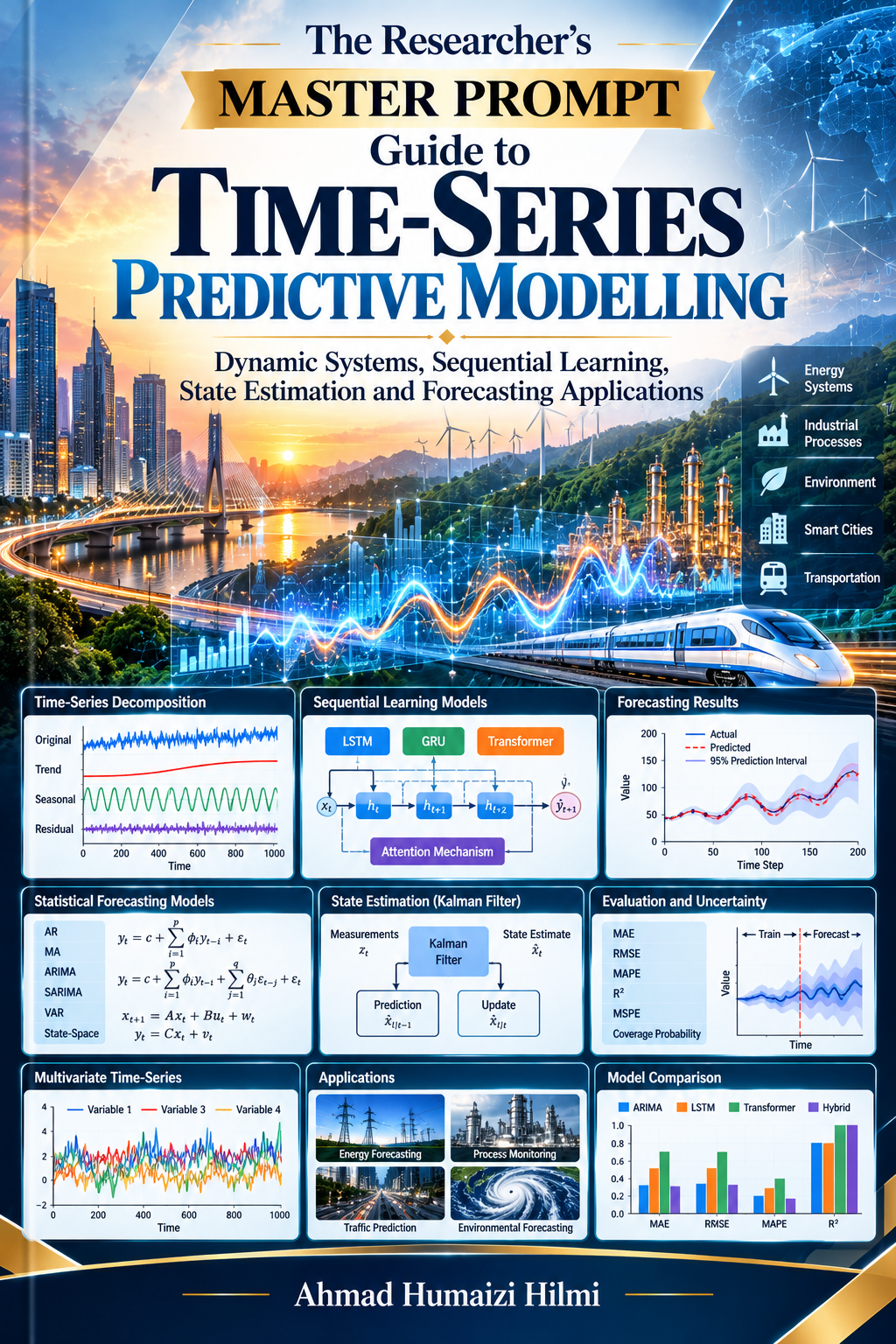
8. PM-TIM-008 — Time-Series Predictive Modelling, Dynamic Systems, Sequential Learning, State Estimation and Forecasting Applications
Description
This Master Prompt focuses on predictive modelling for systems in which observations, responses and underlying processes evolve over time, requiring explicit consideration of temporal dependence, sequential information, dynamic behaviour and prediction horizons. It guides researchers through time-series analysis, autoregressive modelling, moving-average processes, statistical forecasting, state-space models, dynamic regression, recurrent neural networks, LSTM, GRU, temporal attention mechanisms, transformer-based sequential learning and hybrid dynamic predictive architectures. The theme addresses trend identification, seasonality, stationarity, lag structures, temporal feature engineering, sampling frequency, signal decomposition, time-series preprocessing, multivariate dependencies, sequential prediction and rolling-horizon evaluation. Particular attention is given to dynamic state estimation, Kalman filtering, Gaussian process modelling, online parameter updating, residual learning and integration of sensor measurements with predictive algorithms. Researchers are guided in developing short-term and long-term prediction models for oscillatory structural responses, thermal processes, energy consumption, wind power, equipment behaviour, environmental conditions and other evolving systems represented in the uploaded literature. The theme also examines forecast horizons, recursive versus direct prediction, uncertainty propagation, temporal data leakage, concept drift, online learning, adaptive updating and time-aware validation strategies. It establishes the methodological relationship between predictive modelling and forecasting while maintaining their distinctions, particularly when prediction involves dynamic states, future trajectories or time-dependent system responses.