
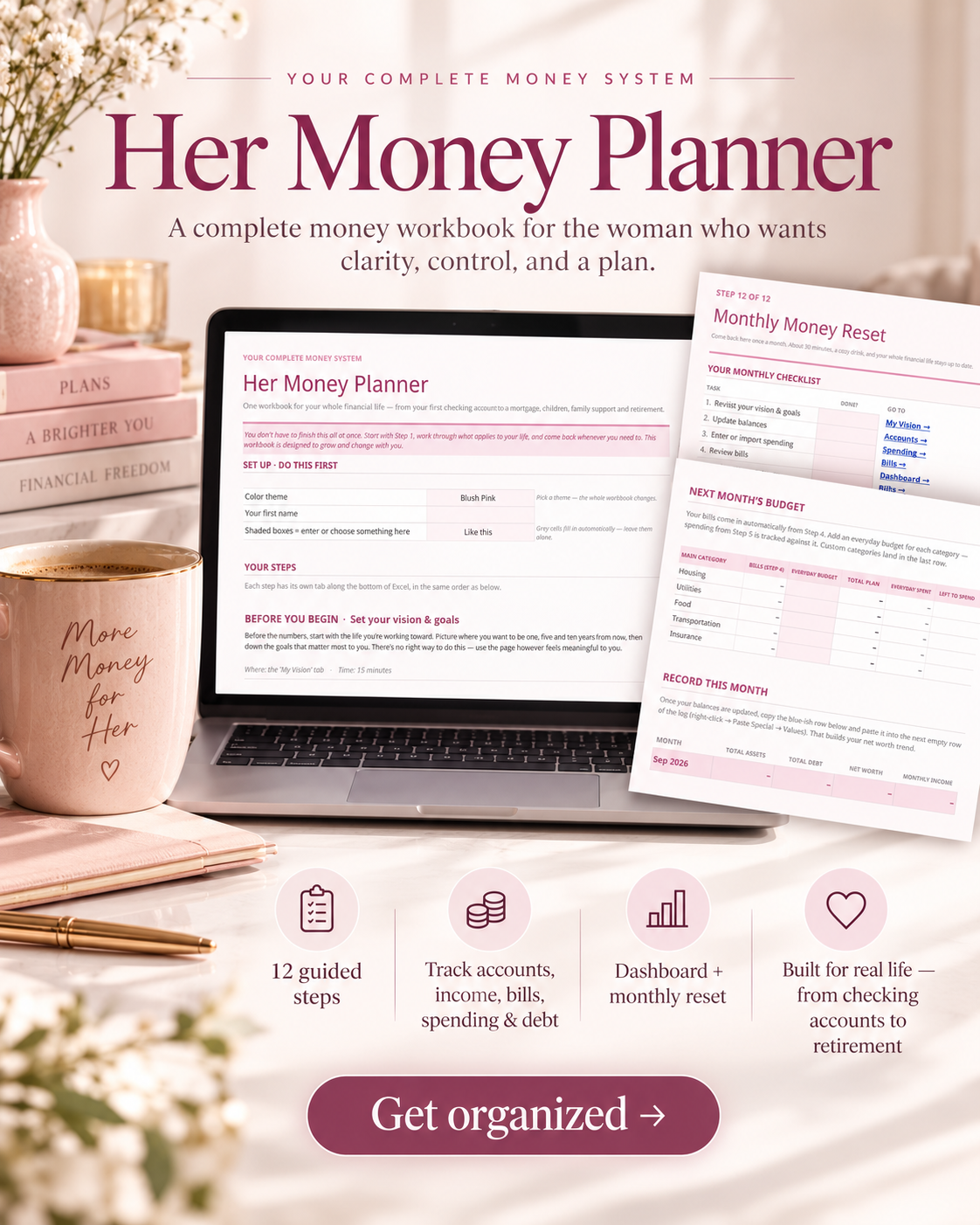
Her Money Planner
I created this spreadsheet because I was so tired of trying to keep my entire financial life in my head.
Bank accounts. Credit cards. Monthly bills. Statements. Subscriptions. Automatic payments. Debt. Savings. Random fees. Money coming in, money going out — and somehow, I still didn’t feel like I actually knew where my money was going.
For a long time, my mindset was basically, “I’ve got it. It’ll all work out. I’ll deal with it later.”
So I would brush things off. I’d pile up statements, forget about subscriptions, overspend here and there, and convince myself everything was fine.
And honestly, a lot of our spending doesn’t even feel irresponsible in the moment.
It’s groceries we fully intend to eat but never do. Another personal care item. Household stuff. Clothes. Takeout because we’re tired. A quick store run. A subscription we forgot about. A fee we didn’t notice. A few dollars here, a few dollars there.
Every purchase has a reason behind it, so it becomes incredibly easy to rationalize.
But those little decisions become habits, and those habits can quietly turn into hundreds of dollars without us even realizing it.
That was a huge part of what I needed to see.
I didn’t need another person telling me to “budget better.” I needed a clear picture of my own numbers, my own habits, and my own patterns.
And when I finally sat down to figure everything out, I went blank.
Where do I start?
What am I supposed to track?
What am I forgetting?
How much am I actually spending?
What accounts do I even have money coming out of?
What needs to change?
And what do I need to do to get where I want to be?
That was the moment I told myself: enough.
So I built the spreadsheet I needed.
I created it in Excel so I could have one downloadable place for everything — something I could save right on my desktop, open whenever I needed it, update as life changed, and come back to without having to dig through apps, statements, notes, or different accounts.
One place to see my bank accounts, bills, spending, subscriptions, income, debt, savings, and all of the little things that are so easy to lose track of.
And I wanted it to actually do the work with me.
The calculations are built in and update automatically as you enter your information, so you’re not sitting there with a calculator trying to add everything up yourself. The goal is to make your numbers easier to see and understand, so you can spend less time doing the math and more time paying attention to what those numbers are actually telling you.
Once everything was finally in front of me, something changed.
I had direction.
I could see what I was spending too much on, what needed to be paid, what I could cut back on, what I was paying for without thinking about it, where my money was actually going, and what I needed to do next.
I stopped feeling like I was just hoping everything would be okay and started feeling like, okay, I actually know what’s going on now. I know where I stand. I know what I need to do. I’ve got this.
That sense of control was completely different from the “it’ll all work out” kind of reassurance I had been giving myself before.
Because there’s a big difference between hoping everything will work out and actually knowing you’re taking care of it.
And the truth is, the future is coming whether we feel ready for it or not.
Emergencies happen. Expenses come up. Cars need repairs. Homes need things. Medical bills happen. Life changes.
And the more we understand our money now, the better chance we have of actually being prepared for what comes next.
For me, getting financially organized wasn’t about becoming perfect with money or cutting out everything I enjoy.
It was about being more honest with myself, holding myself accountable, understanding my habits, creating more stability, and making more intentional decisions with what I have.
Sometimes you don’t need more money advice.
You just need a clearer picture of your own numbers.
A place you can open, update, and come back to whenever you need it.
Because once you can actually see what’s going on, you can stop guessing, stop brushing it off, and start making decisions that support the life and future you’re trying to build.