
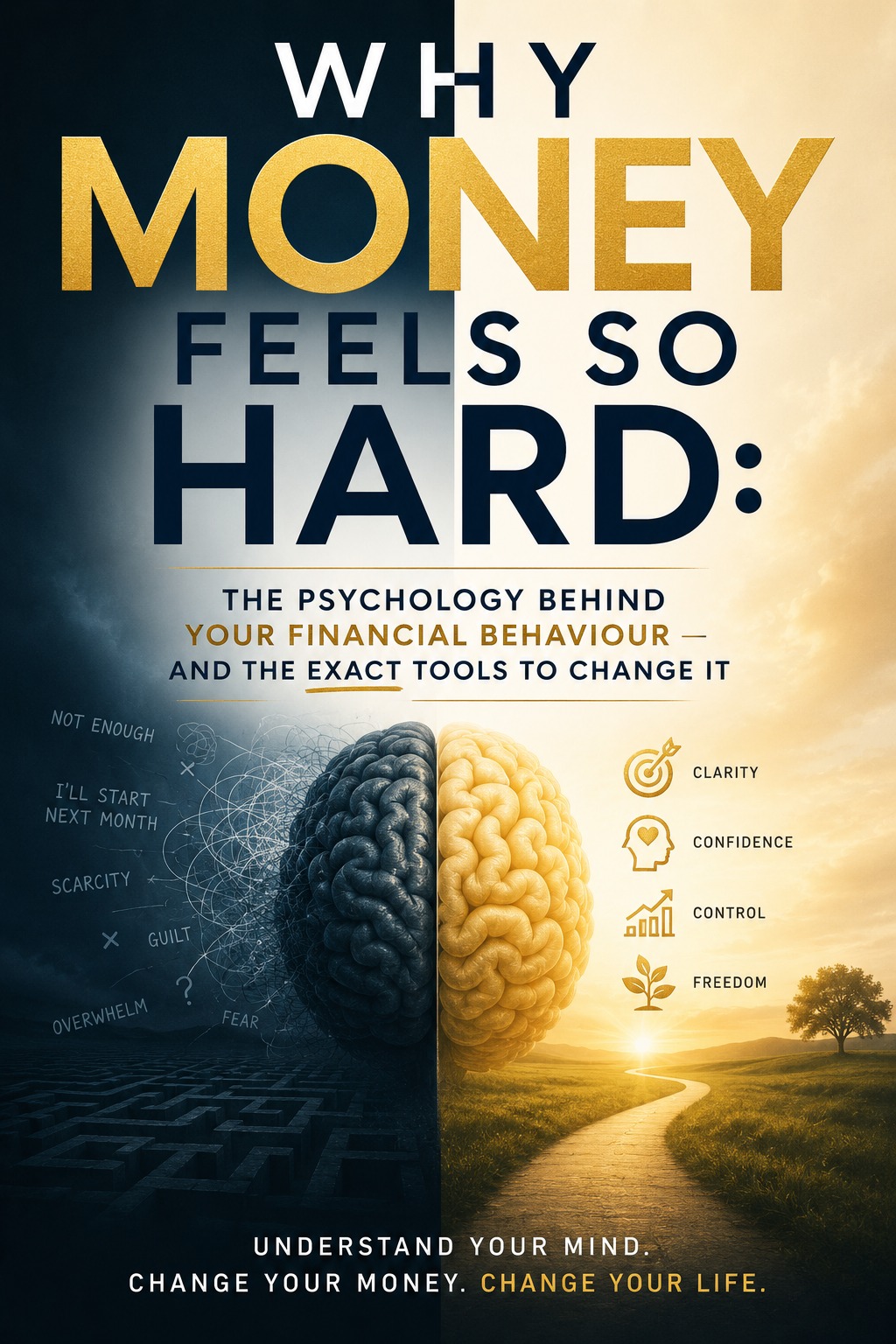
Why Money Feels So Hard: The Psychology behind Your Financial Behavior and the Exact Tools to Change It
📘 [Format: Instant PDF eBook Download]
You know what you should do with money. You have known for years. So why does the gap between knowing and doing keep showing up — quietly, persistently, and without a satisfying explanation?
Here is the explanation nobody gave you:
Your financial behavior is not a discipline problem. It is a psychology problem. And psychology problems require psychology solutions — not more budgets, not more motivation, and not another fresh start on Monday morning.
At the heart of almost every financial struggle is the financial anxiety loop — a self-reinforcing cycle in which financial stress impairs the precise cognitive capacity needed to make good decisions, which leads to worse outcomes, which generates more stress, which deepens the impairment. The loop tightens with every repetition. And no spreadsheet, no savings app, and no willpower-driven fresh start breaks it from the outside.
This guide breaks it from the inside.
This is not a budgeting guide.
You already know how to budget. What you need is the understanding that makes the right financial behaviors feel obvious and sustainable rather than effortful and temporary.
Why Money Feels So Hard is a 50-Page Step-by-Step Guided Digital Workbook that walks you from the neuroscience of why financial behavior is so difficult to change — through the cognitive biases, inherited money scripts, scarcity thinking, comparison trap, and identity investment that sustain the pattern — to the complete psychological and behavioral toolkit that addresses every layer simultaneously.
What you will find inside:
— The complete science of the financial anxiety loop and why willpower alone never breaks it
— The four cognitive biases that make financial irrationality not random but predictable — and what to do about each one
— A four-profile financial behavior diagnostic so you understand your specific pattern and the tools most relevant to you
— The stress-decision interrupt — a structured pause protocol that changes the neurological state in which financial decisions are made
— Cognitive restructuring for money beliefs — identifying and dismantling the inherited money scripts operating beneath your conscious awareness
— Behavioral design tools that make good financial decisions the path of least resistance rather than the path of most effort
— The scarcity trap — why fear-based financial thinking persists at any income level and the sufficiency framework that replaces it
— The comparison trap — the neuroscience of lifestyle inflation and the practical tools that interrupt social comparison-driven spending
— Money and identity — untangling self-worth from net worth and building a financial identity that does not depend on outcomes to remain stable
— A complete values-based financial system that is practical, sustainable, and psychologically designed to reduce anxiety rather than add to it
— The five anchor practices and the identity shift that make financial wellbeing permanent rather than temporary
Who this guide is for:
Anyone who has ever felt that money is harder for them than it seems to be for everyone else. Anyone who knows what they should do financially and cannot seem to do it. Anyone who is exhausted by the gap between their financial intentions and their financial reality — and ready for the explanation that finally makes the fix make sense.
Why this works when everything else has failed:
Most financial advice addresses behavior without understanding psychology. It tells you what to do while ignoring the neurological and emotional forces preventing you from doing it. This guide does the opposite — it starts with the mechanism and builds everything else on top of that understanding.
Because understanding is what transforms a technique you try into a fix that sticks.
You are not bad with money. You are someone who was never given the right explanation for why money felt so hard.
Now you have it. The fix starts on page one.
📥 Buy your eBook now and instantly download your copy tonight to break the financial anxiety loop and regain control.
Disclaimer
The information contained in Why Money Feels So Hard: The Psychology Behind Your Financial Behavior and the Exact Tools to Change It is intended for educational and informational purposes only. This book is designed to help readers better understand the psychological, emotional, and behavioral patterns that influence financial decision-making. It is not intended to serve as financial, legal, tax, investment, medical, or psychological advice.
The author and publisher make no guarantees regarding specific financial outcomes, income levels, investment returns, debt reduction, or personal success resulting from the application of the concepts, tools, or strategies discussed in this book. Every individual’s financial situation, emotional history, risk tolerance, and life circumstances are unique, and results will vary accordingly.
Readers are encouraged to seek guidance from qualified financial advisors, licensed therapists, accountants, legal professionals, or other appropriate experts before making significant financial or personal decisions.
While every effort has been made to ensure the accuracy and reliability of the information presented, the author and publisher assume no responsibility for errors, omissions, or any consequences arising from the use or misuse of the material contained in this book.
This book explores the intersection of psychology and money behavior. Some sections may prompt emotional reflection or personal insight. Readers experiencing significant emotional distress, compulsive financial behaviors, trauma-related responses, anxiety, or mental health concerns are encouraged to seek support from a qualified mental health professional.
All stories, examples, and scenarios are either fictionalized, anonymized, adapted for educational purposes, or used with permission where applicable. Any resemblance to actual persons or situations is purely coincidental unless otherwise stated.
By reading this book, you acknowledge and accept full responsibility for your personal, financial, and professional decisions and outcomes.
Money is emotional. Awareness is powerful. But transformation still requires personal responsibility, consistency, and action.