
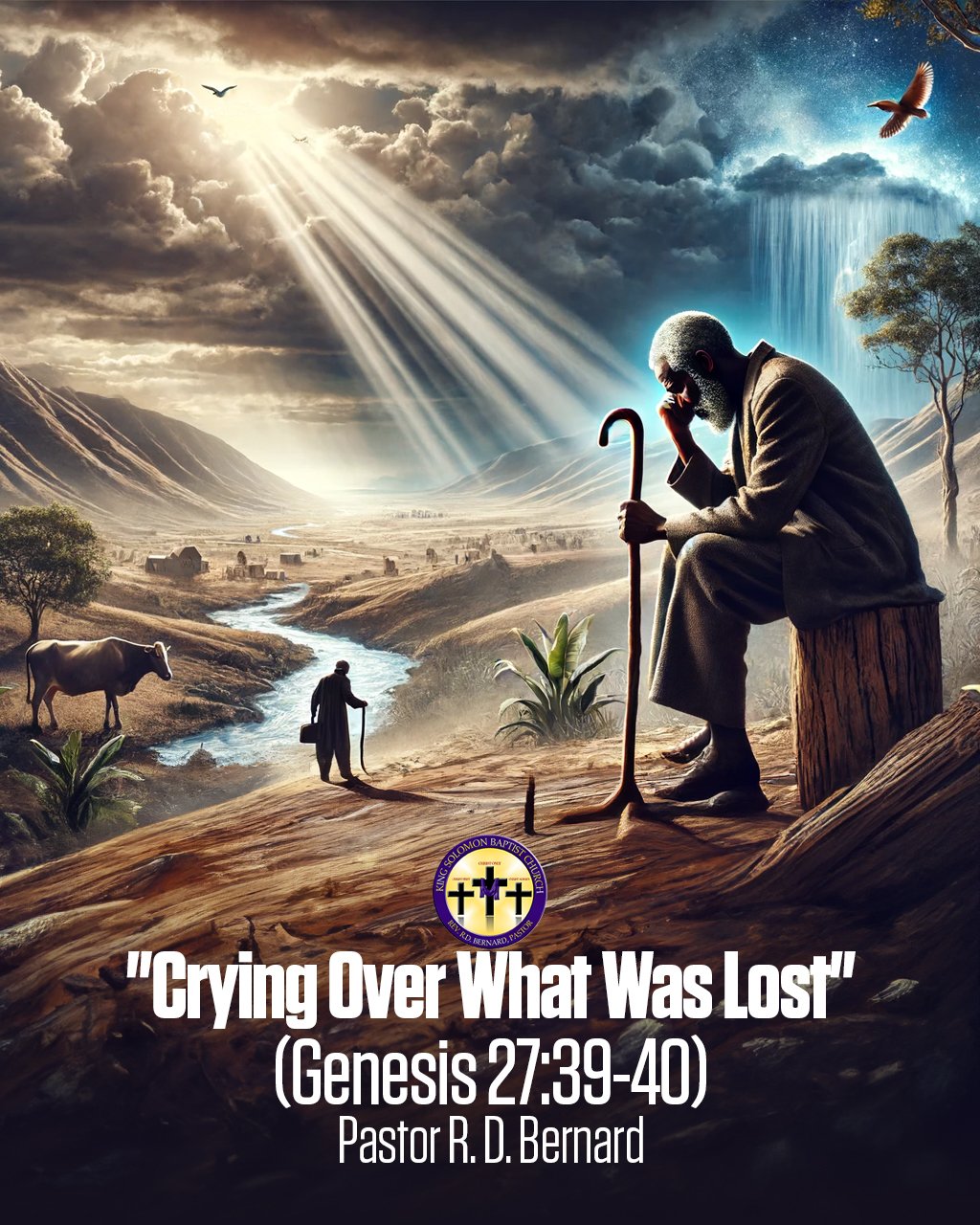
"Crying Over What Was Lost" (MP3 Audio)
"Crying Over What Was Lost" (Genesis 27:39-40)
So much of our time in life, for some of us, is spent crying over what was lost. When we think back over our lives, we are drawn most frequently to our failures. It seems that for some of us, life has become a string of sorry disappointments: disappointed in love, disappointed in finances, disappointed in health and disappointed by children and grandchildren.
Life is full of sorrow and regret. Troubles of all kinds are universal (Job 5:7; 14:1; Matthew 5:45), especially for the faithful Christian (1st Thessalonians 3:3; 1st Peter 4:12). But for some of us, failure and regret are not merely part and parcel of the journey, they become the journey.
Like the Children of Israel sojourning through the wilderness, we cry and complain, remembering what we lost (Numbers 14:2-4). For anyone we meet, we tell the sad tale of what was done to us and how we have been victimized along life’s journey.
But what we fail to do, is to remember all the goodness (undeserved goodness) that God has bestowed on us. Sometimes I want to stop some people in the midst of their crying and complaining and ask: “There were some blessings, right?”
We can’t all be Jacobs – blessed and highly favored (exceedingly, abundantly more than we could ask or think) though we treated others low down; but there was and is a blessing for us. Consider the following four points.
- We lose things in life a. Isaac was a wealthy man (Genesis 26:12-14, 16, 26-29). b. Typically, this wealth would have been handed down by the father as he approached death. This is the scenario of Genesis 27:1-2. i. The blessing, from the mouth of Isaac, was eternally significant, because it would have named Esau as a part of the covenant handed down by God to Abraham in Genesis 12:1-3. ii. Jacob (with his mother’s help) tricked his father into blessing him (Genesis 27:5-13), rather than Esau. iii. The birthright, signified by the blessing, was valuable (Genesis 25:29-34; Deuteronomy 21:15-17). c. Esau was his father’s favorite son (Genesis 25:28), but he didn’t get his father’s best blessing.
- Loss breeds resentment. a. We learned how to hate by hating those in our own family (Genesis 4:5-8; 37:4-5). b. When Esau found out that he lost the blessing, by an act of subterfuge no less, he hated Jacob and planned to kill him (Genesis 27:41). i. This plan brought Esau comfort (Genesis 27:42). ii. Like Job, after his two rounds of testing, our words reflect the bitterness that is in our hearts (Job 3:20; Proverbs 4:23). c. After Jacob was sent away to uncle’s house (Genesis 27:43), Esau went through a period of rebellion where he did anything and everything to hurt his parents (Genesis 27:46; 28:8-9).
- God still allowed Isaac to bless Esau. a. When both Esau and Isaac realized what Jacob and Rebekah had done, Esau cried out to his father three times, begging for a blessing (Genesis 27:34, 36, 38). b. God has mercy, particularly on those of us who have been done wrong (Psalm 10:17-18; 146:7-9). i. Hagar and Ishmael were put out of Abraham’s house, but God still blessed them (Genesis 21:17-20). ii. God allowed Esau hope by telling him that he too would become a great people and that one day he would break his brother’s yoke and free of his dominance (Genesis 27:40).
- When we are finished being angry, we should look for the blessing. a. What God has said about us, we ultimately become (Matthew 4:4). b. What God has purposed for us, we will become (Psalm 138:8; Jeremiah 29:11; Philippians 1:6). c. Esau and his brother Jacob were separated for about 20 years before they saw one another again, after Isaac’s death. It appears that Rebekah was right, Esau was no longer angry with his brother Jacob (Genesis 27:45). d. Jacob feared Esau because of the condition in which he left him some twenty years earlier (Genesis 32:6-8). e. Esau embraced his brother and wept when he saw the one who had deceived him (Genesis 33:4). f. When Jacob offered him a portion of his riches, he told his brother that he too was rich, that he had enough (Genesis 33:9).
"Christ First, Christ Only, Christ Always"