
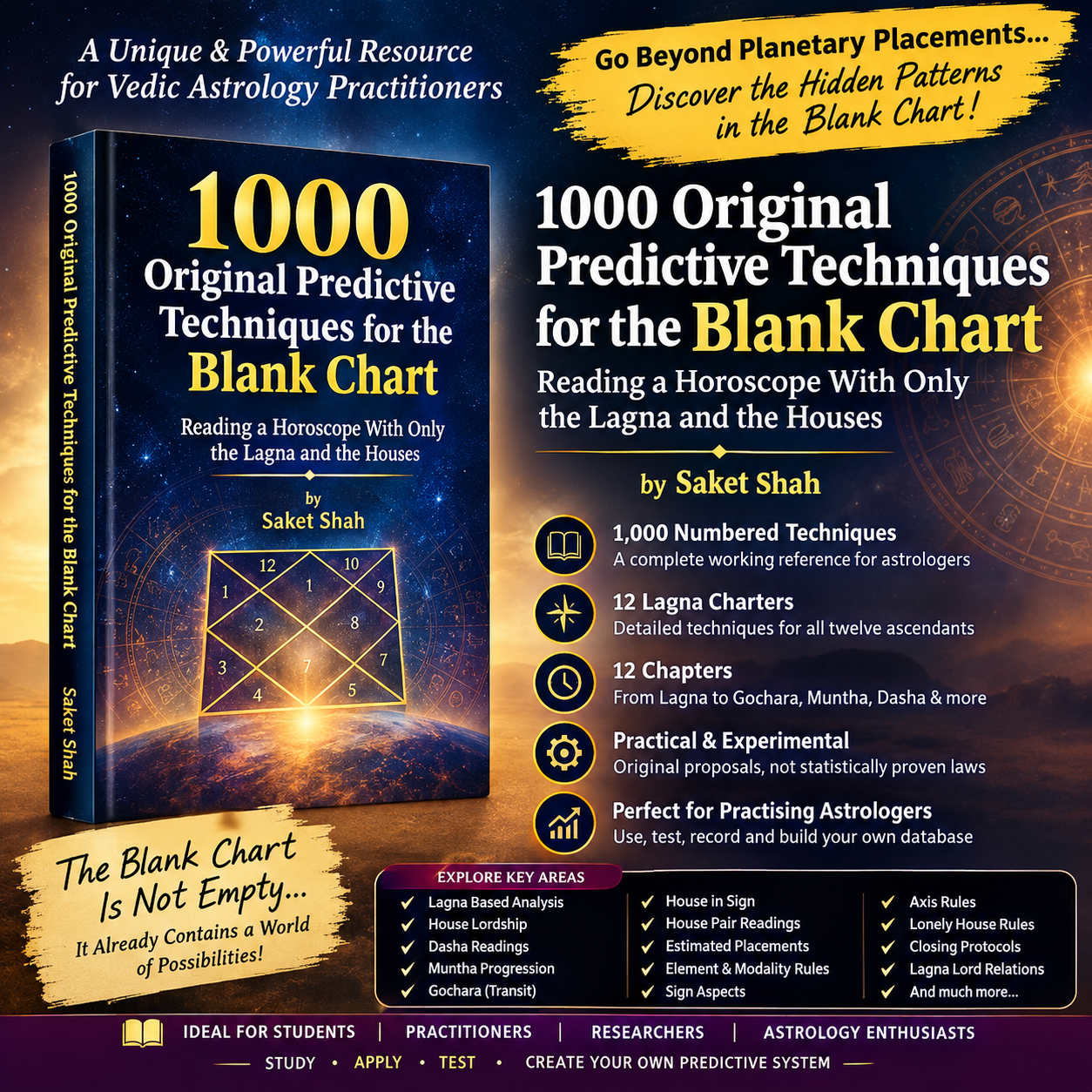
1000 Original Predictive Techniques for the Blank Chart
1000 Original Predictive Techniques for the Blank Chart
Reading a Horoscope With Only the Lagna and the Houses
By Saket Shah
What if a horoscope could still reveal meaningful patterns—even before you know where the planets are placed?
Most astrologers are trained to look immediately for planetary placements, yogas, aspects, dashas and transits.
But what happens when you have a blank horoscope chart?
What if you know the Lagna and the twelve houses, but the planetary placements are unavailable?
This book explores that question in a completely different way.
1000 Original Predictive Techniques for the Blank Chart presents a structured collection of predictive proposals designed to extract information from the framework that already exists in a horoscope: Lagna, house lordships, sign relationships, elements, modalities, Muntha, dasha themes and gochara principles.
The central idea is simple:
A blank chart is not necessarily an empty chart.
It already contains a considerable amount of structural information.
This book turns that structure into a practical reference system for astrologers.
1,000 ORIGINAL PREDICTIVE TECHNIQUES
This is not a short introduction to astrology.
It is a large working reference containing 1,000 numbered techniques that can be tested, recorded and applied to blank-chart analysis.
The techniques are organized so that you can move from the Lagna to houses, house combinations, dashas, Muntha, transits and broader pattern rules.
The book explicitly presents these techniques as original working proposals for testing rather than statistically proven laws. The examples are constructed illustrations rather than readings of real individuals.
That makes the book especially interesting for astrologers who enjoy research, experimentation, pattern recognition and developing their own predictive methodology.
WHAT EXACTLY CAN YOU READ FROM A BLANK CHART?
According to the framework developed in this book, a blank chart can still provide information about:
- House lordships
- Sign aspects
- Element patterns
- Modality patterns
- Functional planetary nature
- Muntha progression
- Dasha quality
- Transit meanings from the Lagna
- House-in-sign combinations
- House-pair relationships
- Lagna-lord relationships
- Pattern rules
- Estimated planetary placements
- Timing frameworks
The book is careful to distinguish between what a blank chart can and cannot tell you.
It cannot establish the actual location of every planet.
Instead, the approach is designed to identify tendencies rather than absolute verdicts.
A PRACTICAL BOOK FOR PRACTISING ASTROLOGERS
This book is written for astrologers who already understand the basic language of Vedic astrology.
It assumes familiarity with:
Signs
Houses
House lordship
Vimshottari Dasha
Basic transit principles
Rather than spending hundreds of pages teaching elementary astrology, the book concentrates on creating a predictive working framework that can be tested on charts.
HOW THE 1,000 TECHNIQUES ARE ORGANIZED
The book is divided into 12 chapters, creating a structured progression from basic Lagna-based interpretation to more advanced pattern testing.
Chapter 1–4: The 12 Lagna Charters
The twelve Ascendants are divided across four chapters.
These chapters contain 216 techniques in total, covering all twelve Lagnas.
Each Lagna receives a detailed predictive charter.
You will find techniques covering areas such as:
- Core life pattern
- Benefic and difficult planets
- Yogakaraka principles
- Maraka considerations
- Badhaka principles
- Wealth patterns
- Career signatures
- Marriage themes
- Children and creativity
- Education
- Fortune
- Foreign connections
- Enemies and debt
- Gains
- Conduct counsel
The Sagittarius section, for example, develops separate techniques for the Lagna's core engine, planetary roster, wealth pattern, career signature, marriage, education, fortune, gains and more.
CHAPTER 5 — DASHA READINGS BY LAGNA
The book then moves into Mahadasha interpretation from the Lagna.
This chapter contains 108 techniques covering the nine major planetary periods for every Lagna.
The methodology also explains how Rahu and Ketu are handled within the blank-chart framework:
- Rahu is read through Saturn's houses.
- Ketu is read through Mars's houses.
This creates a systematic way to discuss dasha themes even when the actual planetary placements are unavailable.
CHAPTER 6 — HOUSE IN SIGN READINGS
The next major section contains 144 house-in-sign readings.
This provides another layer of blank-chart interpretation.
Instead of asking only:
"Where are the planets?"
the approach asks:
"What does the house itself signify through its sign and lordship structure?"
This makes the book useful as a reference when developing house-based predictive analysis.
CHAPTER 7 — HOUSE PAIR READINGS
Some life questions cannot be understood through one house alone.
Relationships between houses can become important.
The book therefore includes 66 house-pair techniques, allowing the astrologer to investigate combinations of houses rather than isolated significations.
This gives the reader another layer of structured predictive experimentation.
CHAPTER 8 — MUNTHA READINGS BY LIFE STAGE
Muntha receives its own dedicated section with 84 techniques.
The book approaches Muntha through life-stage interpretation, creating another timing and thematic layer for the blank chart.
CHAPTER 9 — GOCHARA FROM THE LAGNA
The book also includes 72 gochara techniques.
This is particularly useful for astrologers interested in extracting timing information from the Lagna framework.
The complete method described in the preface is:
Lagna → Houses → Question → Dasha → Muntha → Gochara → Closing Protocols
CHAPTER 10 — ESTIMATED PLANETARY PLACEMENTS
One of the more unusual sections of the book is devoted to estimated placements from birth time, birth date and birth year.
It contains 96 techniques.
This section extends the blank-chart approach beyond purely structural interpretation and explores an estimation framework.
CHAPTER 11 — PATTERN RULES OF THE BLANK CHART
This chapter brings together broader pattern-based techniques, including:
- Element rules
- Modality rules
- Axis rules
- Sign-aspect rules
- Lonely House rules
- Closing protocols
The book lists 37 element/modality/axis rules, 36 sign-aspect rules, 12 Lonely House rules and 9 closing protocols in this section.
CHAPTER 12 — LAGNA LORD RELATIONSHIPS & TESTING THE BOOK
The final chapter contains 120 Lagna-lord relationship readings and explains how the techniques can be tested.
This is important because the book does not present its 1,000 techniques as scientifically validated laws.
Instead, the reader is encouraged to treat them as hypotheses with clear instructions, record when they work and when they fail, and develop evidence through repeated chart testing.
THE BLANK CHART METHOD
The book gives a practical six-step workflow.
STEP 1
Identify the Lagna.
Begin with the relevant Lagna Charter.
STEP 2
Write the lords of all twelve houses beside the chart.
STEP 3
Define the question.
Select the relevant house and apply the applicable house-in-sign and house-pair techniques.
STEP 4
Use Mahadasha and Muntha.
These provide a framework for selecting a period.
STEP 5
Apply Gochara.
Use transit techniques to investigate the year or period.
STEP 6
Apply the closing protocols.
These help determine how confidently the result should be expressed.
WHY THIS BOOK IS DIFFERENT
There are many astrology books that explain established techniques.
This book takes a different route.
It attempts to build a large experimental predictive framework from the information that remains even when planetary placements are missing.
The result is a reference book that can be used for:
🔹 Predictive Astrology Research
Explore and test 1,000 numbered techniques.
🔹 Blank Chart Analysis
Investigate a horoscope when only the Lagna and house structure are available.
🔹 Lagna-Based Astrology
Develop interpretations beginning from the Ascendant rather than immediately depending on planetary placements.
🔹 Vedic Astrology Practice
Work with lordship, dashas, Muntha and gochara in a unified framework.
🔹 Astrology Students
Use the numbered techniques as exercises for developing predictive reasoning.
🔹 Experienced Astrologers
Experiment with alternative combinations and maintain your own records of successful and unsuccessful predictions.
🔹 Astrology Researchers
Treat the techniques as hypotheses and test them against real chart samples.
WHO SHOULD READ THIS BOOK?
This book is especially suited to:
Vedic astrologers
Jyotish practitioners
Astrology students with basic knowledge
Predictive astrology researchers
Astrology teachers
Astrologers interested in Lagna-based analysis
Astrologers interested in experimental techniques
Readers studying house lordship
Readers studying Vimshottari Dasha
Astrologers interested in Muntha
Astrologers interested in Gochara
If you already know the fundamentals of astrology and want a large collection of structured predictive ideas to investigate, this book gives you a substantial working laboratory.
THIS IS NOT A BOOK OF GUARANTEED PREDICTIONS
The author deliberately states the methodological status of the material.
The 1,000 techniques are original proposals created for this book.
They are constructed from classical ingredients such as:
- Lordship
- Sign aspects
- Elements
- Modality
- Muntha
- Dasha
- Gochara
But the combinations and reading rules are presented as new proposals and have not been statistically validated.
That makes the book best approached as a predictive research and experimentation manual, not as a collection of guaranteed outcomes.
A BOOK YOU CAN KEEP BESIDE YOUR CHARTS
With 1,000 numbered techniques, the book is designed to function as a working reference.
You can cite a technique by number.
You can test individual rules.
You can compare results across different Lagnas.
You can maintain your own research notes.
You can discover which techniques repeatedly work in your own practice.
The goal is not simply to read the book once.
The goal is to work with it.
EXAMPLE: SAGITTARIUS LAGNA
The book's Sagittarius Lagna section demonstrates how the methodology works.
It identifies Jupiter as the Lagna and fourth lord, describes the supportive and difficult planetary rosters, discusses the Sun and Mars relationship to fortune and merit, and develops separate techniques for wealth, career, marriage, education, fortune, foreign matters, debts and gains.
This illustrates the central philosophy of the book:
Start with the structure of the chart.
Then progressively build the interpretation.
WHAT YOU WILL FIND INSIDE
1,000 Numbered Predictive Techniques
12 Lagna Charters
216 Lagna-based techniques
108 Dasha techniques
144 House-in-Sign techniques
66 House-Pair techniques
84 Muntha techniques
72 Gochara techniques
96 Estimated-Placement techniques
Element, Modality & Axis rules
Sign-Aspect rules
Lonely House rules
Closing protocols
120 Lagna-Lord relationship readings
A methodology for testing the techniques
The complete organization of these techniques is described in the book's preface and contents.
BUILD YOUR OWN ASTROLOGY RESEARCH SYSTEM
The most interesting feature of this book may not be any single technique.
It is the system of experimentation.
Take a technique.
Apply it to charts.
Record the result.
Compare successful and unsuccessful cases.
Look for repetition.
Test exceptions.
Refine your understanding.
Over time, the book can become a starting point for building your own predictive database and research methodology.
IMPORTANT NOTE
This book is intended for astrology study, practice and experimentation.
The techniques are original working proposals and are not presented as statistically proven laws.
Example charts are constructed illustrations and do not represent real individuals.
The book does not provide medical, legal or financial advice.
GET THE COMPLETE BOOK
If you are interested in Vedic astrology, predictive astrology, Lagna analysis, house lordship, Dasha, Muntha, Gochara and experimental astrology techniques, this book provides a substantial reference collection to explore.
You are not simply getting a few prediction rules.
You are getting a 1,000-technique predictive framework designed to be studied, applied, tested and researched.
Start with the Blank Chart.
Start with the Lagna.
Start testing.
1000 Original Predictive Techniques for the Blank Chart
Reading a Horoscope With Only the Lagna and the Houses
By Saket Shah
SEO KEYWORDS
1000 Predictive Techniques for Blank Chart, Blank Chart Astrology, Blank Horoscope Prediction, Vedic Astrology, Vedic Astrology Predictions, Jyotish, Jyotish Astrology, Predictive Astrology, Lagna Astrology, Ascendant Astrology, Lagna Based Astrology, House Lordship Astrology, Astrology Techniques, Vedic Astrology Techniques, Astrology Prediction Techniques, Horoscope Analysis, Birth Chart Analysis, Blank Horoscope, Astrology Research, Astrology Research Techniques, Experimental Astrology, Original Astrology Techniques, Dasha Astrology, Vimshottari Dasha, Muntha Astrology, Gochara Astrology, Transit Astrology, House in Sign Astrology, House Pair Astrology, Lagna Lord Astrology, Sign Aspects, Astrology Timing Techniques, Advanced Vedic Astrology, Jyotish Techniques, Predictive Jyotish, Astrology Reference Book, Vedic Astrology Book, Jyotish Book, Astrology Ebook, Astrology PDF, Astrology Practitioner, Astrology Students, Astrology Researchers, Horoscope Reading, Lagna Chart, Twelve Lagna, Astrology Prediction Manual.