


Wedding Budget Fixed Costs And The Marginal Guest
A wedding budget is treated as one number and behaves as two. Venue hire, photography, attire and music do not change if twenty more people come; catering, drinks, flowers, stationery and cake do. On a 120-guest wedding the fixed costs are 40% of the money and the per-head costs the rest, so the average cost per guest is misleading in both directions: it overstates what one more person costs and understates what the first guest costs. The number that actually makes decisions is the MARGINAL guest.
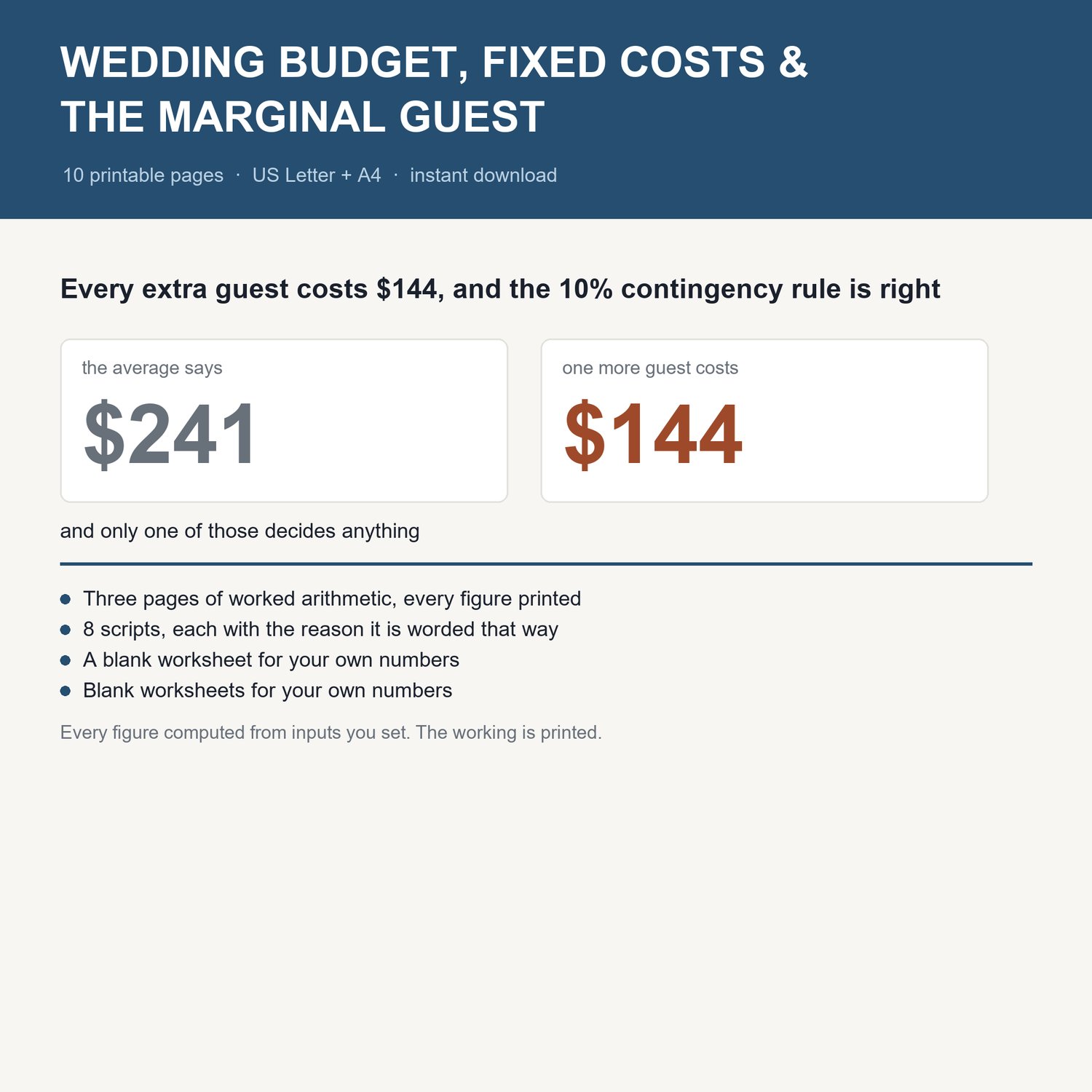
Every extra guest costs $144, not $241
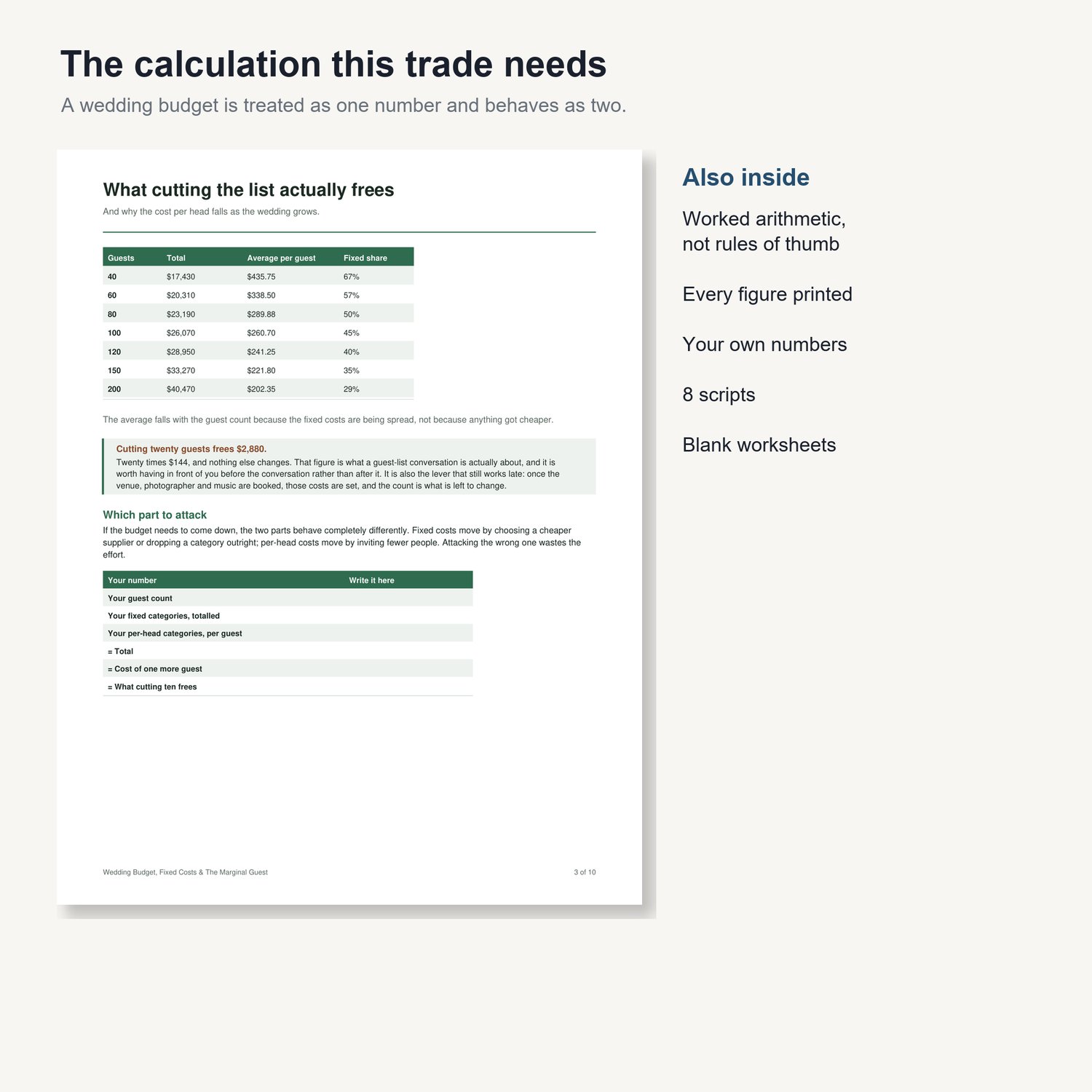
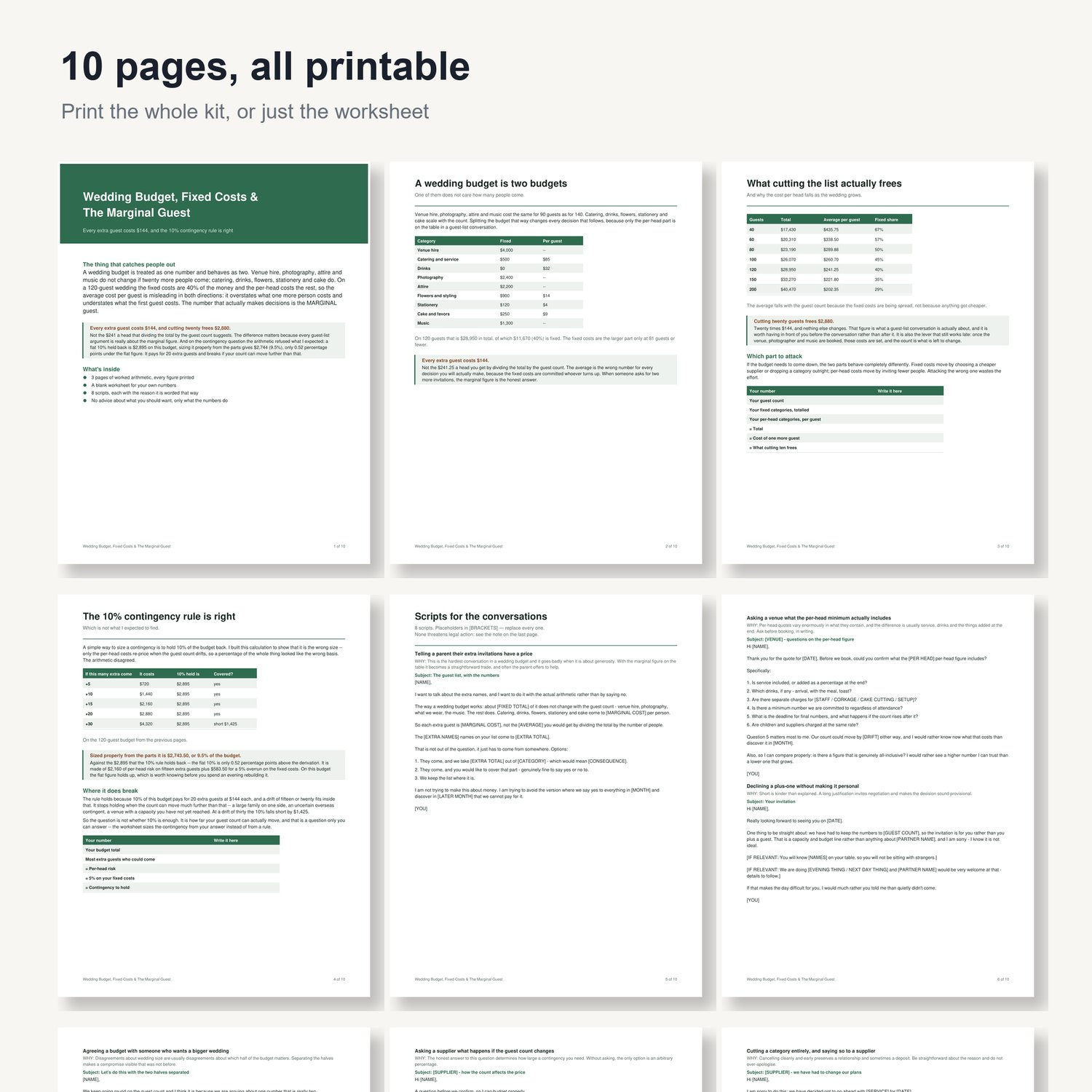
A wedding budget is treated as one number and behaves as two. Venue hire, photography, attire and music do not change if twenty more people come. Catering, drinks, flowers, stationery and cake do. At 120 guests the fixed costs are $11,670, 40% of the total; they are the larger part only at 81 guests or fewer.
On a 120-guest wedding totalling $28,950, dividing through gives $241.25 a head, and that number is wrong for every decision you will actually make. The marginal guest costs $144, and cutting twenty frees $2,880.
On the contingency question the arithmetic refused what I expected to find. I built it to show that holding 10% of the total back is the wrong-sized buffer, since only the per-head costs re-price. It is the right size: 10% here is $2,895, and sizing it properly from the parts gives $2,743.50, 9.5% of budget, only 0.52 percentage points under the flat 10%. So the page says the flat figure is well calibrated and shows where it breaks instead: it pays for 20 extra guests, and at a drift of thirty it falls short by $1,425.
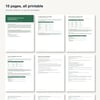
Three pages of worked arithmetic, every category split into its fixed and per-head parts, a worksheet for your own budget, and eight scripts: telling a parent their extra invitations have a price, asking a venue what the per-head minimum includes, and cutting a category entirely.
Includes a live Excel workbook. Enter your own categories and it computes the marginal guest, what cutting ten frees, and a contingency sized from your numbers rather than a rule. Every formula verified by recalculation.
8 scripts for the conversations this involves
Each one carries a line explaining why it is worded that way, because
a script you do not understand is one you will not send. Placeholders are in
[BRACKETS] so nothing goes out in someone else's words.
- Telling a parent their extra invitations have a price
- Asking a venue what the per-head minimum actually includes
- Declining a plus-one without making it personal
- Agreeing a budget with someone who wants a bigger wedding
- Querying a quote that moved after you booked
- Asking a supplier what happens if the guest count changes
- Telling a friend you cannot include their children
- Cutting a category entirely, and saying so to a supplier
What this is not
This is arithmetic, not advice. Every figure is computed from
the inputs stated on the page, and the working is printed so you can substitute
your own. What it cannot tell you is what you should want — it shows what a
choice costs, not which choice is right for your household.
Nothing here is financial, tax or legal advice, and it is not a recommendation
to buy, sell, borrow or sign anything. The scripts are wording for a
conversation, not legal instruments, and none of them threatens anything.
Where the kit uses a published rate or threshold, it is the one current when
the kit was built. Those change; the arithmetic does not.
Honest about the format
Printable PDFs plus an editable Excel workbook, not a physical product. One US Letter PDF (10 pages) and one A4 PDF (10 pages), and one .xlsx that opens in Excel, Numbers, LibreOffice and Google Sheets. Files are available immediately after purchase; nothing ships.
Refunds
If this isn't what you expected, email me within 30 days and I'll refund you in full — no need to explain. Because it's an instant download I can't take the files back, so I'd rather you just had your money back.