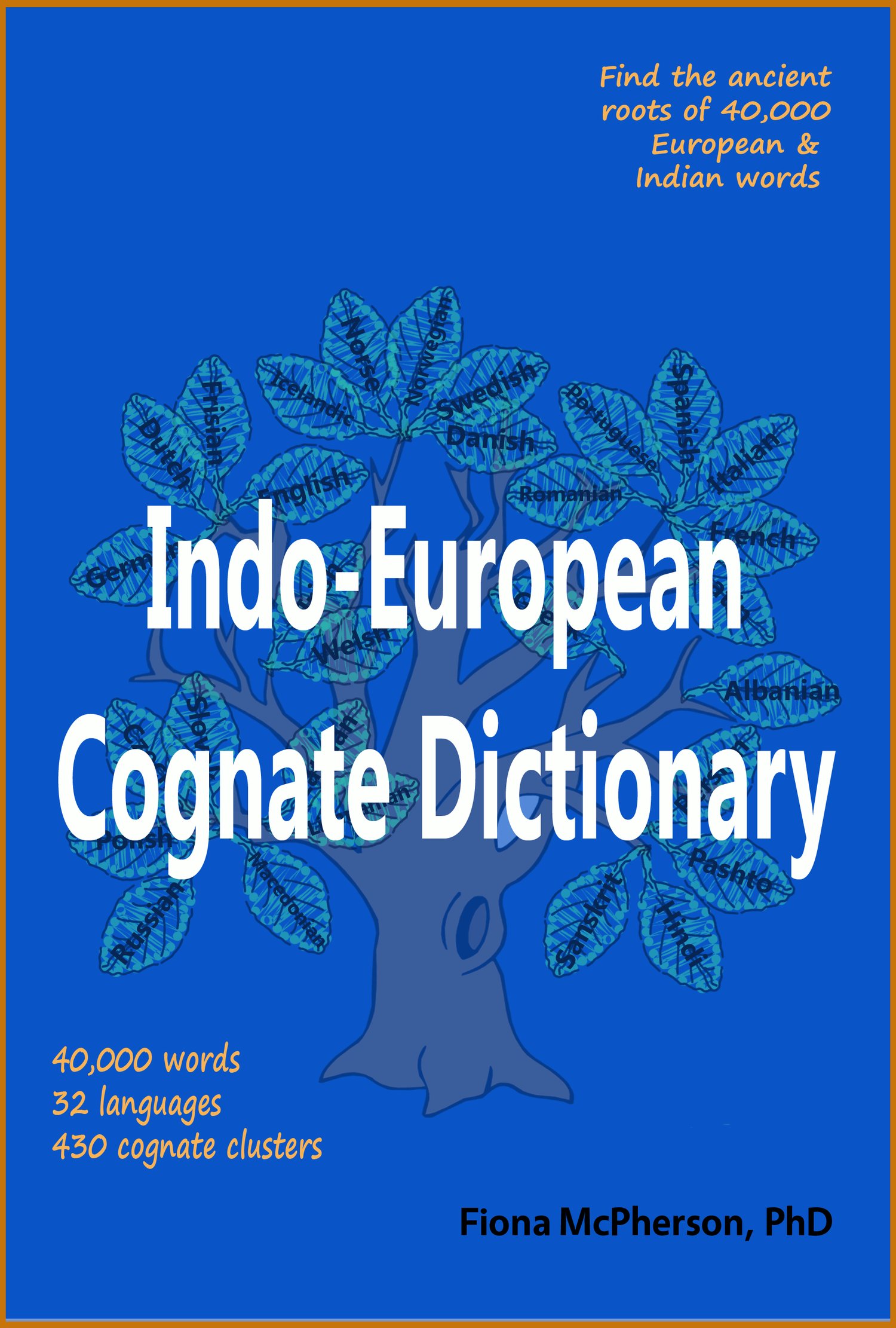


Indo-European Cognate Dictionary (2nd ed.)
An indispensable reference for language learners within the Indo-European language family, as well as for those who love words and want to deepen their understanding of English, or other Indo-European languages.
This is the 2nd edition of the dictionary, and is much more extensive than the first. The 2nd edition includes 46 languages, covering the nine living branches of the Indo-European language family, and has more than doubled the number of Proto-Indo-European root words covered, to over 900. The languages included are:
Germanic: English, Old English, Frisian, Dutch, German, Swedish, Danish, Norwegian, Icelandic, Norse
Celtic: Welsh, Irish, Scottish Gaelic, Breton, Cornish, Manx
Italic: Latin, French, Italian, Spanish, Portuguese, Catalan, Romanian
Greek: Ancient Greek, Modern Greek
Slavic: Russian, Ukrainian, Belarusian, Polish, Czech, Slovak, Macedonian, Bulgarian, Serbo-Croatian
Baltic: Lithuanian, Latvian
Armenian
Albanian
Indo-Iranian: Sanskrit, Hindi, Urdu, Punjabi, Bengali, Persian, Pashto, Kurdish
The dictionary also considerably extends the number of descendant words included. In particular, Germanic and Romance languages are covered far more completely and deeply than other branches. Of the 180,000 words in the dictionary, over 52,000 belong to the Germanic branch (18,000 of which are English), and 57,000 to the Italic branch.
The dictionary consists of two parts. The first part contains the pages for each Proto-Indo-European (PIE) word (the root word, spoken thousands of years ago), showing cognates in the chosen languages plus various descendants and derivatives. These pages are arranged thematically. This part allows you to browse or study. Search is enabled by the second part to the dictionary, which contains a separate index for each language, telling you to which PIE root the word belongs.