
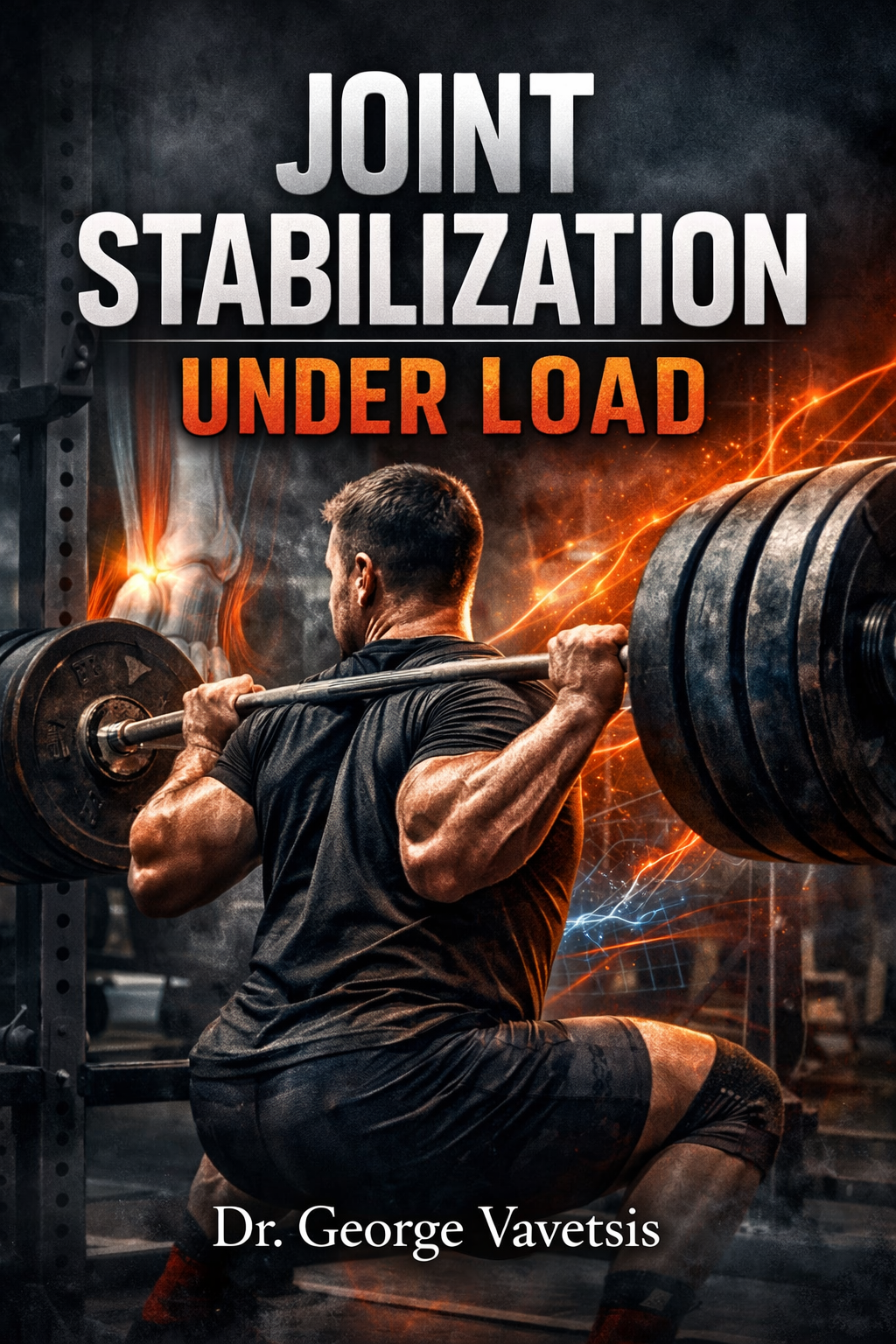
Joint Stabilization Under Load
Pages: 482
Joint stability under load is one of the most decisive yet misunderstood pillars of human movement, strength development, and injury resilience. In applied strength and conditioning, stability is often simplified as “control,” “balance,” or “core strength.” However, in high-load athletic environments, stability represents a far more complex phenomenon—an adaptive, dynamic, and multi-layered interaction between mechanical structures, neuromuscular coordination, reflexive protection, and force transmission across the kinetic chain. This book is built on the premise that true joint stability is not a static property but a load-dependent capability that evolves through exposure, adaptation, and intelligent programming.
In real-world movement, joints are rarely unloaded. Whether in sprinting, lifting, landing, striking, or changing direction, the musculoskeletal system constantly negotiates compressive, shear, and torsional forces. Under these conditions, stability is governed by the integration of passive tissue resistance, active muscular stiffness, and reflex-mediated protective responses. These elements form a continuum—passive, active, and reflexive stabilization—each contributing differently depending on load magnitude, velocity, fatigue, and environmental perturbation.
For the strength and conditioning professional, understanding this continuum is essential. Training stability is not merely about preventing injury; it is about enabling force expression. A joint that cannot maintain centration, resist displacement, and regulate stiffness cannot transmit force efficiently. Strength without stability is force leakage. Power without stability is uncontrolled energy. High performance demands both.
Traditional approaches often treat stability as an early-phase rehabilitation concept or as low-intensity “support work.” Yet in high-performance sport, stability must be trained across the entire loading spectrum—from slow isometric control to high-velocity reactive stabilization. Heavy compound lifts, unilateral loading, perturbation exposure, and reactive landing mechanics all contribute to the development of a joint system capable of resisting destabilizing forces while maintaining movement precision.
One of the central themes of this book is that joint stability is demand-driven. The neuromuscular system adapts only when challenged. Under low load, reflexive activation compensates for reduced passive stiffness. As load increases, passive structures and muscular pre-activation become dominant. At very high force levels, reflex timing, co-contraction efficiency, and neural coordination determine whether the joint maintains integrity or collapses into instability.
This perspective reshapes how stability should be programmed. Instead of isolating stability training from strength development, this book presents an integrated model where stability evolves with load exposure. Stability-first phases prepare tissues and neural pathways. Strength phases enhance co-contraction capacity and force tolerance. Power and reactive phases refine reflexive control and dynamic stiffness. Across this progression, the goal is not simply stability, but load-resilient stability—the ability to maintain joint integrity under the exact mechanical conditions encountered in sport.
A second foundational principle is stiffness regulation. Joint stability is not about rigidity; it is about optimal stiffness. Too little stiffness leads to displacement and instability. Excessive stiffness reduces movement efficiency, increases energy cost, and may even elevate injury risk. The skilled athlete demonstrates the ability to modulate stiffness across slow, fast, and reactive contraction conditions, allowing efficient force absorption, transmission, and redirection.
The book also emphasizes the role of co-contraction and joint protection mechanisms. Synergistic activation of agonist and antagonist muscles enhances joint stiffness and protects passive structures, particularly under heavy load. However, excessive or poorly timed co-contraction can impair performance. The objective is not maximal co-contraction, but intelligent, task-specific stabilization.
Another major concept explored throughout the text is force transmission through articular chains. The body functions as an integrated system where stability at one joint influences stability at others. Efficient force transfer requires kinetic-chain continuity, coordinated timing, and minimal energy leakage. Instability in proximal or distal segments disrupts this chain, reducing performance and increasing injury risk.
Proprioception and sensorimotor integration also play a critical role. Stability is not purely mechanical—it is informational. The nervous system constantly interprets sensory input to predict, prepare, and react to perturbations. Feedforward stabilization prepares the joint before load application, while feedback mechanisms correct unexpected disturbances. Elite stability arises from the integration of both systems under fatigue, speed, and unpredictable loading.
Importantly, this book adopts a performance-centered approach. While injury prevention is a major outcome, the deeper objective is to enhance athletic capability. Stable joints allow stronger force application, faster deceleration, sharper direction change, more efficient energy transfer, and greater tolerance to repeated high-load exposure. In elite sport, stability is not merely protective—it is performance-enhancing.
This text is written specifically for strength and conditioning professionals, performance coaches, rehabilitation specialists, and sport scientists who seek a deeper, applied understanding of stability under load. The goal is not to present abstract theory, but to translate biomechanical and neurophysiological principles into actionable training strategies. Concepts such as perturbation-based training, dynamic stiffness regulation, reflex latency, co-contraction indexing, and stability micro-dosing are explored within a practical programming framework.
Ultimately, joint stability under load represents the foundation of resilient performance. It determines how force is produced, absorbed, transferred, and controlled. It shapes movement quality, protects tissues, and enables athletes to operate at the limits of human capability. Developing this capacity requires precision, progression, and an integrated understanding of load, neuromuscular function, and adaptation.
This book is an invitation to move beyond simplistic notions of stability and toward a comprehensive, load-driven model of joint integrity—one that aligns science with high-performance practice, and stability with strength, power, and athletic excellence.