

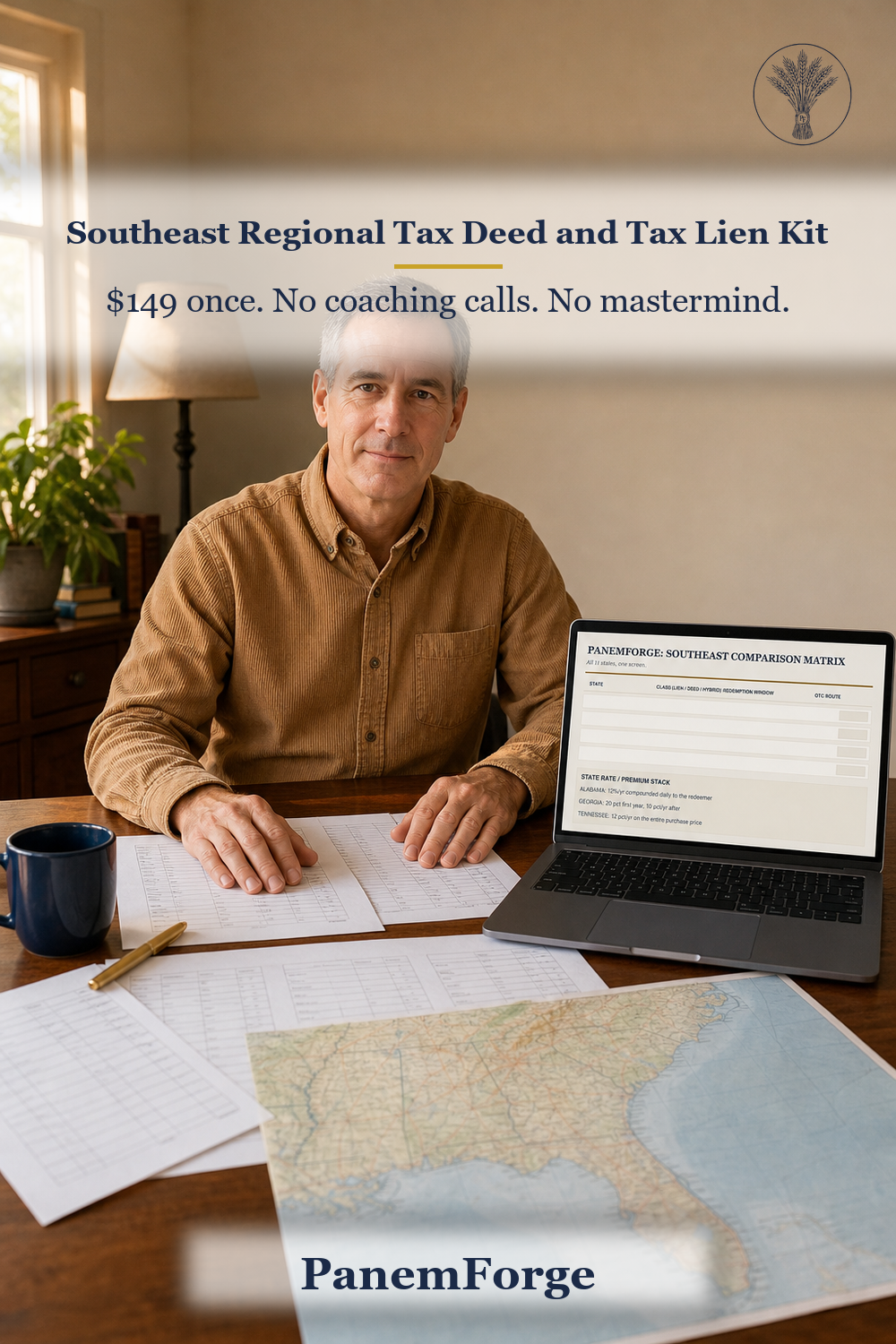
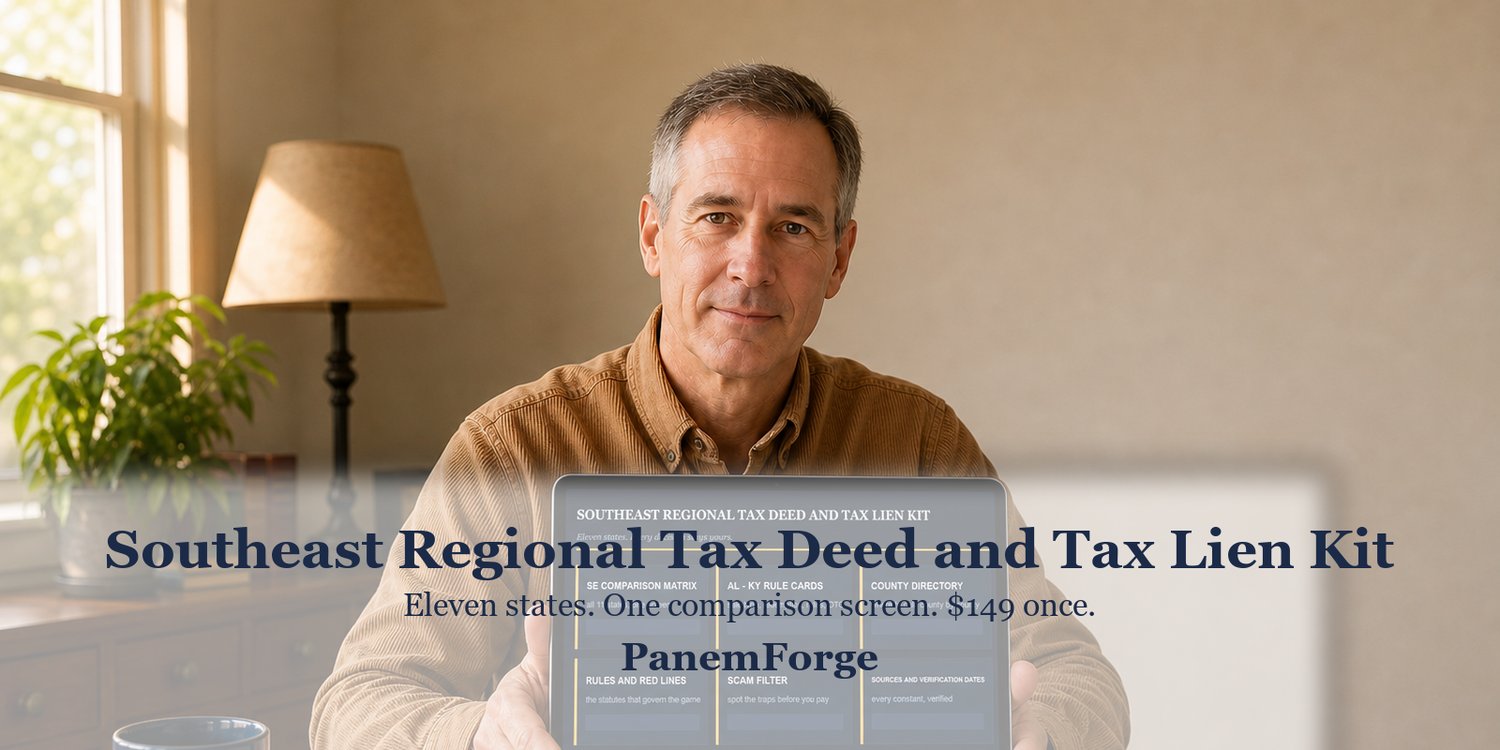




Southeast Regional Tax Deed and Tax Lien Kit: Compare 11 Southeastern States and Pick Where You Buy (Workbook + 33 Page Guide)
Eleven Southeastern states sell property with unpaid property taxes. But they use at least six different systems to do it.
Florida sells tax lien certificates, which are papers showing that you have a claim against a property because of unpaid taxes. Buyers compete by bidding down the interest rate, starting at 18 percent. Arkansas sells tax deeds, which give the buyer ownership of the property when the sale is final. North Carolina does not allow property tax liens to be sold outright. Louisiana ended its old system of selling ownership interests and started a new tax lien system on January 1, 2026. Tennessee changed its redemption period, which is the amount of time a property owner has to pay the overdue taxes and keep the property, in 2026.
The rules are different from state to state. Using what you learned in one state to buy property in another can cost you money. And courses that treat the entire Southeast as if it uses one system won't explain those differences.
This kit gives you an honest, side-by-side look at all eleven systems. It puts the verified rules in one place so you can choose the state you want to invest in before spending any money on a state-specific course or tools.
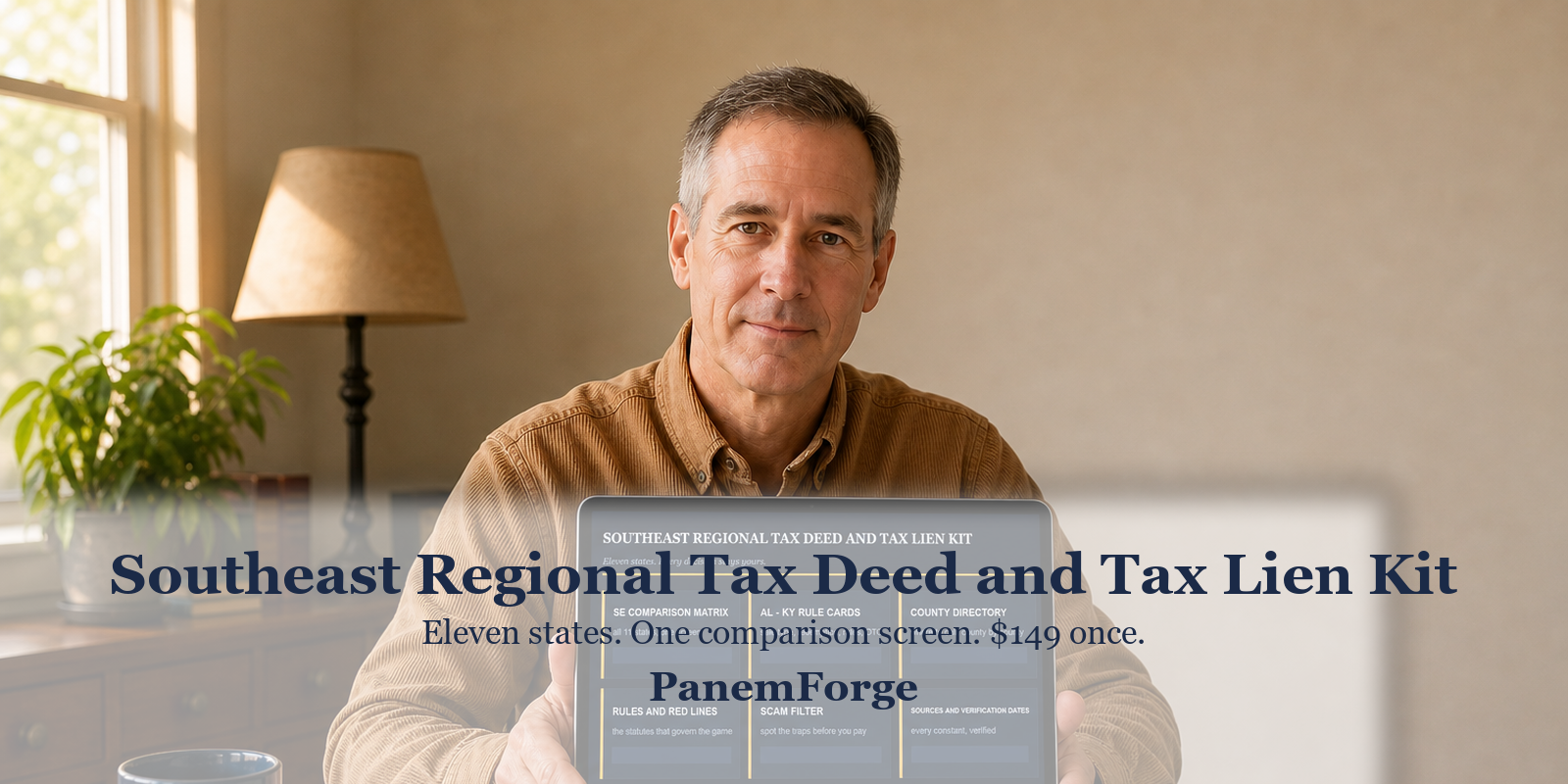 What's included in this kit
Eleven verified state rule cards: Alabama, Georgia, Florida, Tennessee, North Carolina, South Carolina, Mississippi, Louisiana, Arkansas, Virginia, and Kentucky. Each card explains the type of sale (tax lien, tax deed, or hybrid), the redemption period or rule for ending it, how interest or premiums work, and whether the state allows over the counter (OTC) purchases. Over the counter means buying available tax-sale properties directly from the county or state without bidding at a public auction. Each card also lists key rules, their statute numbers, and verification dates. If a number could not be confirmed using an official source, the card clearly says so instead of presenting it as fact.
The comparison matrix: A side-by-side chart comparing all eleven states. It shows the type of sale, interest rates, and over the counter options. It also gives each state a beginner difficulty rating from 1 to 5. The easiest state in this kit rates a 2. The hardest rates a 5.
The county directory: Shows which government office handles tax sales in each state. This matters because the office in charge can change from state to state, and each state keeps its sale lists in different places.
The state selection guide: A step-by-step guide to help you choose a state. It looks at the type of sale, how much money you need to get started, the risk of a property being redeemed, and the 2025 and 2026 law changes. It brings these details together to answer one question: Which state should you start in?
A 33 page guide: The written guide explains the same information in plain language, going through each state one at a time. It ends with chapters on choosing a state, checking a property before buying, and spotting scams. Every number in the guide comes from the workbook, and every number in the workbook was checked against a current statute or official government website.
What this kit does not include
This kit does not include separate workbooks for each state. You won't find state-specific calculators, trackers, or metro-area cards here. Those are included in the deeper, single-state kits, which are separate products with their own prices in this store.
This kit helps you choose a state. The single-state kit helps you work within that state's system.
One more thing, said plainly.
Courses in the tax sale business often cost several hundred dollars. Many also try to sell you additional coaching calls, group programs, and higher-priced packages.
This is not one of those courses. One price, paid once. No coaching calls. No mastermind. No subscription. No back-end tiers. What you see on this page is the whole product.
No income promises. Period.
This kit makes no promises about income, and it never will. And nobody can promise that a property will or will not be redeemed.
The payoff math shows what the numbers look like. It does not predict what will happen. We show you the math, but we don't make promises about future earnings.
How the information was checked
Everything in this kit was verified against statute publishers and official agency pages in November 2026. The verification dates are listed openly for each state.
If we could not confirm a rule using an official source, we did not present it as settled law. We said so instead.
A note about legal advice
This kit is not legal advice. We are not lawyers.
Questions about quiet title, disputed redemptions, federal tax liens, and occupied property need to be handled by an attorney in the state where the property is located. The guide explains when you should stop researching on your own and call an attorney.
Digital product and refunds
Because these are digital files, all sales are final. There is nothing to send back.
However, if a file will not open, is damaged, or does not match what this page promised, reply to your purchase email. We will send you a fixed or replacement file at no extra cost.
 Follow along
Watch the walkthrough on YouTube at youtube.com/@PanemForge.
Find more ideas and guides on Pinterest at pinterest.com/panemforge.
Frequently asked questions
Is this a one time purchase?
Yes. One payment of $149. The workbook and guide are yours to keep. No subscription, no account, no login.
What software do I need?
The workbook works in Microsoft Excel, LibreOffice, and Google Sheets. No macros and no bank connections.
Is this legal or financial advice?
No. The Southeast Regional Tax Deed and Tax Lien Kit is an educational kit. It names the tasks that belong to a licensed attorney, and the guide tells you exactly when to hire one.
What if a file does not open or is not what this page promised?
Reply to your purchase email and we will send a fixed or replacement file, free. Because these are digital files, all sales are final: there is nothing to send back.