

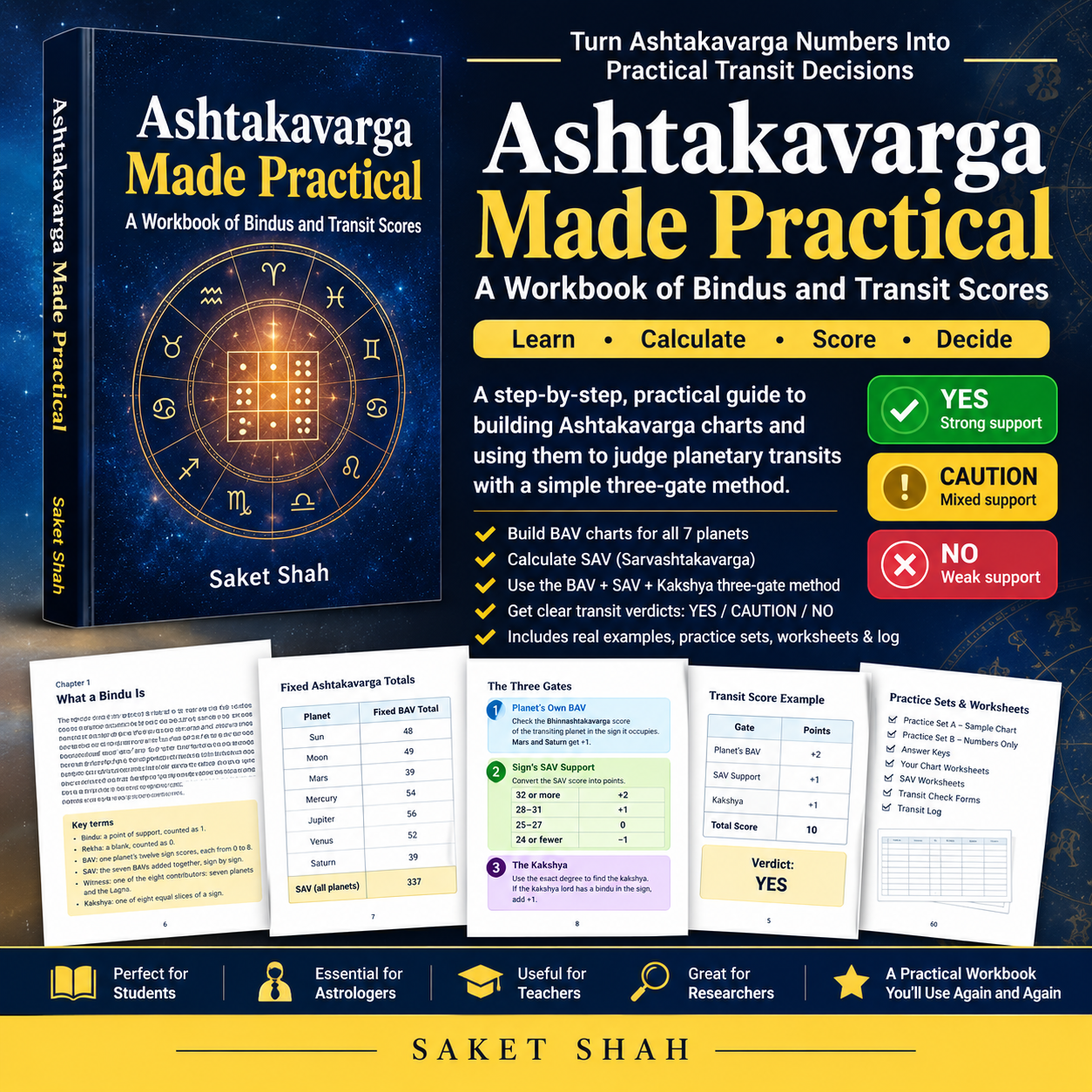
Ashtakavarga Made Practical A Workbook of Bindus and Transit Scores Score any transit YES, CAUTION or NO in three steps
Ashtakavarga Made Practical
A Workbook of Bindus and Transit Scores
Turn Ashtakavarga Numbers Into Practical Transit Decisions
Ashtakavarga is often presented as a complex system of numbers, tables and bindus.
But knowing the numbers is one thing.
Knowing what to DO with those numbers when a planet is transiting a sign is another.
Ashtakavarga Made Practical by Saket Shah is designed to bridge that gap.
This book takes the traditional framework of Ashtakavarga and turns it into a practical, structured workbook for evaluating planetary transits.
The central approach is simple:
BAV + SAV + Kakshya = Practical Transit Score
You learn how to work through the numbers and arrive at a clear:
YES
CAUTION
NO
transit assessment.
The book specifically explains that its purpose is to help the reader build the Ashtakavarga charts and then use them to assess whether a planetary transit has strong, mixed or weak support.
What Makes This Book Different?
Many astrology books explain Ashtakavarga theoretically.
This book emphasizes application.
Instead of leaving you with pages of calculations and asking you to interpret them yourself, the book develops a practical scoring procedure based on three gates:
Gate 1 — The Planet's Own BAV
Check the Bhinnashtakavarga score of the transiting planet in the sign it occupies.
Mars and Saturn receive an additional point in the author's scoring method.
Gate 2 — The Sign's SAV Support
The Sarvashtakavarga score of the sign is converted into points.
- 32 or more: Rich — +2
- 28–31: Fair share or better — +1
- 25–27: Thin — 0
- 24 or fewer: Poor — −1
Gate 3 — The Kakshya
The exact degree of the transiting planet is used to identify its kakshya.
If the kakshya lord has contributed a bindu in the relevant sign, the transit receives an additional point.
The three gates are then combined into one practical score.
The YES / CAUTION / NO Transit System
The book establishes the following working scoring bands:
7 or more → YES
The transit has real backing.
5 or 6 → CAUTION
The transit has mixed support and may require preparation.
4 or less → NO
Support is thin; the method suggests deferring or scaling down where possible.
This gives the astrologer a repeatable framework rather than relying entirely on intuition.
Learn How to Build the BAV Charts
The book takes you through the construction of the seven planetary Bhinnashtakavarga charts.
You learn how to work with the eight witnesses:
- Sun
- Moon
- Mars
- Mercury
- Jupiter
- Venus
- Saturn
- Lagna
The book explains how each witness contributes bindus and how the twelve sign scores are calculated.
You also get the fixed totals that allow you to check your calculations:
PlanetFixed BAV TotalSun48Moon49Mars39Mercury54Jupiter56Venus52Saturn39SAV337
These fixed totals provide built-in mathematical checks while constructing the charts.
Understand BAV and SAV Together
One of the central ideas of the book is learning to distinguish between:
BAV — support for a particular planet
and
SAV — overall support associated with a sign.
The book explains that BAV shows how strongly an individual planet is supported in a sign, while SAV provides the combined sign-level support. Reading the two together forms the foundation of the practical scoring method.
Go Beyond Basic Ashtakavarga Interpretation
The book also introduces the kakshya refinement.
Each 30° sign is divided into eight equal sections of 3°45′:
- Saturn
- Jupiter
- Mars
- Sun
- Venus
- Mercury
- Moon
- Lagna
This allows the method to examine where within a sign the transit receives additional support.
The result is a more granular way to examine planetary movement.
Practical Timing With Different Planets
The book explains that planets operate on very different timescales.
For example:
- Moon — about 2¼ days per sign
- Sun — about one month
- Mars — about six weeks
- Jupiter — about one year
- Saturn — about two and a half years
These differences matter when using transit scores for planning and timing.
The book also explains the principle:
Slow planets set the season. Fast planets pick the day.
Jupiter and Saturn provide the broader background, while faster planets can help identify more specific windows.
Apply Ashtakavarga to Real Decisions
The book provides a practical planet-to-decision framework.
Examples include:
Starting a business: Jupiter, Mercury, Saturn
Signing a contract: Mercury, Jupiter
Beginning a relationship: Venus, Jupiter
Buying property: Mars, Saturn, Venus
Taking a new job: Sun, Saturn, Jupiter
Beginning a course of study: Mercury, Jupiter
The book clearly identifies these pairings as the author's working convention rather than classical rules.
A Practical Approach to Saturn and Sade Sati
The book also applies the numerical approach to Saturn's passage through:
- the sign before the natal Moon,
- the natal Moon sign,
- the sign after the natal Moon.
These three scores are combined into what the book calls the Bindu Sum.
The working interpretation is:
11 or more: Lighter than usual
9–10: Middling
8 or fewer: Heavier than usual
Importantly, the book emphasizes that this measures support rather than fate.
Learn the "Rule of Two"
For important decisions, the book introduces a practical rule:
Check two planets.
One should be a slow planet and the other should be relevant to the decision.
The book's framework asks for at least CAUTION from the slow planet and YES from the decision planet.
This creates a structured way to combine broad timing conditions with the planet most relevant to the decision.
Includes a Complete Worked Example
The book does not simply provide abstract formulas.
A fictional Taurus Lagna chart is used throughout the worked example so that the calculations can be followed from beginning to end.
The completed example demonstrates:
- Seven BAV charts
- SAV calculation
- Sign-by-sign scores
- Transit scoring
- Kakshya analysis
- YES / CAUTION / NO verdicts
For example, the book demonstrates a Jupiter transit with a total score of 10 → YES, showing exactly how the three gates are combined.
This Is Also a Workbook
This is not only a reading book.
The third part is designed for hands-on practice.
It includes:
Practice Set A
Transit exercises using the sample chart.
Practice Set B
Numbers-only exercises where you calculate the final verdict.
Answer Keys
Solutions are provided so you can check your calculations.
Your Chart Worksheets
Blank worksheets for constructing your own planetary BAV charts.
SAV Worksheets
Forms for organizing your Sarvashtakavarga calculations.
Transit Check Forms
Reusable forms for recording:
- Planet
- Sign
- Degree
- BAV score
- Mars/Saturn adjustment
- SAV score
- Kakshya result
- Total
- Verdict
Transit Log
A dedicated place to record your transit calculations over time.
What You Will Learn
By working through the book, you will learn how to:
✓ Understand the meaning of a bindu and rekha
✓ Build the seven planetary BAV charts
✓ Check your calculations using fixed planetary totals
✓ Calculate the Sarvashtakavarga
✓ Identify strong and weak signs
✓ Read SAV scores by house
✓ Calculate planetary transit support
✓ Apply the Mars and Saturn scoring adjustment
✓ Use the kakshya gate
✓ Incorporate exact transit degrees
✓ Create YES / CAUTION / NO transit assessments
✓ Work with slow and fast planetary transits
✓ Apply the method to Saturn and Sade Sati
✓ Use the Rule of Two
✓ Create practical transit windows
✓ Practice using worked examples
✓ Complete your own Ashtakavarga worksheets
✓ Maintain a transit log
Who Is This Book For?
This book can be useful for:
Vedic Astrology Students
who want to move beyond memorizing Ashtakavarga concepts and practice actual calculations.
Vedic Astrologers
who want a repeatable framework for evaluating transits.
Astrology Teachers
who want structured examples and worksheets for teaching Ashtakavarga.
Researchers and Practitioners
who want to record and compare transit scores systematically.
Serious Astrology Learners
who want a practical workbook rather than a purely theoretical treatment.
What This Book Does NOT Claim
The book is deliberately specific about the limits of its method.
Ashtakavarga is presented as a measure of support, not a complete prediction system.
It does not replace:
- Dashas
- Houses
- Yogas
It also does not attempt to predict the exact content of an event. Instead, the method assesses how well supported a transit is.
The book also clearly distinguishes its practical scoring bands and three-gate procedure from the classical contribution tables, describing the scoring system as the author's working method and convention.
A Book You Can Use Again and Again
Once your BAV and SAV charts are constructed, you do not need to rebuild them every time a planet moves.
The book provides reusable worksheets and transit forms so you can keep evaluating future planetary movements using the same framework.
The final Quick Reference Card condenses the principal calculations, scoring bands, kakshya order and verdict thresholds into a single reference sheet.
Start Working With Ashtakavarga in a Practical Way
If you have studied Ashtakavarga but still find yourself asking:
"What do I actually do with these numbers?"
this workbook is designed specifically around that question.
Learn the calculations.
Build the charts.
Score the transit.
Check the kakshya.
Record the result.
Then compare your findings with the practical framework presented in the book.
Ashtakavarga Made Practical
A Workbook of Bindus and Transit Scores
By Saket Shah
A structured practical guide for students and practitioners of Vedic Astrology who want to work with BAV, SAV, bindus, kakshya and planetary transit scores.
Get the book and start building your own Ashtakavarga transit worksheets.
SEO Keywords
Ashtakavarga Made Practical, Ashtakavarga, Vedic Astrology, Ashtakavarga astrology, Ashtakavarga calculator, Ashtakavarga transit, Ashtakavarga transit analysis, Sarvashtakavarga, SAV, Bhinnashtakavarga, BAV, Bindu analysis, Ashtakavarga bindus, planetary transit prediction, Vedic astrology transits, transit timing Vedic astrology, Jupiter transit astrology, Saturn transit astrology, Saturn Ashtakavarga, Jupiter Ashtakavarga, Sade Sati Ashtakavarga, Kakshya, Kakshya astrology, Kakshya transit, Vedic astrology workbook, astrology workbook, Vedic astrology book, Ashtakavarga book, practical Vedic astrology, transit scoring, planetary transit timing, astrology timing techniques, Vedic astrology prediction, Saket Shah astrology.