
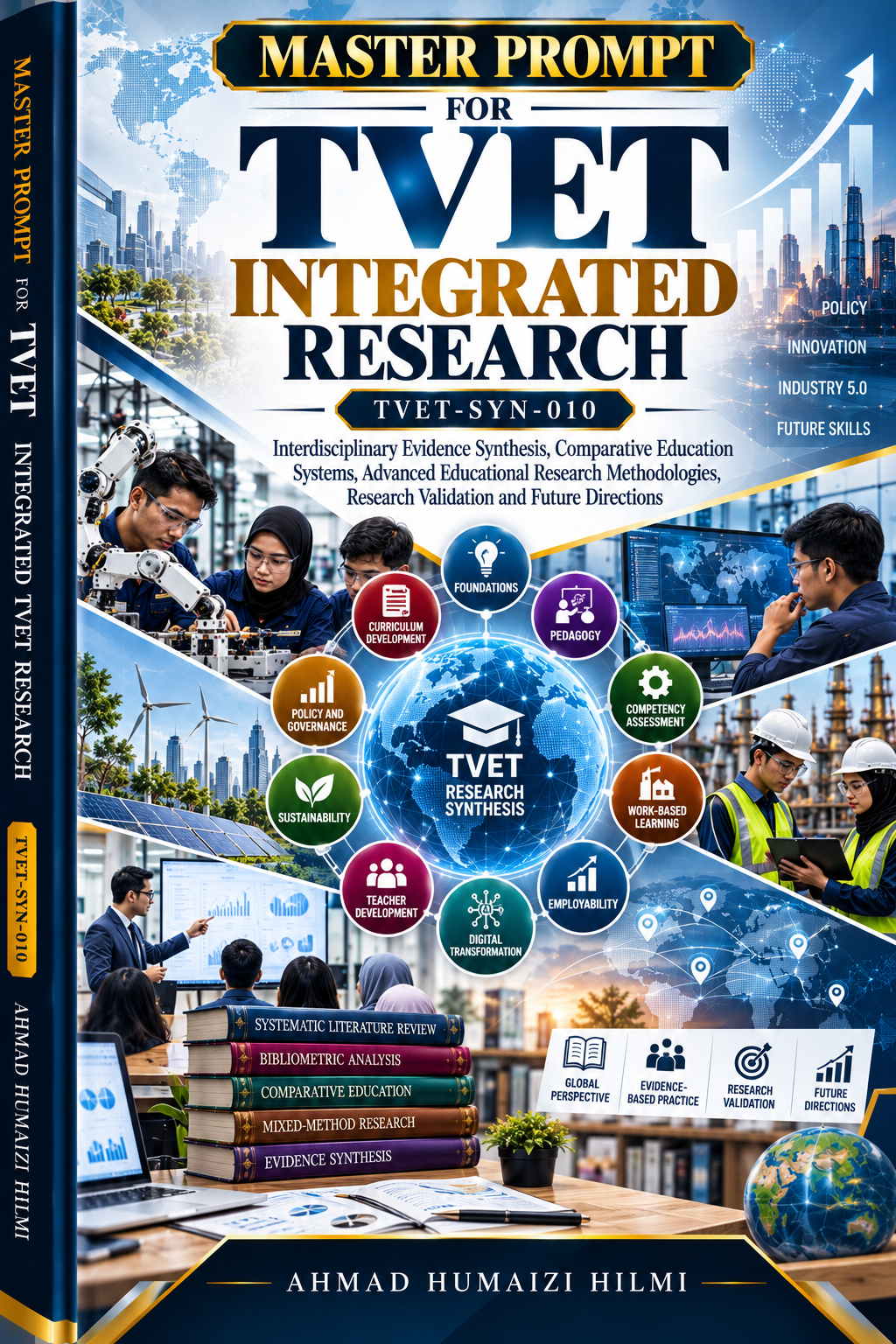
10. TVET-SYN-010 — Integrated TVET Research, Interdisciplinary Evidence Synthesis, Comparative Education Systems, Advanced Educational Research Methodologies, Research Validation and Future Directions
Description
This Master Prompt provides an integrated and interdisciplinary framework for synthesizing theoretical perspectives, empirical evidence, educational methodologies, technological innovations, institutional practices and policy developments across the major domains of contemporary Technical and Vocational Education and Training. It examines the relationships among TVET foundations, curriculum development, vocational pedagogy, occupational competency assessment, work-based learning, graduate employability, entrepreneurship education, digital transformation, teacher professional development, educational leadership, sustainability, social inclusion and education policy. Particular emphasis is placed on identifying convergent and divergent research findings, evaluating theoretical compatibility, comparing methodological approaches, integrating qualitative and quantitative evidence and developing comprehensive explanatory frameworks for understanding TVET effectiveness and transformation. The framework supports systematic literature reviews, scoping reviews, bibliometric analysis, meta-analysis, umbrella reviews, integrative reviews, comparative education studies, longitudinal investigations, advanced statistical modeling, structural equation modeling, multilevel analysis, design and development research and mixed-method evidence synthesis. Researchers are guided in developing systematic search strategies, establishing inclusion and exclusion criteria, evaluating research quality, identifying methodological limitations, assessing publication bias where applicable, conducting thematic synthesis, examining relationships among educational constructs and integrating evidence across institutional, national and international contexts. The Master Prompt also addresses conceptual framework development, theoretical model integration, research instrument validation, methodological triangulation, sensitivity analysis, reproducibility, research transparency and responsible Artificial Intelligence in evidence synthesis. Particular attention is given to distinguishing empirical findings from theoretical assumptions, identifying contradictory evidence, evaluating generalizability, examining contextual influences and ensuring that interdisciplinary integration does not conceal differences in research paradigms or methodological assumptions. The framework further explores emerging research directions involving Industry 5.0, human-centred Artificial Intelligence, smart vocational education, digital credentials, green workforce transitions, lifelong technical learning, educational equity and future skills ecosystems. Its central objective is to support the development of scientifically defensible, methodologically rigorous and policy-relevant research syntheses that advance theoretical understanding, educational innovation, institutional effectiveness and sustainable development within the global TVET research landscape.