
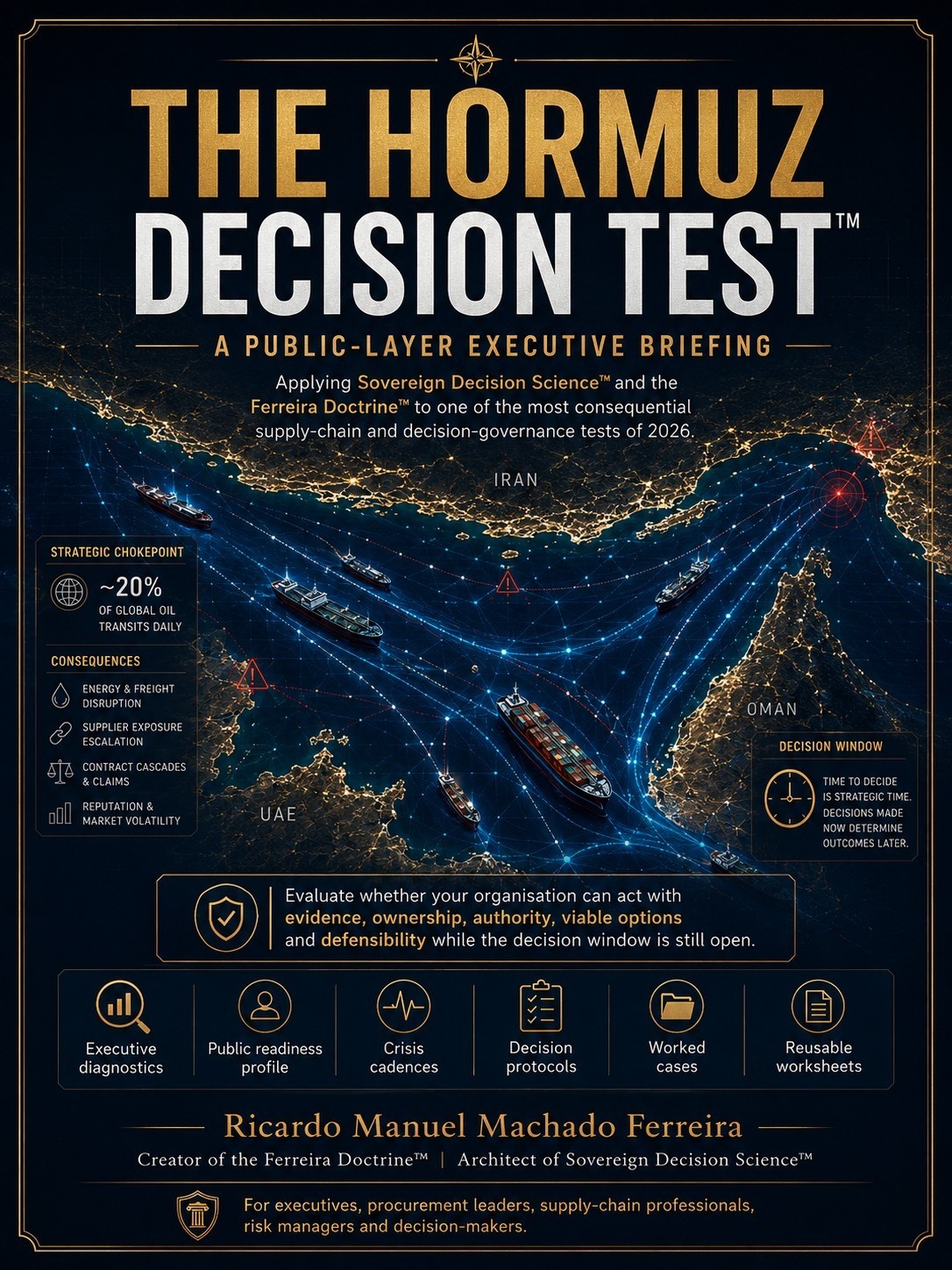
The Hormuz Decision Test™
THE HORMUZ DECISION TEST™
Freight Shock, Route Uncertainty, Supplier Exposure, Contract Pressure and Executive Defensibility
A premium public-layer executive briefing by Ricardo Manuel Machado Ferreira, Creator of the Ferreira Doctrine™ and Architect of Sovereign Decision Science™.
The Strait of Hormuz is not only a maritime chokepoint.
For boards, executives, procurement leaders and supply-chain professionals, it is a test of whether an organisation can convert external disruption into a timely, owned, authorised and defensible decision before meaningful options disappear.
THE HORMUZ DECISION TEST™ examines how freight shocks, route uncertainty, supplier concentration, energy exposure, contract pressure and delayed authority can become internal governance failures before they become visible supply-chain failures.
This is not a geopolitical forecast.
It is not a shipping-route recommendation.
It is a public-layer executive briefing on decision governance under disruption.
The external event may be beyond the organisation’s control.
The internal decision is not.
Why this briefing matters
A route shock does not remain a route problem.
It can move through:
→ freight inflation;
→ capacity restrictions;
→ energy and insurance exposure;
→ supplier fragility;
→ lead-time deterioration;
→ inventory pressure;
→ customer commitments;
→ contract economics;
→ emergency buying;
→ operational continuity;
→ financial consequence;
→ board accountability;
→ executive defensibility.
The danger is not only that disruption occurs.
The deeper danger is that the organisation discovers too late that:
→ critical dependencies were not fully visible;
→ several suppliers relied on the same route, hub or upstream source;
→ evidence existed but did not reach authority in time;
→ ownership was distributed across functions but held by no one;
→ approval took longer than the decision window allowed;
→ alternatives existed in theory but were not executable;
→ contracts provided remedies without preserving continuity;
→ options expired while leadership continued to monitor the situation;
→ the final rationale could not be reconstructed after consequence appeared.
The governing question
Could an independent reviewer understand what the organisation knew, who owned the decision, which options remained, why action was taken when it was, and who accepted the residual risk?
If the answer is unclear, the organisation may be monitoring the disruption without governing the decision.
What this briefing examines
Inside this executive briefing, the reader will find:
→ a decision-governance reading of the Hormuz exposure environment;
→ the distinction between supplier diversity and dependency diversity;
→ how external disruption travels through capacity, inventory, procurement, finance, contracts and operations;
→ why monitoring does not automatically become accountable action;
→ the importance of evidence, ownership, authority, optionality and defensibility;
→ the difference between theoretical alternatives and executable alternatives;
→ why formal authority must operate inside the real decision window;
→ how contractual protection can exist without operational continuity;
→ how dashboards, predictive models, workflows and AI can accelerate control—or accelerate confusion;
→ public-layer executive questions for boards, CFOs, COOs, CPOs, legal, risk and compliance;
→ illustrative cases showing how several interdependent decisions can emerge from one external shock;
→ a controlled public-layer route from exposure recognition to executive review;
→ a clear intellectual-property boundary between public understanding and protected implementation architecture.
This briefing helps leaders understand
→ why a freight shock is not only a logistics problem;
→ how supplier dependencies can remain hidden behind apparently diversified supply bases;
→ why a green supplier dashboard may not reveal shared upstream exposure;
→ how delayed decisions reduce negotiating power and operational choice;
→ why waiting for certainty can become an unrecorded decision;
→ how time changes the price and quality of available options;
→ why the cheapest immediate response may destroy greater strategic value;
→ why a favourable outcome does not automatically prove that the decision was well governed;
→ why an adverse outcome does not automatically prove that the decision was unreasonable;
→ why serious decisions must remain reconstructible under board scrutiny, audit, litigation, regulatory review or public consequence.
Who this briefing is for
This product is written for:
→ board members;
→ CEOs and executive leadership teams;
→ CFOs, COOs, CPOs, CIOs and CTOs;
→ procurement leaders;
→ supply-chain professionals;
→ logistics and transport leaders;
→ operations and continuity teams;
→ finance and treasury functions;
→ supplier-risk and third-party-risk teams;
→ contract owners;
→ legal and contract-governance professionals;
→ risk, audit and compliance functions;
→ technology and digital-governance teams;
→ ERP and MRP decision environments;
→ regulated organisations;
→ public institutions and government decision-makers;
→ leaders responsible for critical programmes, assets, services or public obligations.
It is particularly relevant where organisations face:
→ freight shock;
→ maritime-route uncertainty;
→ energy exposure;
→ supplier concentration;
→ common upstream dependencies;
→ contract fragility;
→ insurance or capacity pressure;
→ inventory deterioration;
→ emergency buying;
→ limited substitution;
→ approval delays;
→ fragmented decision ownership;
→ closing decision windows.
The central decision test
Can your organisation act with sufficient evidence, accountable ownership, usable authority, viable options and a defensible rationale while the decision window is still open?
The purpose is not to eliminate uncertainty.
The purpose is to prevent uncertainty from dissolving ownership, delaying authority and allowing executable options to disappear without a conscious decision.
Recommended next steps
Readers who want to continue examining related supplier, contract, continuity and executive decision exposure may proceed to:
→ When Hormuz Moves, Every Contract Moves;
→ Contract Exposure Note;
→ Supplier Failure Before Impact;
→ 72-Hour Decision Readiness Test;
→ Public Decision Record Pack;
→ Boardroom Consequence Brief;
→ Executive Decision Defensibility Review.
These public written products examine whether supplier, contractual, operational and executive decisions remain visible, owned and defensible when external pressure becomes internal consequence.
Product information
Document ID: SDS-HDT-2026-001
Edition: Controlled Public-Layer Edition
Version: 2.0
Format: 36-page executive PDF briefing
Language: English
Delivery: Immediate digital download
Access: Individual read-only public-layer access
Important rights and use boundary
This is a paid public-layer written product.
Purchase grants the individual purchaser a personal, non-transferable, read-only right to access the published briefing for executive understanding and professional awareness.
Purchase does not grant rights to:
→ organisational implementation;
→ internal or external training;
→ consultancy or advisory reuse;
→ reproduction or redistribution;
→ resale or sublicensing;
→ adaptation or derivative development;
→ extraction or repackaging;
→ creation of operational templates;
→ software translation or embedding;
→ dashboard or workflow development;
→ ERP or MRP integration;
→ API development;
→ AI or LLM ingestion, training, modelling or retrieval use;
→ institutional, commercial or governmental deployment.
No formula, mathematical model, weighting, coefficient, threshold, score band, classification criterion, decision gate, calibration method, custody protocol, protected taxonomy, executable sequence, implementation workflow, software logic or operational architecture is transferred through this product.
Any institutional use of Sovereign Decision Science™, the Ferreira Doctrine™, The Hormuz Decision Test™ or associated protected systems requires a separate written licence agreement, an approved scope, separate commercial terms and explicit written authorisation from Ricardo Manuel Machado Ferreira.
This product is not geopolitical, military, maritime-security, legal, financial, investment, insurance, cybersecurity, procurement or supply-chain consultancy.
It does not predict the duration or outcome of geopolitical events.
It does not recommend a particular supplier, carrier, route, contract position, investment or operational response.
It is not training, software, an implementation system or an operational template package.
The public layer explains the exposure.
Protected implementation requires formal written licensing.
Official access
Official website:
https://www.ricardoferreira.ai/
Institutional licensing:
General contact:
Rights and intellectual property:
Serious decisions must become defensible before consequence appears.
Ricardo Manuel Machado Ferreira
Creator of the Ferreira Doctrine™
Architect of Sovereign Decision Science™