
John Deere 27D Excavator Operator's Manual OMT223334 PDF Download - MJODOMT223334.zip
John Deere 27D Excavator Operator's Manual (OMT223334)
omt223334 - 27D Excavator Operator's Manual.pdf
Complete official Operator's Manual for John Deere 27D Excavator, with all the shop information to maintain & operate the 27D.
Total Pages: 348 pages
File Format: PDF (bookmarked, Searchable, Printable, high quality)
Language: English
omt223334 - 27D Excavator
Table of Contents
Emission Control Statement
Technical Information Feedback Form
Section 1-1: Safety—Safety and Operator Convenience
Safety and Operator Convenience Features
Section 1-2: Safety—General Precautions
Recognize Safety Information
Follow Safety Instructions
Operate Only If Qualified
Wear Protective Equipment
Avoid Unauthorized Machine Modifications
Add Cab Guarding for Special Uses
Inspect Machine
Stay Clear of Moving Parts
Avoid High-Pressure Fluids
Avoid High-Pressure Oils
Work In Ventilated Area
Prevent Fires
Prevent Battery Explosions
Handle Chemical Products Safely
Dispose of Waste Properly
Prepare for Emergencies
Section 1-3: Safety—Operating Precautions
Use Steps and Handholds Correctly
Start Only From Operator's Seat
Use and Maintain Seat Belt
Prevent Unintended Machine Movement
Avoid Work Site Hazards
Keep Riders Off Machine
Avoid Backover Accidents
Avoid Machine Tip Over
Use Special Care When Lifting Objects
Add and Operate Attachments Safely
Section 1-4: Safety—Maintenance Precautions
Park and Prepare for Service Safely
Service Cooling System Safely
Remove Paint Before Welding or Heating
Make Welding Repairs Safely
Drive Metal Pins Safely
Section 1-5: Safety—Safety Signs
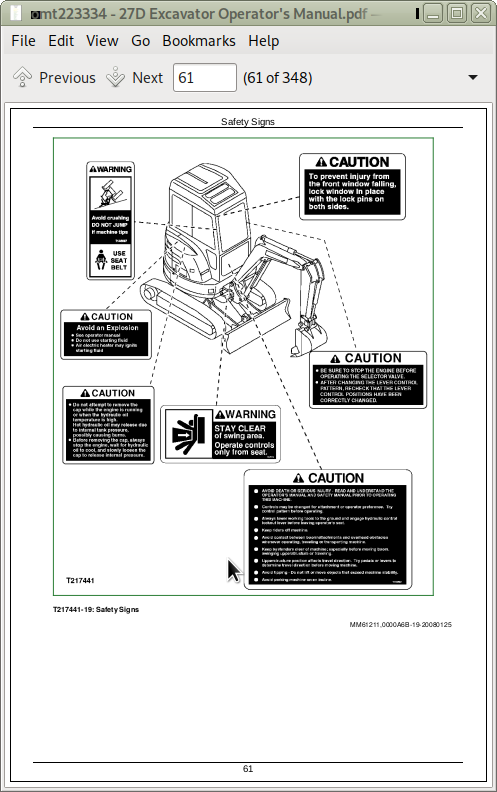
Safety Signs
Section 2-1: Operation—Operator Station
Monitor Panel and Functions (S.N. —255551)
Monitor Panel and Functions (S.N. 255551— )
Switch Panel—Cab
Switch Panel—Canopy
Pedals and Levers
Engine Speed Control Lever
Pilot Control Shutoff Lever
Setting Trip Meters
Door Release Lever—If Equipped
Front (Secondary Exit) Window—If Equipped
Secondary Exit Tool—If Equipped
Opening Rear Window—If Equipped
Opening Right Side Window—If Equipped
Adjusting Operator Seat
Toolbox and Operator’s Manual Compartment
Section 2-2: Operation—Operating the Machine
Before Starting Work
Operator's Daily Machine Check Before Starting
Starting the Engine
Starting the Engine in Cold Weather
Checking Instruments After Starting
Cold Weather Warm-Up
Travel Pedals and Levers
Control Lever Pattern Operation
Control Lever Pattern Conversion
Multi-Function Control Lever—If Equipped
Boom-Swing Pedal
Auxiliary Pedal
Positioning Auxiliary Line Selector Valve
Operating Backfill Blade
Operating Tips—Backfill Blade
Operating in Water and Mud
Selecting Correct Track
Driving Up a Steep or Slippery Slope
Lowering Boom With Engine Stopped
Parking
Loading and Unloading for Transport
Towing Machine a Short Distance
Lifting
Lifting Machine
Section 3-1: Maintenance—Machine
Diesel Fuel
Lubricity of Diesel Fuel
Handling and Storing Diesel Fuel
Biodiesel Fuel
Testing Diesel Fuel
Minimizing the Effect of Cold Weather on Diesel Engines
Alternative and Synthetic Lubricants
Diesel Engine Oil
Diesel Engine Oil and Filter Service Intervals
Hydraulic Oil
Travel Gearbox Oil
Grease
Light Duty Diesel Engine Coolant (for diesel engines without wet sleeve cylinder liners)
Drain Intervals for Diesel Engine Coolant
John Deere COOL-GARD™ II Coolant Extender
Supplemental Coolant Additives
Operating in Warm Temperature Climates
Additional Information About Diesel Engine Coolants and John Deere COOL-GARD™ II Coolant Extender
Testing Diesel Engine Coolant
Section 3-2: Maintenance—Periodic Maintenance
Service Machine at Specified Intervals
Check the Hour Meter Regularly
Preparing Machine for Maintenance
Engine Access Door
Maintenance Access Cover
Tilting the Operator Station
Fuel Tank
Checking Washer Fluid Level
Hydraulic Breaker and Crusher Attachments
Fluid Analysis Program Test Kits and 3-Way Coolant Test Kit
Service Intervals
Required Parts
Section 3-3: Maintenance—As Required
Cleaning Air Cleaner Element
Cleaning Radiator Core and Oil Cooler
Check Coolant
Section 3-4: Maintenance—Every 10 Hours or Daily
Checking Engine Oil Level
Checking Hydraulic Oil Tank Level
Draining Fuel Tank Sump
Draining Water Separator
Checking Recovery Tank Coolant Level
Checking Bucket Teeth
Checking Track Sag—Rubber Track
Checking Track Sag—Steel Track—If Equipped
Track Sag General Information
Adjusting Track Sag
Seat Belt
Section 3-5: Maintenance—First 50, Then Every 100 Hours
Lubricate Bucket and Link Pins
Grease Front Joint Pins
Inspect Fan Belt, Check and Adjust Tension
Section 3-6: Maintenance—Every 250 Hours
Grease Swing Bearing
Checking Travel Gearbox Oil Level
Draining Hydraulic Oil Tank Sump
Replacing Hydraulic Oil Tank Filter
Take Engine Oil Sample
Section 3-7: Maintenance—Every 500 Hours
Changing Engine Oil and Replacing Filter
Lubricate Swing Bearing Gear
Lubricate Control Lever Universal Joint
Replacing Final Fuel Filter
Lubricate Blade Pins
Replacing Air Cleaner Element
Replacing Hydraulic Oil Tank Filter
Take Fluid Samples
Section 3-8: Maintenance—Every 1000 Hours
Changing Travel Gearbox Oil
Replacing Pilot System Oil Filter
Checking and Adjusting Engine Valve Lash (Clearance)
Checking Starter and Alternator
Check Coolant
Section 3-9: Maintenance—Every 2000 Hours
Draining Cooling System
Cooling System Fill and Deaeration
Changing Hydraulic Tank Oil and Cleaning Suction Screen
Section 3-10: Maintenance—Every 6000 Hours
Draining Cooling System
Cooling System Fill and Deaeration
Section 4-1: Miscellaneous—Machine
Do Not Service or Adjust Injection Nozzles or High Pressure Fuel Pump
Do Not Service Control Valves, Cylinders, Pumps, or Motors
Precautions for Alternator and Regulator
Handling, Checking, and Servicing Batteries Carefully
Using Booster Batteries—12-Volt System
Using Battery Charger
Replacing the Battery
Welding On Machine
Bleed Hydraulic System
Clean Machine Regularly
12-Volt Auxiliary Power Outlet
Connecting and Disconnecting Auxiliary Lines
Replacing Fuses
Cleaning Heating and Air Conditioning Filter Screens—If Equipped
Installing Bucket With Quick Coupler
Checking Track Shoe Hardware
Rubber Track Care
Removing and Installing Rubber Track
Converting the Track
Unified Inch Bolt and Screw Torque Values
Metric Bolt and Screw Torque Values
Section 4-2: Miscellaneous—Operational Checkout
Operational Checkout
Section 4-3: Miscellaneous—Troubleshooting
Using Troubleshooting Charts
Engine
Electrical System
Hydraulic System
Section 4-4: Miscellaneous—Storage
Prepare Machine for Storage
Monthly Storage Procedure
Section 4-5: Miscellaneous—Serial Numbers
Record Product Identification Number (PIN)
Record Engine Serial Number
Keep Proof of Ownership
Keep Machines Secure
Section 4-6: Miscellaneous—Specifications
Engine Specifications
Drain and Refill Capacities
Machine Specifications
Working Ranges
Excavator Lift Capacity (Blade on the Ground With Standard Boom and Canopy)
Excavator Lift Capacity (Blade on the Ground With Long Arm and Canopy)
Excavator Lift Capacity (Blade on the Ground With Standard Boom and Cab)
Excavator Lift Capacity (Blade on the Ground With Long Arm and Cab)