
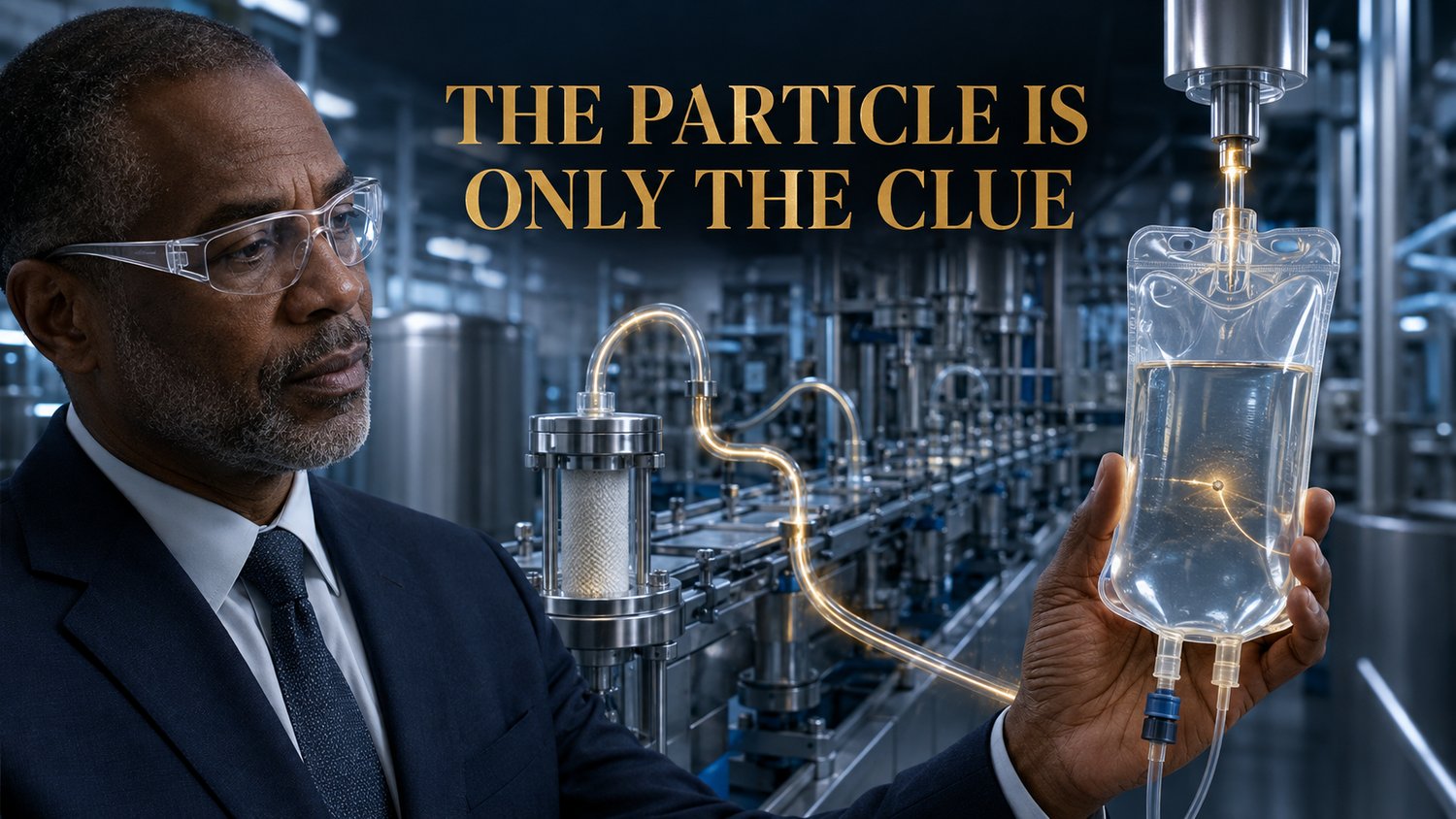
How FDA Should Expect Baxter to Investigate
When particulate matter is discovered in a sterile injectable product, identifying the particle is only the beginning.
The real investigation must determine how the material entered the product, which controls failed to prevent or detect it, whether other products or lots could be affected, and what scientific evidence supports the proposed recall boundaries.
In this premium investigative guide, former FDA Investigator DeVaughn Edwards uses the recent Baxter fiberglass recalls as a case study to demonstrate how an experienced FDA Investigator would approach a sterile injectable particulate investigation.
This is not a summary of the recalls, and it is not a generic investigation checklist.
Instead, you will be taken inside the investigative thought process, where each answer naturally leads to the next question.
You will learn how an experienced FDA Investigator would:
- Use laboratory particle identification to narrow potential contamination sources
- Reconstruct the complete manufacturing pathway from formulation through filling
- Determine why the location of the final sterilizing-grade filter changes the entire investigation
- Examine pre-use and post-use filter integrity testing
- Evaluate bubble point, diffusion, and pressure-hold test results
- Recognize when a filter-integrity concern becomes a broader sterility-assurance concern
- Investigate every product-contact component downstream of the final filter
- Evaluate the container system as a scientifically plausible contamination pathway
- Examine supplier qualification, incoming inspection, container cleanliness, transportation, and handling
- Challenge major repairs, replacement parts, and questionable “like-for-like” maintenance decisions
- Conduct a horizontal investigation across additional products, lines, facilities, suppliers, and container systems
- Establish and defend the scientific scope of a product recall
- Determine whether CAPA addresses the actual failure mechanism or merely corrects the immediate problem
The guide concludes with Five Questions I Would Expect FDA to Answer Before Closing This Investigation—five questions that every pharmaceutical Quality Unit should be able to answer before declaring a particulate investigation complete.
Who Should Read This?
This resource is designed for:
- FDA INVESTIGATORS(!!)
- Quality Assurance and Quality Control professionals
- Sterile manufacturing leaders
- Investigation and CAPA personnel
- Regulatory Affairs professionals
- Validation and engineering personnel
- Supplier Quality professionals
- Consultants and auditors
- Executives responsible for pharmaceutical Quality Systems
- Anyone preparing for an FDA inspection involving sterile manufacturing or particulate contamination
The central lesson is simple but critical:
The particle is merely the clue. The true investigation is reconstructing the pathway that allowed it to enter the product, bypass existing controls, pass unnoticed through the Quality System, and ultimately reach the patient.
If your organization manufactures sterile injectable products—or is responsible for investigating foreign particulate complaints—this is the level of investigative thinking FDA may expect.
Written by DeVaughn Edwards
Former FDA Investigator and CEO/Principal Consultant, FD-AID, LLC