

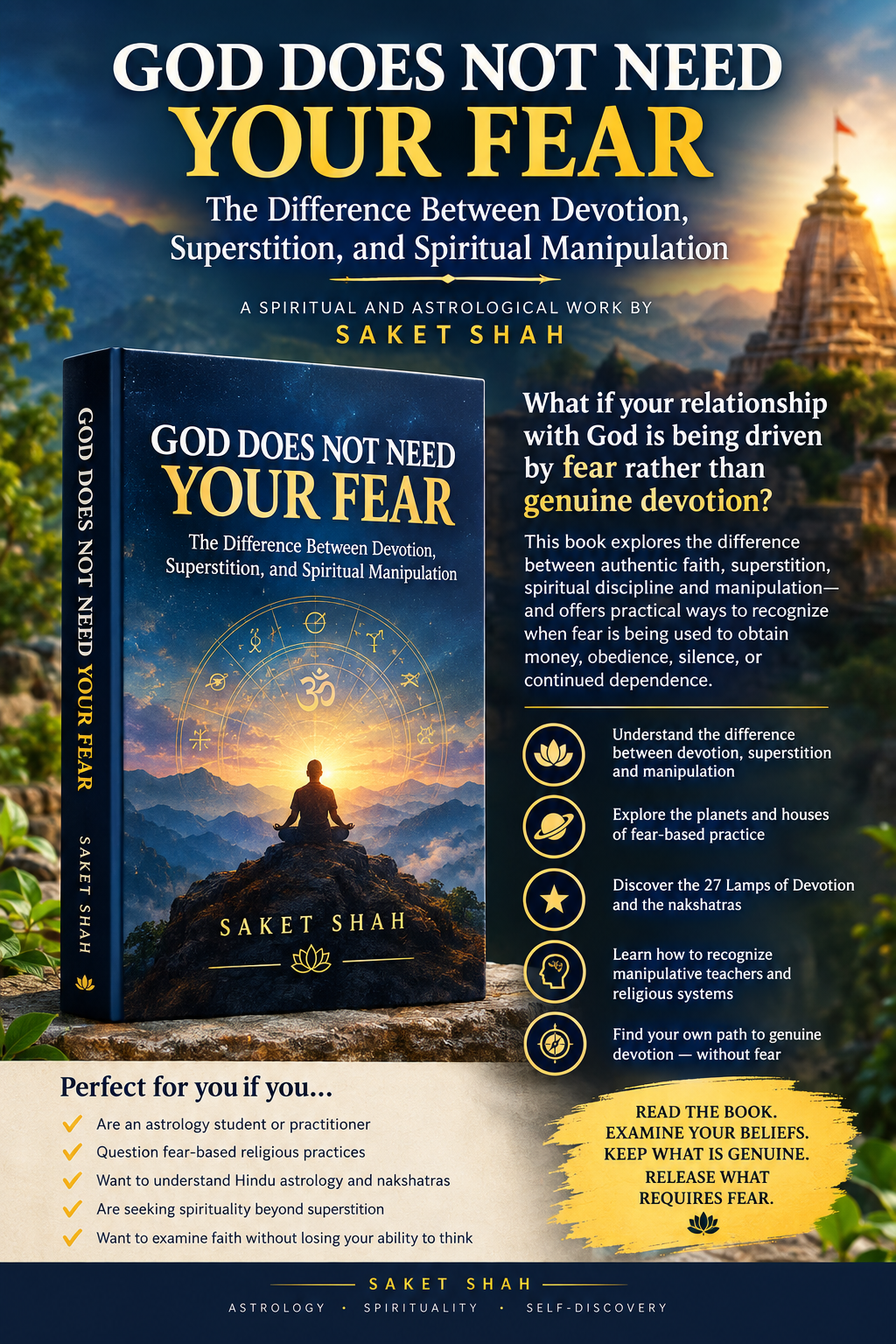
GOD DOES NOT NEED YOUR FEAR
God Does Not Need Your Fear
The Difference Between Devotion, Superstition, and Spiritual Manipulation
By Saket Shah
What if your relationship with God is being driven by fear rather than genuine devotion?
God Does Not Need Your Fear is a spiritual and astrological exploration of one of the most difficult questions in religious and spiritual life: Where does genuine devotion end and fear-based manipulation begin?
This book examines the difference between authentic faith, superstition, spiritual discipline, and manipulation—and offers practical ways to recognize when fear is being used to obtain money, obedience, silence, or continued dependence.
What You'll Discover
- Why genuine devotion does not require terror or constant fear
- The difference between devotion, superstition, and manipulation
- How Saturn can represent discipline—and how discipline can become dread
- How Rahu's hunger for certainty can be exploited through fear
- The difference between genuine renunciation and fear-driven avoidance
- How religious fear can transform into anger and hostility
- When a spiritual teacher gradually becomes more important than the divine itself
- How certainty can become a commercial product in spiritual and astrological guidance
- The Ninth House and the difference between faith and dogma
- The Twelfth House: surrender versus self-erasure
- The Eighth House and the fear of death
- How guilt can become a chronic mechanism of spiritual control
- How inherited religious fear can pass from one generation to another
- The psychology behind fear-based religious practices
- Intermittent reinforcement, sunk costs, and social pressure
- How to distinguish meaningful ritual from anxiety-driven superstition
- Practical ways to recognize manipulative teachers and traditions
- What genuine devotion can actually feel like
- The Twenty-Seven Lamps of Devotion, exploring the nakshatras through a spiritual lens
A Different Way to Think About Faith
This book does not attack reverence, humility, discipline, or sincere religious practice.
Instead, it asks a narrower and more uncomfortable question:
Are you choosing your spiritual practice freely—or are you continuing because you are afraid of what will happen if you stop?
The book argues that there is an important difference between awe and threat, between discipline and dread, between surrender and self-erasure, and between faith and unquestionable dogma.
Astrology Meets Spiritual Ethics
Using the symbolism of planets and houses, this work explores how spiritual fear can manifest through familiar astrological themes.
Saturn becomes a lens for examining discipline versus dread.
Rahu examines the hunger for certainty.
Ketu explores renunciation versus avoidance.
Mars examines fear, anger, and religious aggression.
The Sun explores the danger of allowing a guru to replace one's relationship with the divine.
Jupiter examines what happens when wisdom becomes the commercial sale of certainty.
The book then moves into the houses of belief and the psychology of spiritual manipulation.
For Readers Who Have Ever Questioned Their Faith
This book is especially relevant if you have ever wondered:
“Am I devoted—or simply afraid?”
“Is this ritual meaningful, or am I afraid not to perform it?”
“Is this teacher helping me become independent, or more dependent?”
“Why does questioning this teaching feel dangerous?”
“Why does every solution seem to require another ritual, payment, or intervention?”
These questions form the heart of the book.
The 27 Lamps of Devotion
The journey eventually turns toward the twenty-seven nakshatras, presenting each as a different lamp of devotion.
From Ashwini to Revati, the nakshatras become a framework for exploring spiritual qualities, devotion, and the movement from fear toward a more genuine relationship with the sacred.
Who Is This Book For?
This book is for:
- Astrology students and practitioners
- Spiritual seekers
- Readers questioning fear-based religious practices
- People interested in Hindu astrology and nakshatras
- Readers exploring spirituality beyond superstition
- Anyone interested in the psychology of religious manipulation
- Teachers, practitioners, and spiritual communities interested in ethical guidance
- Readers who want to examine faith without abandoning thoughtful inquiry
Your Faith Should Not Require Fear
A central idea of this book is simple:
Fear can produce compliance. It cannot, by itself, produce genuine devotion.
If a spiritual practice continually leaves you frightened, dependent, guilty, or convinced that you must keep paying, obeying, or seeking another remedy to remain safe, it may be time to examine what is really happening.
This book invites you to examine that relationship honestly.
Not with rebellion.
Not with blind obedience.
But with discernment.
Get Your Copy
God Does Not Need Your Fear invites you to question fear without abandoning spirituality, and to seek devotion without surrendering your ability to think, question, and choose.
Read the book. Examine your beliefs. Keep what is genuine. Release what requires fear.
By Saket Shah
Keywords: astrology, spiritual awakening, spirituality, Hindu astrology, Vedic astrology, nakshatra, faith, devotion, superstition, spiritual manipulation, religious fear, guru manipulation, spiritual abuse, astrology books, spiritual growth, Saturn astrology, Rahu astrology, Ketu astrology, Jupiter astrology, Ninth House astrology, Twelfth House astrology, Eighth House astrology, spiritual psychology, religious psychology, spiritual ethics, genuine devotion, fear based religion