
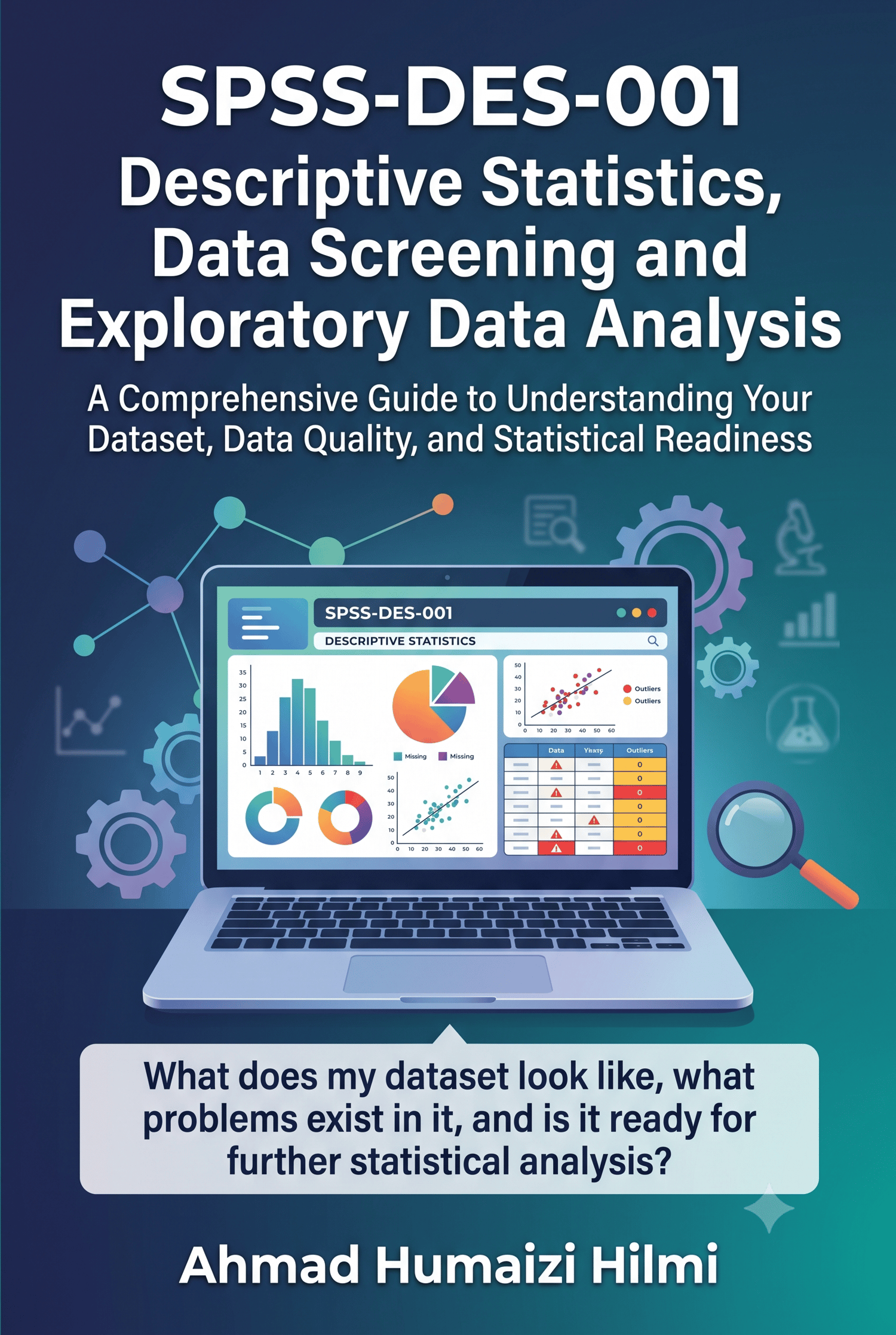
SPSS-DES-001 Descriptive Statistics, Data Screening and Exploratory Data Analysis
Assalamualaikum and good day for you all.
The intention of this master prompt is to help you make draft papers that suitable for your study needs. Frequently journal submissions are being rejected because of inadequate facts and also because of improper writing styles. I had studied papers related to the Master Prompt themes and make the master prompt for it. It is hope that the generated contents may help your research planning in doing experiments, inserting equations, tables, graphs and etc. It is also hope that the journal submission may be accepted at first time.
How to use this book
1. Upload your research proposal into your favourite A.I such as Chatgpt or Gemini or others.
2. Copy the section Prompt one by one beginning with abstract until conclusion. Save the results into Word document
3. The complete contents is the draft for your paper which you may submit for journal submission and others. Revise it, put related figures, tables, graphs, equations, charts as suggested by the prompts.
This is the Master Prompt Series on SPSS . The book that you purchase is a part of Master Prompt for SPSS . The list of other Master Prompts are as below
SPSS-DES-001 — Descriptive Statistics, Data Screening and Exploratory Data Analysis
This Master Prompt helps researchers understand their data before performing advanced statistical analysis. It guides the researcher through checking missing data, unusual values, outliers, data distributions, means, standard deviations, frequencies, and percentages. In simple terms, it answers: “What does my dataset look like, and is it ready for further analysis?”
SPSS-PSY-002 — Questionnaire Validation, Reliability and Psychometric Scale Development
This Master Prompt is designed for researchers who develop, adapt, or validate questionnaires, surveys, scales, or measurement instruments. It helps determine whether questionnaire items consistently and accurately measure the intended concepts. Typical analyses may include Cronbach's alpha, item analysis, EFA, CFA, and validity testing. In simple terms, it answers: “Is my questionnaire reliable and valid enough to use in research?”
SPSS-CMP-003 — Group Comparison Using t-Tests, ANOVA and Post-Hoc Analysis
This Master Prompt helps researchers determine whether two or more groups are statistically different. For example, a researcher may compare performance between male and female participants, three teaching methods, or several manufacturing conditions. It guides the selection and interpretation of t-tests, ANOVA, and post-hoc tests. In simple terms, it answers: “Are these groups really different, or could the differences have occurred by chance?”
SPSS-COR-004 — Correlation, Association and Relationship Analysis
This Master Prompt helps researchers investigate whether two or more variables are related. It can examine the strength and direction of relationships using techniques such as Pearson or Spearman correlation. For example, researchers could investigate whether workload increases with stress or whether temperature is associated with surface roughness. In simple terms, it answers: “When one variable changes, is another variable also likely to change?”
SPSS-REG-005 — Multiple, Hierarchical and Predictive Regression Analysis
This Master Prompt helps researchers identify which variables influence or predict an outcome. Regression can examine several predictors simultaneously and determine their individual contributions to the dependent variable. It can also show how much variation in the outcome is explained by the model. In simple terms, it answers: “Which factors are important predictors of my outcome, and how strong is their influence?”
SPSS-MEDMOD-006 — Mediation, Moderation and Conditional Process Analysis Using PROCESS
This Master Prompt is intended for more complex relationships between variables. Mediation investigates how or why one variable affects another, while moderation investigates when, for whom, or under what conditions that relationship changes. SPSS PROCESS can be used for these analyses. In simple terms, it answers: “How does X affect Y, and does another variable explain or change that relationship?”
SPSS-FASEM-007 — Factor Analysis, Structural Equation Modelling and SPSS AMOS
This Master Prompt helps researchers test complex theoretical models involving several constructs and relationships. Factor analysis can establish how observed questionnaire items represent underlying constructs, while SEM can test multiple relationships simultaneously. SPSS and AMOS are commonly combined for this purpose. In simple terms, it answers: “Does my theoretical model fit the data, and are the proposed relationships between constructs supported?”
SPSS-PCA-008 — Principal Component Analysis, Dimension Reduction and Index Development
This Master Prompt helps researchers simplify datasets containing many related variables. Principal Component Analysis (PCA) combines correlated variables into a smaller number of meaningful components. These components can also support the development of composite scores or indices. In simple terms, it answers: “Can I reduce many variables into a smaller number of meaningful components without losing too much information?”
SPSS-SURV-009 — Survival Analysis, Kaplan–Meier and Cox Proportional Hazards Regression
This Master Prompt is designed for studies where researchers are interested in how long it takes before a particular event occurs. The event might be death, disease recurrence, equipment failure, customer withdrawal, or another defined outcome. Kaplan–Meier analysis estimates survival patterns, while Cox regression investigates factors affecting event risk. In simple terms, it answers: “How long until an event occurs, and what factors increase or decrease its risk?”
SPSS-PRED-010 — Statistical Prediction, Classification, ROC Analysis and Time-Series Forecasting
This Master Prompt focuses on using statistical data to predict future outcomes or classify cases. Depending on the research problem, researchers may evaluate predictive accuracy, sensitivity, specificity, ROC curves, AUC, classification performance, or forecasting errors. In simple terms, it answers: “Can my statistical model accurately predict an outcome, classify cases, or forecast what will happen next?”