

Trauma-Informed Conversations: Everyday Practice in Homeless Services
Rich Los Angeles context. Skills that work wherever you practice.
Built for homeless-services staff in any US city or county, with Los Angeles as the worked example.
A self-paced field guide and toolkit for frontline and supervisory staff in shelter and interim housing, outreach, case management, housing navigation, drop-in, coordinated entry access points, prevention and peer roles. It turns "trauma-informed" from a training word into everyday conversations: how you explain what happens next, offer real choices, ask a hard question, carry out a required check, and stay steady with someone who is overwhelmed, without diagnosing anyone, asking for anyone's story, or doing therapy. Published by Homeless Services Learning Lab Foundation (California). Edition 1.0, October 2026.
What you'll be able to do
- Explain SAMHSA's concept of trauma and its six principles in plain terms, what trauma-informed care isn't, and where your role ends and a clinician's begins.
- Use what ACE research shows about populations without turning it into a screening tool or a label.
- Offer choices you can honor, handle waits honestly, and say plainly what isn't negotiable and why.
- Ask only the questions a task needs, explain why and who sees the answer, and accept "I'd rather not say".
- Carry out bag checks, room checks and rule conversations so they're authorized, predictable, private and fair.
- Support someone in distress with psychological first aid principles and optional grounding, link them to qualified help, and call 911 at once in an emergency.
Included in the download
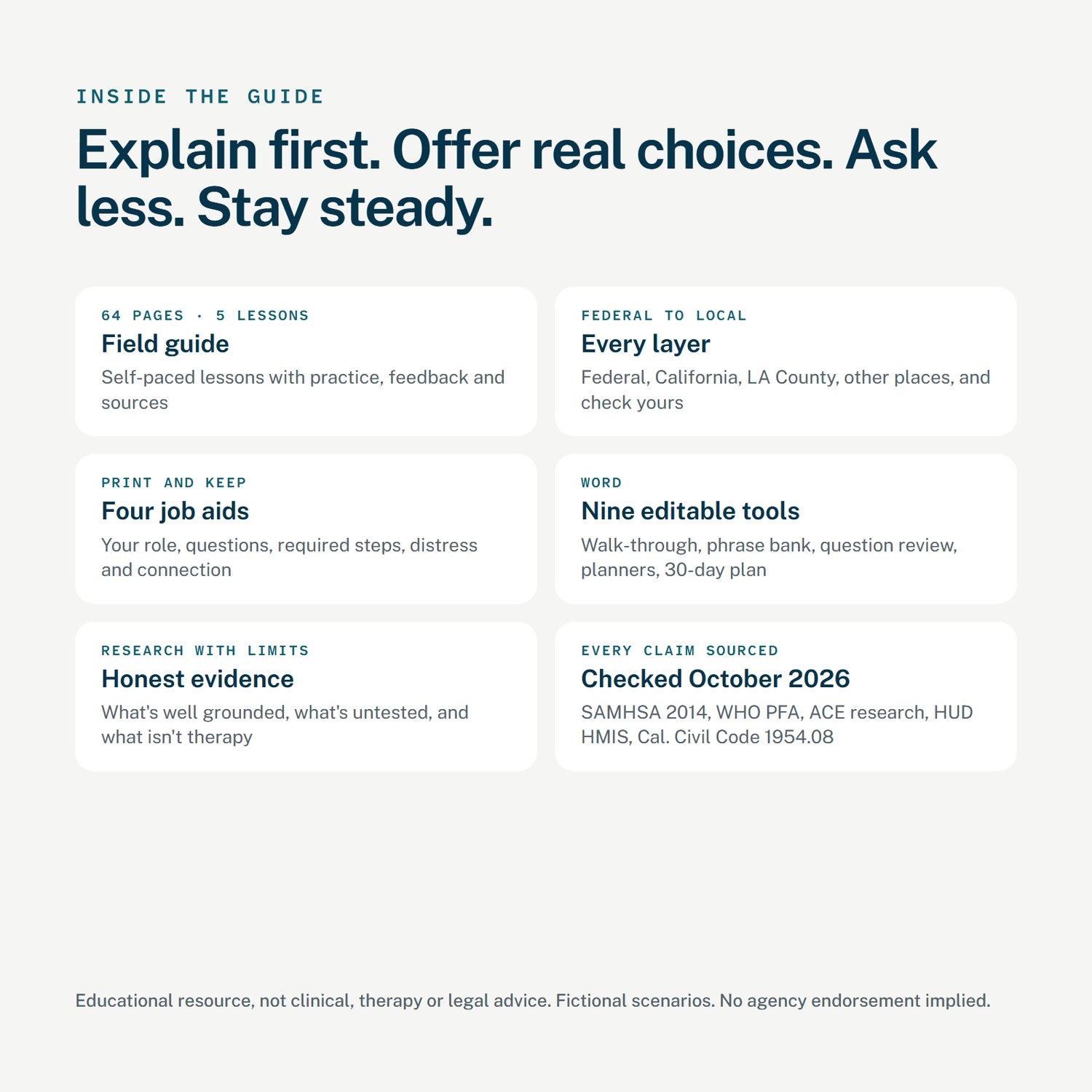
- 64-page field guide with five lessons. Each lesson has a layer-by-layer view (federal, California, LA County, other places such as Washington, D.C. and rural Balance-of-State CoCs in Texas and Nebraska, and "check yours"), a worked decision, practice scenarios with model answers, a self-check with feedback, and numbered sources.
- Four printable one-page job aids and a Check Yours worksheet (PDF and Word).
- Nine editable Word practice tools with a printable PDF: routine walk-through, real-choices phrase bank, intake question review, explaining information use, authorized checks planner, rule-with-a-reason planner, brief support and connection planner, peer observation and feedback, and a practice rubric with a 30-day plan.
- Start Here and the license for the tier you choose. (No spreadsheet: this is a conversation skill, and the practice plan lives in Word.)
License tiers
- Individual (1 user): $49
- Program / Site Team (15 named users): $199
- Agency / Multi-site (50 named users): $499
Before you buy
- Sources: built on 99 research, guidance and legal claims, each traced to its source; SAMHSA's 2014 trauma guidance and the laws and regulations used were read in full, and research was checked against the published record (some studies from their abstracts, as each source note says). Key sources: SAMHSA's Concept of Trauma and Guidance for a Trauma-Informed Approach (2014) and its 2023 practical guide, WHO's Psychological First Aid guide, the ACE Study and a meta-analysis of ACEs among adults experiencing homelessness, Cochrane evidence on psychological debriefing, HUD's FY 2026 HMIS Data Standards and coordinated entry notice, California's interim-housing law (Civil Code §§1954.08–1954.09) and Housing First law (W&I Code §8255), and Washington, D.C.'s shelter client-rights law.
- Honest about evidence: trauma-informed care is well-grounded guidance, but its outcome research in homeless services is thin, and grounding by non-clinical staff hasn't been tested. The guide says so.
- What it isn't: clinical, therapy, legal or HR advice, a certification, or a replacement for your agency's policies, contracts or required training. No agency endorsement is implied. The scenarios are fictional.
- Related HSLL toolkits: Participant Support & Difficult Situations (de-escalation, emergencies, disclosures) and Rules, Rights and Fair Exits (exits and grievances).
- Accessibility: the PDFs aren't certified PDF/UA accessible. The worksheet and tools are also supplied in Word.
Downloadable digital resource.