
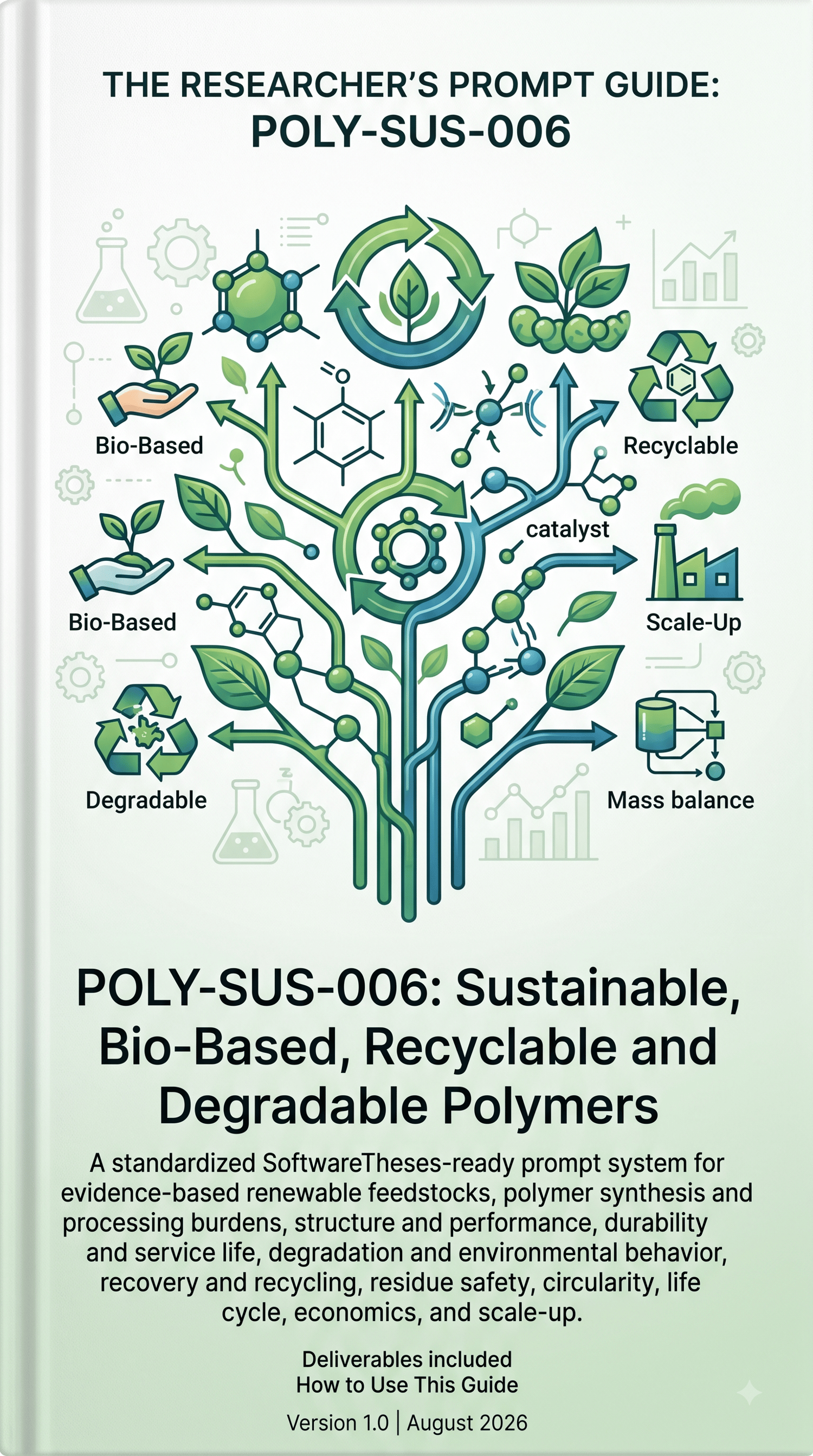
POLY-SUS-006: Sustainable, Bio-Based, Recyclable and Degradable Polymers
POLY-SUS-006: Sustainable, Bio-Based, Recyclable and Degradable Polymers
PURPOSE: A standardized SoftwareTheses-ready prompt system for evidence-based renewable feedstocks, polymer synthesis and processing burdens, structure and performance, durability and service life, degradation and environmental behavior, recovery and recycling, residue safety, circularity, life cycle, economics, and scale-up.
Deliverables included
1. One comprehensive master prompt
2. Sixteen standardized manuscript section prompts
3. Thirty-nine conditional sustainability modules
4. Bio-based, waste-derived, degradable, recyclable, dynamic-network, controlled-lifetime, upcycling, safety, LCA, circularity, and scale-up branches
5. Continuous placeholders for 6 figures, 16 tables, 11 equations, 10 charts, and 7 diagrams
6. Anti-fabrication, claim-separation, mass-balance, functional-unit, degradation, recovery, toxicity, and system-boundary controls
Version 1.0 | August 2026
How to Use This Guide
- Upload the literature matrix, selected papers, feedstock and formulation specifications, synthesis and processing logs, characterization and performance data, aging/degradation records, recycling mass balances, product analyses, toxicity data, LCA/TEA inventories, statistics, and journal instructions.
- Paste the Master Prompt once at the beginning of the SoftwareTheses workflow.
- Generate one manuscript section at a time using its corresponding Section Prompt.
- Replace every [INFORMATION REQUIRED] with verified information and every [Ref] with a traceable source.
- Activate only modules supported by the actual study; retain low yields, incomplete degradation, unidentified products, property loss, virgin reconstruction inputs, and unfavorable burdens when they define boundaries.
- Complete the final audit across sample codes, origin and composition bases, functional unit, system boundary, test environments, mass balances, products, claims, and placeholder numbering.