
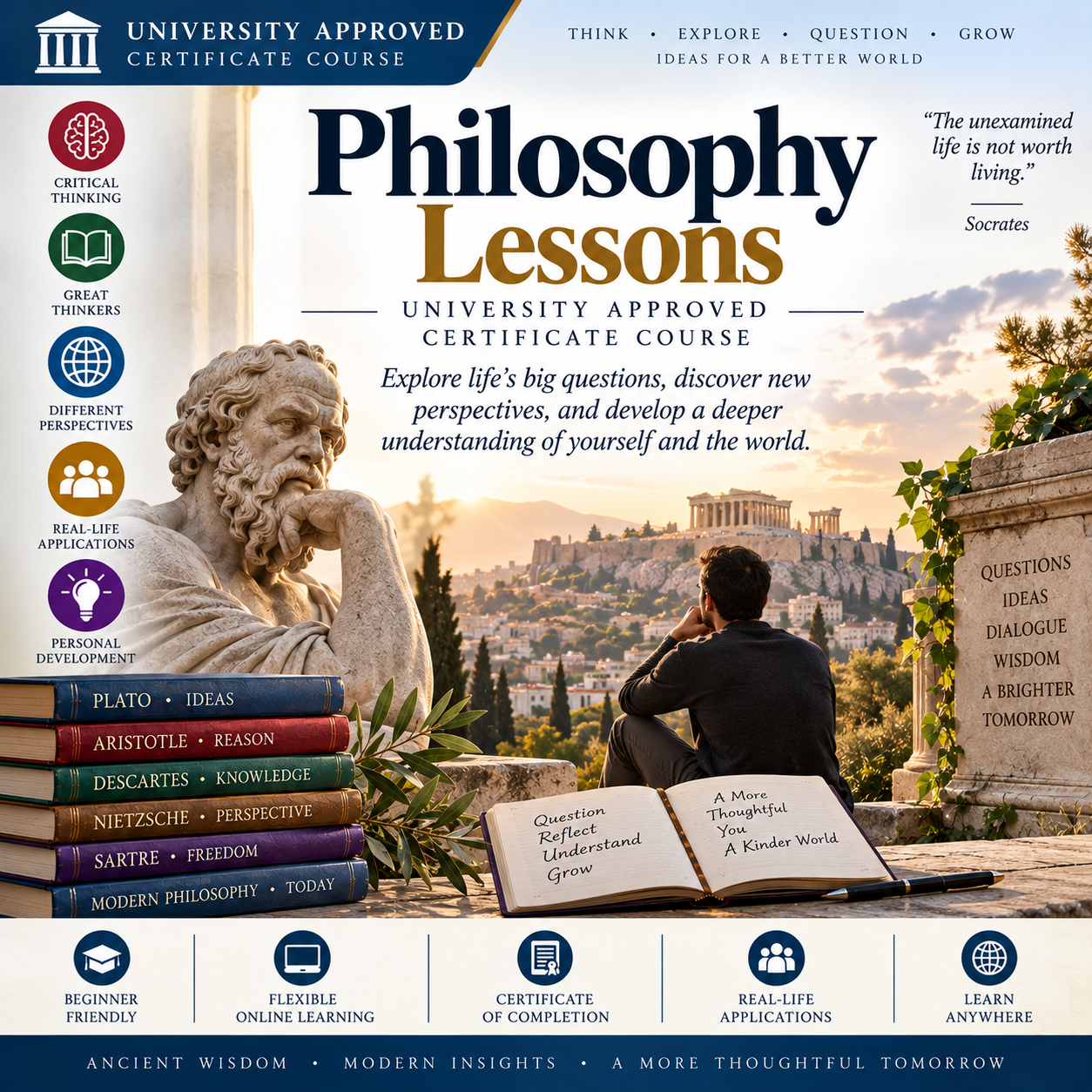
Philosophy Lessons University Approved Certificate Course
Philosophy Lessons – University Approved Certificate Course
Explore the Great Questions of Life, Develop Critical Thinking, and Discover New Perspectives
Philosophy begins with questions.
What is truth?
What is knowledge?
What makes an action right or wrong?
What is justice?
What does it mean to live a good life?
Are human beings truly free?
What is the relationship between the mind and the body?
How should society be organised?
What gives life meaning?
The Philosophy Lessons – University Approved Certificate Course provides a structured and accessible introduction to the ideas, questions, arguments, thinkers, and traditions that have shaped philosophy across centuries.
This online course is designed for beginners as well as learners who want to strengthen their critical thinking, reasoning, analytical, and reflective skills.
No previous academic study of philosophy is required.
Whether you are studying for personal development, continuing education, academic preparation, professional growth, or simply because you enjoy exploring important ideas, this course offers an engaging starting point.
What Is Philosophy?
Philosophy is traditionally associated with the “love of wisdom.”
It is the systematic exploration of fundamental questions concerning:
- Knowledge
- Reality
- Truth
- Morality
- Justice
- Consciousness
- Freedom
- Human nature
- Society
- Politics
- Religion
- Beauty
- Meaning
- Reason
Philosophy does not simply provide ready-made answers.
Instead, it teaches us how to examine questions more carefully.
It encourages us to identify assumptions, evaluate arguments, compare perspectives, consider evidence, and develop more reasoned conclusions.
What You Will Learn
Throughout the course, you will explore topics such as:
- Introduction to philosophy
- Philosophical thinking
- History of philosophy
- Ancient philosophy
- Major philosophers
- Logic
- Critical thinking
- Ethics
- Metaphysics
- Epistemology
- Political philosophy
- Philosophy of mind
- Philosophy of religion
- Aesthetics
- Existential questions
- Freedom and responsibility
- Truth and knowledge
- Human nature
- Meaning and purpose
- Philosophy in everyday life
The course combines historical perspectives with practical philosophical thinking.
Learning to Think Philosophically
Philosophical thinking begins when we stop accepting ideas automatically.
Instead, we ask questions such as:
- Why do I believe this?
- What evidence supports this belief?
- Is the argument logically consistent?
- Could there be another explanation?
- What assumptions are being made?
- Are there weaknesses in the reasoning?
- What are the consequences of this idea?
These questions can help us think more carefully in both academic and everyday situations.
The History of Philosophy
Philosophy has developed across many cultures and historical periods.
The course introduces learners to major stages in philosophical thought, which may include:
- Ancient philosophy
- Classical Greek philosophy
- Hellenistic philosophy
- Medieval philosophy
- Renaissance thought
- Enlightenment philosophy
- Modern philosophy
- Contemporary philosophy
Understanding historical context helps learners see why certain philosophical questions emerged and how ideas developed over time.
Socrates and the Power of Questions
Socrates remains one of the most influential figures in philosophy.
He became famous not for providing simple answers, but for asking questions.
The Socratic method encourages people to examine beliefs through dialogue and careful questioning.
This approach can help learners:
- Clarify ideas
- Identify contradictions
- Examine assumptions
- Develop stronger arguments
- Improve critical thinking
The method remains relevant in education, law, leadership, communication, and personal development.
Plato and the World of Ideas
Plato explored fundamental questions about:
- Knowledge
- Justice
- Reality
- Education
- Politics
- Virtue
- Leadership
- Society
His work continues to influence philosophy and political thought.
Learners will be introduced to selected Platonic ideas and their historical significance.
Aristotle and Reason
Aristotle contributed to many areas of human knowledge.
His work influenced:
- Logic
- Ethics
- Politics
- Metaphysics
- Biology
- Rhetoric
- Psychology
- Education
The course introduces learners to selected Aristotelian concepts and explains why his work became so influential.
Descartes and the Question of Knowledge
René Descartes is strongly associated with modern philosophical questions concerning certainty and knowledge.
Learners will explore questions such as:
- What can we know with certainty?
- Can our senses deceive us?
- How do we distinguish reality from appearance?
- What is the relationship between mind and body?
These questions remain important in contemporary philosophy.
Modern Philosophical Perspectives
The course also introduces later philosophical developments.
Depending on the lessons, learners may encounter ideas associated with thinkers such as:
- Immanuel Kant
- John Locke
- David Hume
- Friedrich Nietzsche
- Jean-Paul Sartre
- John Stuart Mill
The aim is not to memorise every philosopher.
Instead, learners are encouraged to understand major questions and compare different approaches.
Logic and Reasoning
Logic is one of the most important tools in philosophy.
It helps us examine whether conclusions follow reasonably from premises.
Learners will explore ideas such as:
- Arguments
- Premises
- Conclusions
- Validity
- Consistency
- Deductive reasoning
- Inductive reasoning
- Contradictions
- Logical fallacies
These skills can be applied far beyond philosophy.
Critical Thinking
Critical thinking involves evaluating information carefully rather than accepting claims automatically.
It may include:
- Evaluating evidence
- Recognising bias
- Identifying assumptions
- Comparing explanations
- Testing arguments
- Distinguishing fact from opinion
- Considering alternative viewpoints
Critical thinking is useful in:
- Education
- Business
- Management
- Politics
- Journalism
- Research
- Law
- Communication
- Everyday decision-making
Logical Fallacies
People often use arguments that sound persuasive but contain errors in reasoning.
Learners may explore fallacies such as:
- Ad hominem
- Straw man
- False dilemma
- Hasty generalisation
- Circular reasoning
- Appeal to authority
- Slippery slope
- Emotional reasoning
Recognising fallacies can help learners evaluate arguments more effectively.
Ethics
Ethics examines questions about right and wrong.
Important questions include:
- What makes an action morally right?
- Should consequences determine morality?
- Do people have moral duties?
- What is virtue?
- Are moral principles universal?
- What makes a good life?
The course introduces learners to approaches such as:
- Virtue ethics
- Deontology
- Consequentialism
- Utilitarianism
- Moral relativism
These approaches provide different ways of examining ethical problems.
Moral Dilemmas
Philosophy becomes especially interesting when different values come into conflict.
Learners may consider questions involving:
- Honesty
- Loyalty
- Justice
- Responsibility
- Freedom
- Harm
- Rights
The purpose is not always to find one simple answer.
Instead, philosophical analysis helps learners understand the reasoning behind different positions.
Metaphysics
Metaphysics explores the nature of reality.
Questions may include:
- What does it mean to exist?
- What is reality?
- What is time?
- What is causation?
- What creates personal identity?
- Is free will possible?
- What is the relationship between mind and matter?
These are among philosophy’s oldest and deepest questions.
Epistemology
Epistemology is the study of knowledge.
It asks:
- What is knowledge?
- What is belief?
- What counts as evidence?
- Can we trust our senses?
- How certain can we be?
- What is the difference between knowledge and opinion?
These questions are increasingly important in a world filled with large amounts of information.
Truth
What does it mean for something to be true?
Can truth be objective?
Can people experience the same event differently?
How should conflicting claims be evaluated?
Philosophy helps learners approach these questions systematically rather than relying only on intuition.
Political Philosophy
Political philosophy asks how society should be organised.
Topics may include:
- Justice
- Liberty
- Equality
- Rights
- Authority
- Government
- Democracy
- Citizenship
- Responsibility
- Power
Many modern political debates are connected to philosophical questions developed centuries ago.
Philosophy of Mind
The philosophy of mind examines questions such as:
- What is consciousness?
- What is the mind?
- Are thoughts physical?
- What creates identity?
- How does the brain relate to subjective experience?
These questions connect philosophy with psychology, neuroscience, cognitive science, and artificial intelligence.
Philosophy of Religion
Philosophy of religion examines religious ideas through philosophical reasoning.
Topics may include:
- Faith and reason
- Arguments concerning God
- Religious experience
- Free will
- Morality
- The problem of evil
- Religious knowledge
The course approaches these questions academically and respectfully.
Aesthetics
Aesthetics is the branch of philosophy concerned with art and beauty.
Questions may include:
- What is beauty?
- What makes something art?
- Is artistic value objective?
- Why do tastes differ?
- Can art communicate truth?
Aesthetics connects philosophy with:
- Painting
- Music
- Literature
- Architecture
- Film
- Design
Existential Questions
Philosophy also deals with questions concerning existence.
These may include:
- What gives life meaning?
- What is freedom?
- What is responsibility?
- How should we respond to uncertainty?
- How do people create meaning?
Existential philosophy encourages learners to reflect on personal responsibility, choice, identity, and meaning.
Freedom and Responsibility
Are human beings genuinely free?
If our decisions are influenced by:
- Biology
- Environment
- Culture
- Family
- Education
- Society
then how should responsibility be understood?
These questions connect philosophy with psychology, law, ethics, and religion.
Philosophy and Human Nature
Philosophers have long debated what human beings are fundamentally like.
Questions include:
- Are people naturally cooperative?
- Are people naturally selfish?
- How much does society shape behavior?
- What makes people moral?
- What is human dignity?
Different philosophical traditions provide different answers.
Philosophy and Society
Philosophy can help us examine questions involving:
- Justice
- Equality
- Social responsibility
- Technology
- Education
- Authority
- Freedom
- Human rights
Understanding philosophical ideas can help learners participate more thoughtfully in social debates.
Philosophy in Everyday Life
Philosophy is not limited to universities.
We encounter philosophical questions every day.
For example:
Should I always tell the truth?
What makes a decision fair?
What responsibilities do I have toward others?
When should individual freedom be limited?
What does success mean?
How should I respond to disagreement?
What kind of life do I want to live?
Philosophical thinking can help us approach these questions more carefully.
Philosophy and Personal Development
Studying philosophy can support:
- Self-reflection
- Critical thinking
- Intellectual curiosity
- Clear communication
- Better questioning
- Greater awareness of assumptions
- More thoughtful decision-making
- Openness to different perspectives
Philosophy does not necessarily tell you what to think.
It helps you improve how you think.
Dialogue and Debate
Philosophy has a strong tradition of dialogue.
Constructive philosophical discussion involves:
- Listening
- Asking questions
- Giving reasons
- Examining evidence
- Respecting disagreement
- Revising views when appropriate
The ability to disagree thoughtfully is a valuable intellectual and professional skill.
Building Stronger Arguments
The course helps learners recognise the basic structure of arguments.
A strong argument should ideally involve:
- Clear claims
- Relevant reasons
- Logical consistency
- Appropriate evidence
- Awareness of objections
Learning how to construct arguments can improve both speaking and writing.
Questioning Assumptions
Many beliefs are based on assumptions we rarely examine.
Philosophical reflection encourages learners to ask:
Why do I think this?
Where did this belief come from?
Is it supported by evidence?
Could another perspective also be reasonable?
This habit of questioning can lead to deeper understanding.
Different Perspectives
Philosophy exposes learners to ideas that may challenge their existing beliefs.
This does not mean accepting every viewpoint.
It means learning to understand different positions before evaluating them.
Engaging with different perspectives can strengthen intellectual independence.
Who Is This Course For?
This course may be suitable for:
- Complete beginners
- Philosophy students
- Psychology students
- History students
- Political science students
- Theology students
- Teachers
- Writers
- Researchers
- Managers
- Leaders
- Lifelong learners
- Personal development enthusiasts
- Anyone interested in ideas and critical thinking
No previous philosophy qualification is required.
Beginner Friendly
The course has been designed to introduce concepts progressively.
Learners do not need to understand complex philosophical terminology before beginning.
Important ideas are explained within context to help make philosophy accessible.
Flexible Online Learning
Study according to your own schedule.
The online format makes this course suitable for learners balancing education with:
- Employment
- University study
- Family responsibilities
- Professional commitments
- Other courses
You can revisit course materials whenever necessary.
What You Can Gain From This Course
By completing this course, you can develop a broader understanding of:
- Philosophical thinking
- Major philosophers
- Major philosophical traditions
- Logic
- Critical thinking
- Ethics
- Metaphysics
- Epistemology
- Political philosophy
- Philosophy of mind
- Philosophy of religion
- Aesthetics
- Existential philosophy
- Freedom
- Human nature
- Truth
- Knowledge
- Meaning
You can also develop reasoning and analytical skills applicable to many other subjects.
A Foundation for Further Study
This course may provide useful preparation for further learning in areas such as:
- Ancient philosophy
- Ethics
- Logic
- Metaphysics
- Epistemology
- Existentialism
- Political philosophy
- Philosophy of mind
- Philosophy of science
- Philosophy of religion
- Contemporary philosophy
It can also complement studies in psychology, history, politics, law, theology, literature, sociology, and education.
Professional Relevance
Philosophical skills can be useful in many professional environments.
They can contribute to:
- Analytical thinking
- Decision-making
- Problem-solving
- Written communication
- Argumentation
- Leadership
- Research
- Ethical reasoning
The subject is particularly valuable wherever people need to evaluate ideas carefully and communicate clearly.
Certificate of Completion
Learners who successfully complete the applicable course requirements may receive a Certificate of Completion for:
Philosophy Lessons – University Approved Certificate Course
The certificate may be useful for:
- CVs and résumés
- LinkedIn profiles
- Personal development portfolios
- Continuing education records
- Academic portfolios
- Professional development documentation
- Demonstrating additional learning
Course Format: Online
Level: Beginner / Introductory
Study Method: Self-Paced
Subject: Philosophy
Certificate: Available upon successful completion of applicable course requirements
Why Choose This Course?
Explore Great Ideas
Discover questions and ideas that have influenced human thought for centuries.
Develop Critical Thinking
Learn to evaluate claims, arguments, and assumptions more carefully.
Improve Reasoning
Build a stronger understanding of logic and argumentation.
Explore Different Perspectives
Encounter different approaches to truth, ethics, society, knowledge, and existence.
Practical Relevance
Apply philosophical thinking to everyday decisions and modern issues.
Beginner Friendly
No previous philosophy education is required.
Flexible Online Learning
Study according to your own schedule.
Certificate of Completion
Receive documentation of your learning upon successfully completing the applicable requirements.
Think. Explore. Question. Grow.
Philosophy reminds us that some of the most important questions do not always have simple answers.
Learning to live with complexity while still thinking clearly is one of philosophy’s greatest contributions.
The Philosophy Lessons – University Approved Certificate Course gives you the opportunity to explore major ideas, develop stronger reasoning skills, and look at familiar questions from new perspectives.
Ask better questions.
Examine assumptions.
Explore great ideas.
Strengthen your reasoning.
Develop a broader understanding of yourself and the world.
Ancient Wisdom. Modern Insights. A More Thoughtful Tomorrow.
Begin your philosophy journey today.
Important Professional Notice
This course is intended for educational and personal/professional development purposes.
Completion of this course does not by itself confer a formal academic degree, regulated professional licence, or professional philosopher qualification where additional institutional or jurisdictional requirements apply.
Learners should verify any academic recognition, credit-transfer, employment, or professional requirements relevant to their own country, institution, or intended use of the certificate.