

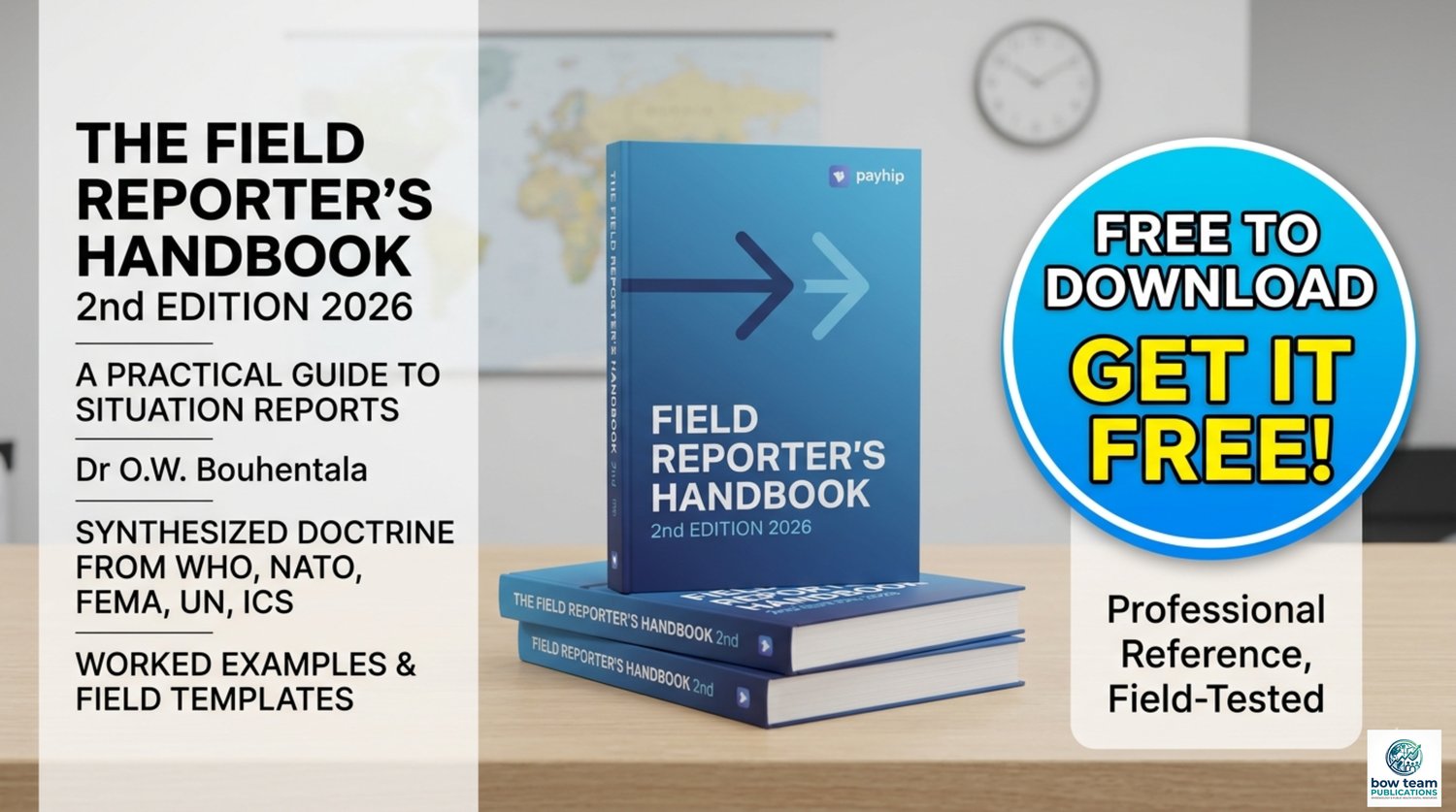
THE FIELD REPORTER'S HANDBOOK: A Practical Guide to Writing Situation Reports
🎁 FREE DOWNLOAD — No account required. No payment. Yours forever.
━━━━━━━━━━━━━━━━━━━━━━━━━━━━━━━━━━━━━
You've been handed a blank report template and a 2-hour deadline.
The situation is moving. The minister is waiting. The data is incomplete.
What do you write first?
If that sentence made you uncomfortable — this guide was written for you.
──────────────────────────────────────
📘 WHAT YOU'RE DOWNLOADING
──────────────────────────────────────
The Field Reporter's Handbook is a 49-page professional masterclass on writing Situation Reports (SitReps) — the high-stakes operational documents used by WHO, FEMA, NATO, UN agencies, public health directorates, NGOs, humanitarian organizations, and corporate crisis teams to brief decision-makers during active events.
Written by a practicing physician-epidemiologist with field experience in outbreak investigation and operational reporting — not assembled from a textbook, not generated by an algorithm. This is the guide that didn't exist when it was needed most.
Available in both PDF (print-ready)
──────────────────────────────────────
📑 WHAT'S INSIDE — ALL 5 PARTS
──────────────────────────────────────
▸ PART I — FOUNDATIONS
What a SitRep actually is (and what it's not). The four reader types and what each one needs. The five principles of operational writing — BLUF, Precision, Parsimony, Confidence, Time-Discipline. Beginner-friendly, with no assumed knowledge.
▸ PART II — STRUCTURE & ANATOMY
The nine canonical sections used across WHO, OCHA, FEMA, ICS, and NATO — with a worked example for each. The complete header fields. The four-sentence Executive Summary formula. Essential epidemiological metrics (Attack Rate, CFR, Incidence vs. Cumulative, Trend Interpretation, Escalation Triggers). Data visualization rules for epi curves, maps, and tables.
▸ PART III — THE CRAFT
How to produce a publishable draft in 45 minutes. The full language-upgrade table (weak vs. strong phrasing). The five confidence levels (confirmed / reported / suspected / assessed / possible). A dedicated chapter on writing under institutional pressure — uncertain data, hierarchy softening, conflicting sources. The ten recurring failures and how to stop making them.
▸ PART IV — FIELD EXAMPLES
Four full-length, annotated Situation Reports ready to adapt:
• Cholera outbreak (public health / DSP context)
• Industrial chemical release (HSE / corporate)
• Flash flood displacement (NGO / humanitarian)
• Data breach (corporate crisis)
▸ PART V — TEMPLATES & TOOLKIT
• Fillable Master Template — print and use today
• Expanded Annex Templates: epi curve spec, 3W matrix, methodology note
• 20-item Pre-Send Checklist
• Four-tier Escalation Matrix
• Operational glossary & doctrinal references
──────────────────────────────────────
👤 WHO IS THIS FOR?
──────────────────────────────────────
✔ Epidemiologists and public health officers writing outbreak SitReps
✔ Field coordinators and team leads in NGOs and humanitarian organizations
✔ Health ministry staff producing ministerial briefings
✔ Emergency managers (FEMA, civil protection, crisis cells)
✔ Corporate communications and crisis management teams
✔ WHO, UNICEF, OCHA, MSF, Red Cross staff
✔ Military and government operations liaisons
✔ Medical students and MPH candidates building reporting skills
✔ Anyone who has ever stared at a blank report template at 23:00
If your job puts information in front of decision-makers — this guide is for you.
──────────────────────────────────────
📄 FORMAT & DELIVERY
──────────────────────────────────────
• PDF — 49 pages, A4, print-ready, monochrome
• Instant download — no waiting, no sign-up required
• One-time download — yours to keep, share with your team, print
──────────────────────────────────────
💡 WHY FREE?
──────────────────────────────────────
Because a badly written SitRep during an active outbreak delays a decision that could save lives. This knowledge should not sit behind a paywall.
If this guide earns its place in your workflow — share it with a colleague. That's the only ask.
────────────────────