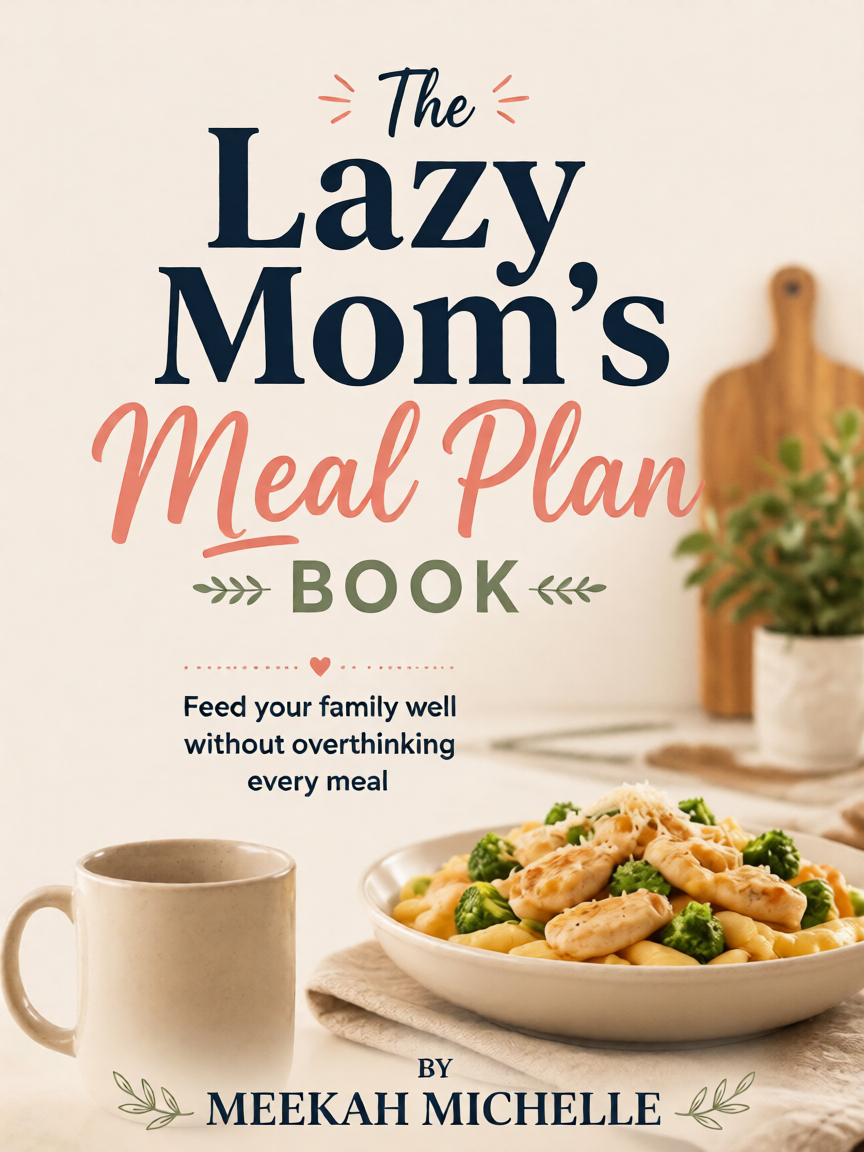
The Lazy Mom's Meal Plan
Feed your family without the 5 o'clock panic — even on the days you have nothing planned
WHAT THIS IS
"The Lazy Mom's Meal Plan" is a short, honest system for the mom who stands in front of an open fridge at 5:40, still in her work clothes, wondering how this became the hardest part of her whole day — and who's starting to suspect the problem isn't her cooking.
This isn't a cookbook. There are no thirty-ingredient recipes, no meal prep marathons, no photos of food styled on a marble slab. It's not another plan that assumes you have a free Sunday and a pantry full of glass containers. This book addresses the real reason dinner defeats you: you're not out of cooking skill — you're out of decisions. And nobody ever gave you a system built for the life you actually have.
Inside, you'll find:
• The Four Loads — Dinner isn't one job. It's four stacked on top of each other: deciding what to eat, tracking whether you have it, negotiating who will tolerate it, and doing the actual cooking. Most advice only aims at the cooking — but you weren't drowning in the cooking. You were drowning in the deciding, the tracking, and the negotiating. The invisible ones. The ones that happen in your head, unpaid and unseen, all day long
• The Lazy Week (The Core Method) — Instead of choosing seven dinners each week, you give each night of the week a permanent shape. Not a specific meal — a category. Monday is pasta. Tuesday is tacos. Wednesday is breakfast for dinner. When you sit down to plan, you're not answering "what should we eat Tuesday?" You're answering "which taco?" That's a much smaller question, and a smaller question is one your tired brain can handle
• The Ten-Meal Rotation — A short list of meals you already know by heart. Not new recipes. Not aspirational dinners. Ten ordinary things you've made before without reading instructions. Repetition isn't failure — it's how restaurants work, it's how kids feel safe, and it's how you stop reading recipes while something burns
• Shopping Without Thinking — A standing grocery list you reuse every week instead of rewriting from scratch. Organized by aisle so shopping becomes a single loop, not a scavenger hunt. Plus: buy doubles of the six things that ruin dinner when you run out, and the whole week gets easier
• The Bare-Minimum Plan — An emergency shelf with three no-cook dinners that nobody touches except you on the worst night. Because there must be a version of dinner that requires no cooking, no thawing, and no willpower — and without a floor, one bad night turns into a bad week
• The Deconstructed Plate Rule — The answer to the picky eater problem isn't making two dinners. It's serving one meal with parts they can choose from. Tacos are toppings. Pasta is sauce on the side. Rice bowls are a row of bowls and everyone builds their own. Plus: one sentence you say in a flat voice when someone complains, and the fight ends before it starts
• The Three Rules Behind the Method — Decide once, not nightly. Repeat on purpose. Always have a floor. Everything in this book is just those three rules made specific
• Your First Seven Days — Day 1: write seven themes on the fridge. Day 2: pick three meals under each theme. Day 3: build the standing list. Day 4: set up the emergency shelf. Day 5: do one grocery order. Day 6: cook your first themed night. Day 7: look back and notice what already changed. Not a boot camp. A setup — once — that coasts for years
The book is short on purpose — because you're reading it at five o'clock, tired, with someone asking what's for dinner. The system in here takes fifteen minutes to set up. After that, dinner stops being a question you have to answer every single night for the rest of your life.
WHO THIS IS FOR
This is for the woman who:
• Stands in front of an open fridge at 5:40 like it might tell her something, and the only thing it tells her is that the chicken she meant to thaw is still frozen solid and nobody's going to eat the thing in the container she's afraid to open
• Has tried the color-coded Sunday prep — the chopping, the little glass containers, the feeling of being on top of it — and by Wednesday the peppers have gone slimy, she ordered pizza, and she felt like a fraud
• Gets asked "what's for dinner?" before she's taken her shoes off, and feels it land like a bill she forgot to pay — not because she doesn't love them, but because answering means deciding, and she is out of decisions
• Can plan a beautiful week of dinners at ten in the morning when her battery is full, but by five o'clock that woman is gone and the one standing in the kitchen doesn't have a single choice left in her
• Has spent more mental energy on "what are we eating" than on actually eating it — tracking what's in the fridge, remembering who won't touch sauce, calculating thaw times, and maintaining a live inventory of her kitchen in her head that nobody sees and nobody counts as work
• Has bought a meal plan online with seven new recipes and a color-coded grocery list, spent more than usual, made it through Monday and Tuesday, and by Thursday was scraping wilted cilantro into the trash feeling worse than when she started
• Feels like she's running a small restaurant on top of everything else — with no menu, no prep cook, and no closing time — and then gets called lazy for serving the same thing twice
• Serves frozen pizza on a Wednesday and carries the guilt of it for three days, like one night off from cooking is a character document instead of a Wednesday
• Has a child who will eat exactly four things and somehow none of them overlap with what the other child will eat, and the idea of "one family meal" sounds like a lovely story from a book written by someone with one well-behaved toddler
• Knows she's not bad at cooking — she's bad at the everything-else: the deciding, the remembering, the negotiating, the standing-up-when-her-body-wants-to-sit-down, every single night, forever
• Is not looking for culinary inspiration. She's looking for a way to get a decent dinner on the table on a regular Tuesday without it costing her the last hour of energy she was saving for herself
If you've ever cried over a rotisserie chicken — not because you can't cook, but because dinner asked you for three more decisions you didn't have — this book was written for you.
WHY YOU SHOULD BUY THIS
Because the answer to "why is dinner so hard?" isn't "try harder." It's "stop asking your most exhausted self to make decisions."
You've been told dinner is a cooking problem. A planning problem. A discipline problem. A "just meal prep on Sunday" problem. And maybe some of those things sound right on a good day. But the real reason dinner defeats you — the reason you can plan beautifully at ten and fall apart by five — is that dinner asks you the biggest open-ended question of the day at your lowest-energy hour. Every. Single. Night. Forever.
This book moves every decision out of five o'clock and into a calm moment — once. Then it gives you a structure so those decisions never need making again. Themes so you're never choosing from nothing. Ten familiar meals instead of endless options. A grocery list you reuse instead of rewrite. A floor for the nights you have nothing left.
Here's what changes when you run this system:
✅ You stop opening the fridge hoping an answer has appeared — the theme for tonight is already decided. You're not answering "what's for dinner?" You're answering "which pasta?" And that's a question your tired brain can actually handle
✅ You stop planning seven brand-new dinners every week — you rotate ten meals you already know by heart. No new recipes. No aspirational cooking. Just familiar dinners you can make half-asleep, and that's not laziness, that's competence
✅ You stop the grocery-store scavenger hunt — a standing list organized by aisle, reused every week. Plus doubles of the six things that ruin dinner when they run out. One loop through the store, or ninety seconds on a pickup app, and you're done
✅ You stop one bad night from turning into a bad week — the emergency shelf sits there waiting. Three no-cook dinners that require nothing from you. Frozen pizza on a Wednesday isn't a failure — it's a Wednesday that got handled
✅ You stop fighting the picky eater every night — one meal with parts they can choose from. Tacos are toppings. Pasta is sauce on the side. Plus one sentence in a flat voice when someone complains, and the negotiation ends before it starts
✅ You finally understand why every meal plan you've ever tried quit by Thursday — because it was built by your ten-a.m. self for your five-p.m. self, and those are two different women with two different energy levels. This plan works specifically because it asks nothing of the woman standing in the kitchen at five o'clock
You don't need to become a woman who meal preps. You need a system built for the woman you already are. Tired at five, short on time, feeding people with opinions. This book gives you that system.
WHAT'S INCLUDED
• 8 focused chapters plus Introduction and Conclusion — from understanding why dinner feels so heavy (it's not the cooking) to running your first seven days with the Lazy Week method
• Reflection questions, journal prompts, and 3 Quick Things at the end of every chapter — five minutes with a pen, and they're where this stops being a book you read and becomes a system you run
• The One-Page Fridge Card — everything in this book, on one page. Your seven themes, your ten meals, your standing list, your emergency shelf, your one sentence, your weekly twenty minutes. Stick it where you can see it from where you stand when you open the fridge
• Questions I Get Asked Most — honest answers to: "Won't my family get bored of ten meals?" "Is it really okay to have takeout on the plan?" "I work full time and get home at six — does this still work?" "My kids eat at different times because of activities" and "I've tried meal planning three times and quit — why would this be different?"
• My Plan, Written Down — fill-in companion journal with your seven themes, your ten meals, your standing grocery list by category, your emergency shelf items, your fastest three dinners, your safe foods for the kids, and your one sentence at the table
• The 30-Day Dinner Tracker — one line a night. Mark it off if dinner happened — and dinner counts whether you cooked it, reheated it, or paid for it. Mood column, win column, and at thirty days you count the nights dinner happened. That number is the only measure that matter
You don't need to become a different person.
You just need to stop dreading dinner.
Don't wait for the Sunday that never comes. Start tonight.
Get the system and finally walk into your kitchen without dreading what it's going to ask you.