
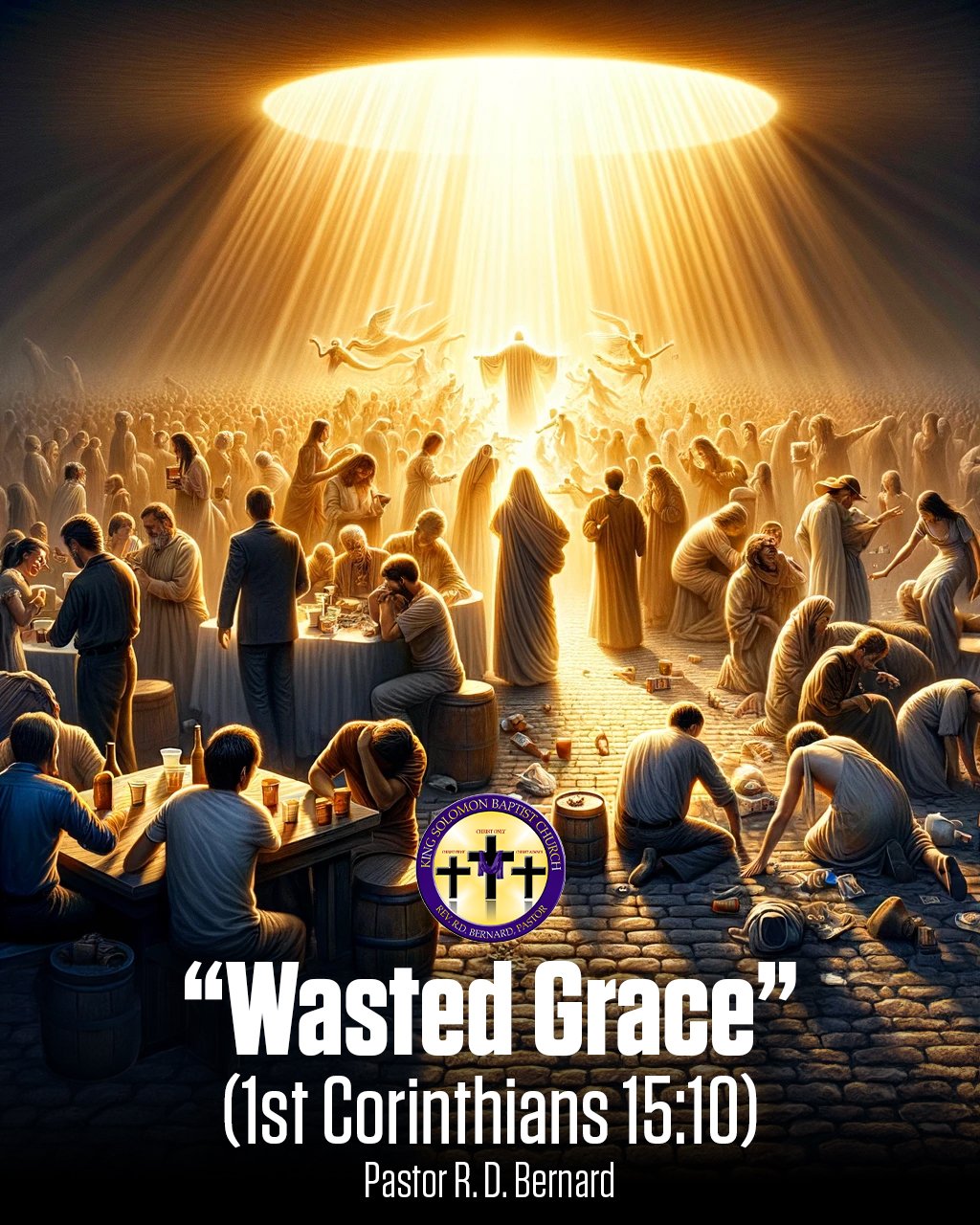
"Wasted Grace" (MP3 AUDIO)
"Wasted Grace" (1 Corinthians 15:10)
In life, there is nothing like a second chance. There is a freedom in knowing that you were guilty, you had been caught, and were sentenced to death like so many others; only to have your penalty wiped away, and a better life given back to you, as if your failings never happened (Hebrews 8:12; Psalm 103:12).
It is God's grace, His divine forbearance; His propensity toward goodness to people who don't deserve it. But some folks don't know what to do with a second (or in some cases, a third or fourth) chance. Grace, according to Paul, was wasted on them.
The Apostle Paul is often called the Apostle of Grace because of his profound emphasis on grace as the central theme of the Gospel. Grace is a new beginning. It is a second or perhaps third chance.
Now Paul's grace is not to be mistaken for the "cheap grace" that is peddled in the church of today and mediated by sinful men and women who give second chances based on their personal whims and predilections (Jude 4).
The grace of which Paul speaks is the very grace of God, which has its origins in eternity past by the predestining activities of God the Father (Ephesians 1:4). This grace is mediated by Christ the Savior and His atoning sacrifice on Calvary.
This grace has power, as it is empowered and applied to our lives by the Holy Ghost, by whose power Christ was raised from the dead (Romans 8:11). This grace is the hand of God busily working in the lives of quite ordinary, unremarkable, even evil, unthankful people. Paul's grace is all of God, but none of us. We are its intended recipients because God loves us.
It is this goodness of God, His love towards undeserving us, that should cause us to change (Romans 2:4). Do you know what to do with a second or perhaps third chance? Consider the following three points.
- God has been good to us all, but none of us deserve it.
- a. When Paul writes in 1 Corinthians 15:10, "But by the grace of God, I am what I am," he was already a pioneering trailblazer, a living legend in the early church.
- i. Whereas Peter had gained preeminence among the Jews, Paul was the apostle who was sent to the Gentiles, or rather to the remainder of the world (Romans 11:13; Galatians 2:7-8).
- ii. Though he had not seen Christ in the flesh, he was considered as being on the same level as the other Apostles (1 Corinthians 9:1-2; Ephesians 3:7-8; Galatians 1:11-12; 1 Timothy 2:7). Paul made it clear that he was second class to nobody (2 Corinthians 11:5; 12:11).
- b. Paul once persecuted the church, blasphemed Christ, and oversaw the killings of Christians (1 Timothy 1:12-15).
- i. In 1 Corinthians 15:9, Paul deprecates his own person because of the persecution he put on the church.
- ii. Acts 9:1 indicates that it was Paul, who was breathing out "threats and murder" against the disciples.
- iii. Paul was so violently against the early Christians that when God finally saved him, one of the disciples, Ananias, was told by the Lord to go help Paul, but Ananias was hesitant (Acts 9:13-14).
- c. We too have been the sexually immoral, backbiters, idolaters, scoffers, and mockers who needed God's grace, but were certainly undeserving of it (1 Corinthians 6:9-10; Romans 3:10, 23).
- i. We have fallen short of God's standard (Romans 6:23).
- ii. We also took up for others who were wrong and encouraged them in their wrongdoing (1 Corinthians 15:33).
- The grace of God is meant to make you labor for God.
- a. In Ephesians 2:8-9, Paul explained that the foundation for our new life is grace.
- b. Paul goes on in Ephesians 2:10 to explain that our response to this new life or this new beginning in the church, is labor for the Lord.
- c. In 1 Corinthians 15:10, Paul stated that the grace of God that was bestowed on him was not in vain; it was not wasted, because He worked for Christ (see also Luke 12:48).
- Grace powers and supports what remains of our lives.
- a. Paul finishes the verse under our consideration by writing that his actions after experiencing were indeed his own, but it was powered or enabled by God's grace (1 Corinthians 15:10).
- b. Paul would later say that he can do "all things" through Christ who strengthens him (Philippians 4:13).
"Christ First, Christ Only, Christ Always"