
Late Super & SGC Calculator – Payday Super Australia 2026-27
On Sale
A$15.00
A$15.00
Missed, late or wrong-fund super under Payday Super? See what it could cost, and what fixing it now saves.
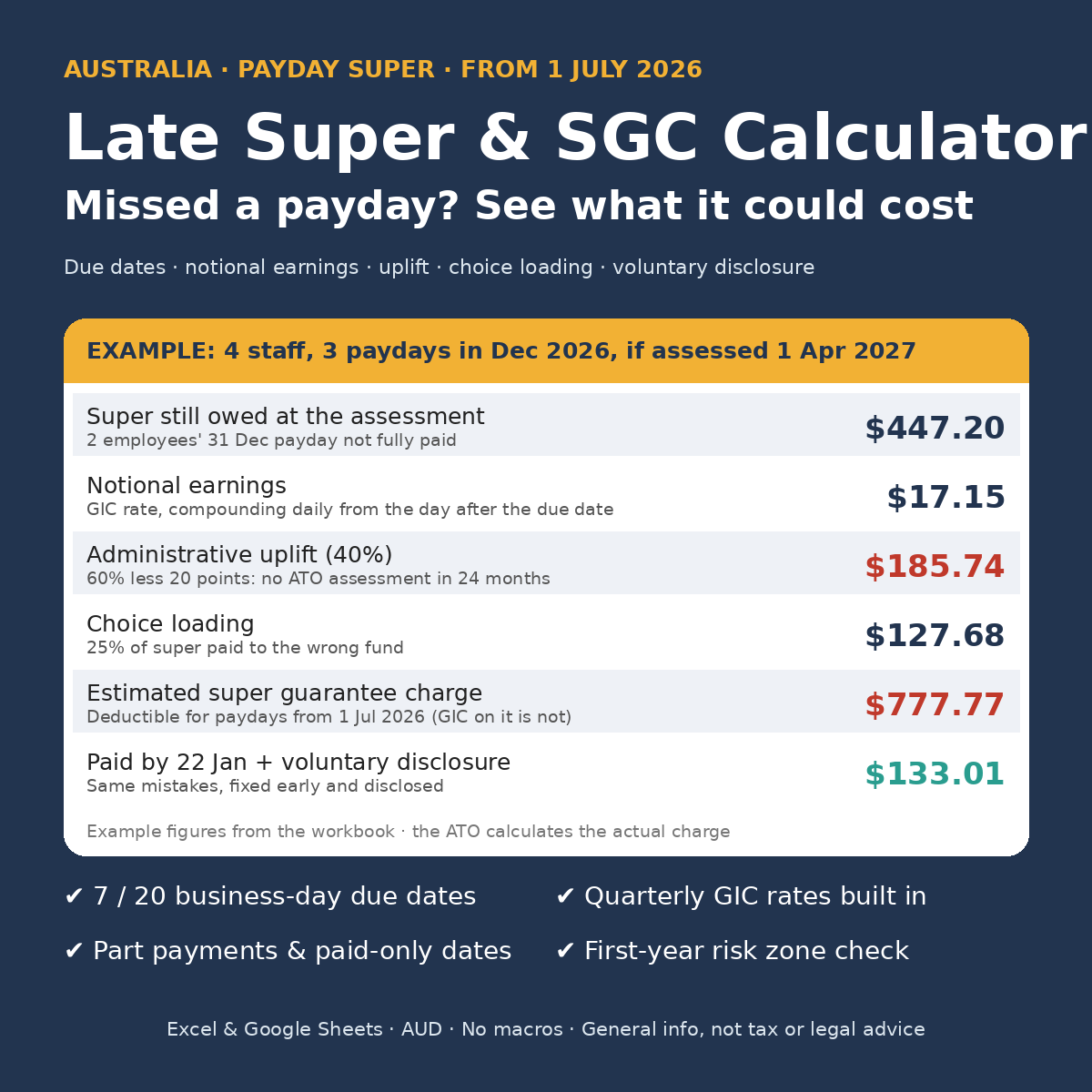
Since 1 July 2026, super has to reach each employee's fund within 7 business days of every payday. Miss it and the ATO's super guarantee charge adds up: the unpaid super, notional earnings at the GIC rate compounding daily, an administrative uplift of up to 60%, and choice loading if it went to the wrong fund. In our example, four staff and three December paydays come to about $778 if the ATO assesses in April. Paying what's owed in January and lodging a voluntary disclosure brings it to about $133.
Built for Australian small employers, bookkeepers and BAS agents in the first year of Payday Super.
What it does
- Due dates done properly: 7 business days, or 20 for a new employee, new fund or rehire, skipping weekends and whole-state public holidays (July 2026 to December 2027 built in), with the bunching rule and an override for out-of-cycle payments.
- Notional earnings: daily compounding at the ATO's quarterly GIC rates (11.43% and 11.51% built in), from the day after the due date to the day it's paid, or to the day before the assessment.
- Late and part payments: two late payments per row. If you only know the date you paid, it uses the ATO's rule (received 7 business days later).
- Administrative uplift: 60%, less 20 points with no ATO-initiated assessment in the last 24 months, less up to 40 points for a voluntary disclosure, depending on how many days after the payday you lodge.
- Choice loading: 25% of super paid to the wrong fund, capped at $1,200 per employee per notice period.
- The total: charge by payday (the way the ATO assesses it), tax deduction, GIC and the late payment penalty if you pay the charge late, and the cost after tax.
- Fix-it comparison: what you'd pay if you cleared everything on a date you choose, with and without a voluntary disclosure.
- First year of Payday Super: each row's likely risk zone under the ATO's first-year approach, with the "fix by" date (28 days after the quarter ends).
- Checks: flags received dates before the due date, payments after the assessment, duplicate rows, text in number cells and more.
What you get
- 1 Excel workbook (.xlsx) that works in Excel, LibreOffice and Google Sheets
- Tabs: Instructions, Settings, Summary, Register, Results, Paydays, Holidays, Checks, Rates, Rules
- A worked EXAMPLE (a plumbing business with four staff and a Christmas shutdown: a clearing-house delay, an unpaid apprentice, a part payment and super sent to the wrong fund) to type over
- Up to 50 employee-payday rows. No macros, no add-ins, no subscription. AUD.
Good to know
- Rules and rates checked against the ATO (Payday Super guidance, LCR 2026/3, GIC rates) and the Fair Work Ombudsman's public holiday lists on 23 November 2026. Type each new quarter's GIC rate on the Rates tab; until then it carries the latest rate forward as an estimate.
- It's an estimate. The ATO calculates and assesses the actual charge. It doesn't lodge a disclosure, decide who is an employee, work out qualifying earnings or handle exceptional circumstances.
- General information, not tax, legal or financial advice. Not affiliated with the ATO.