
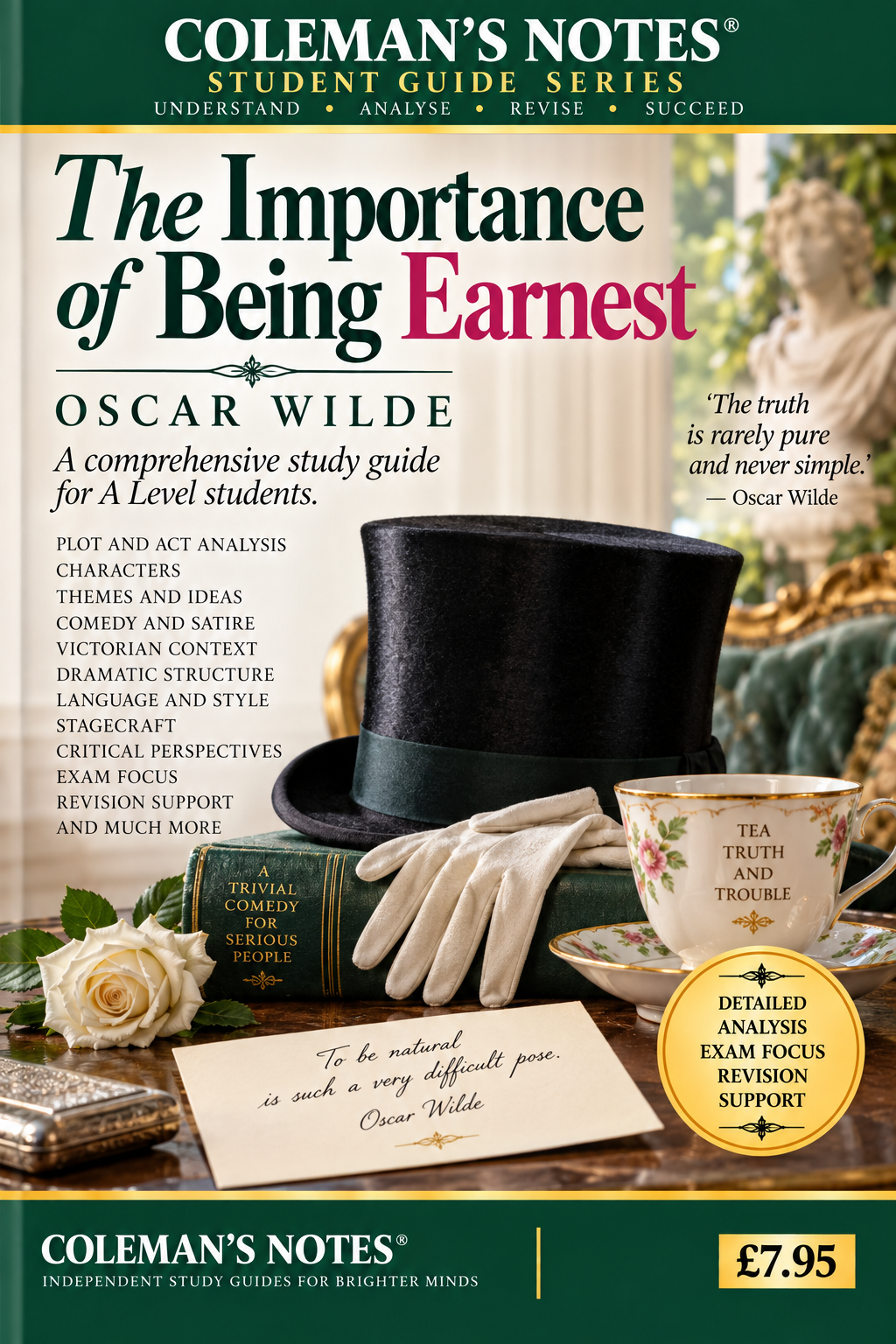
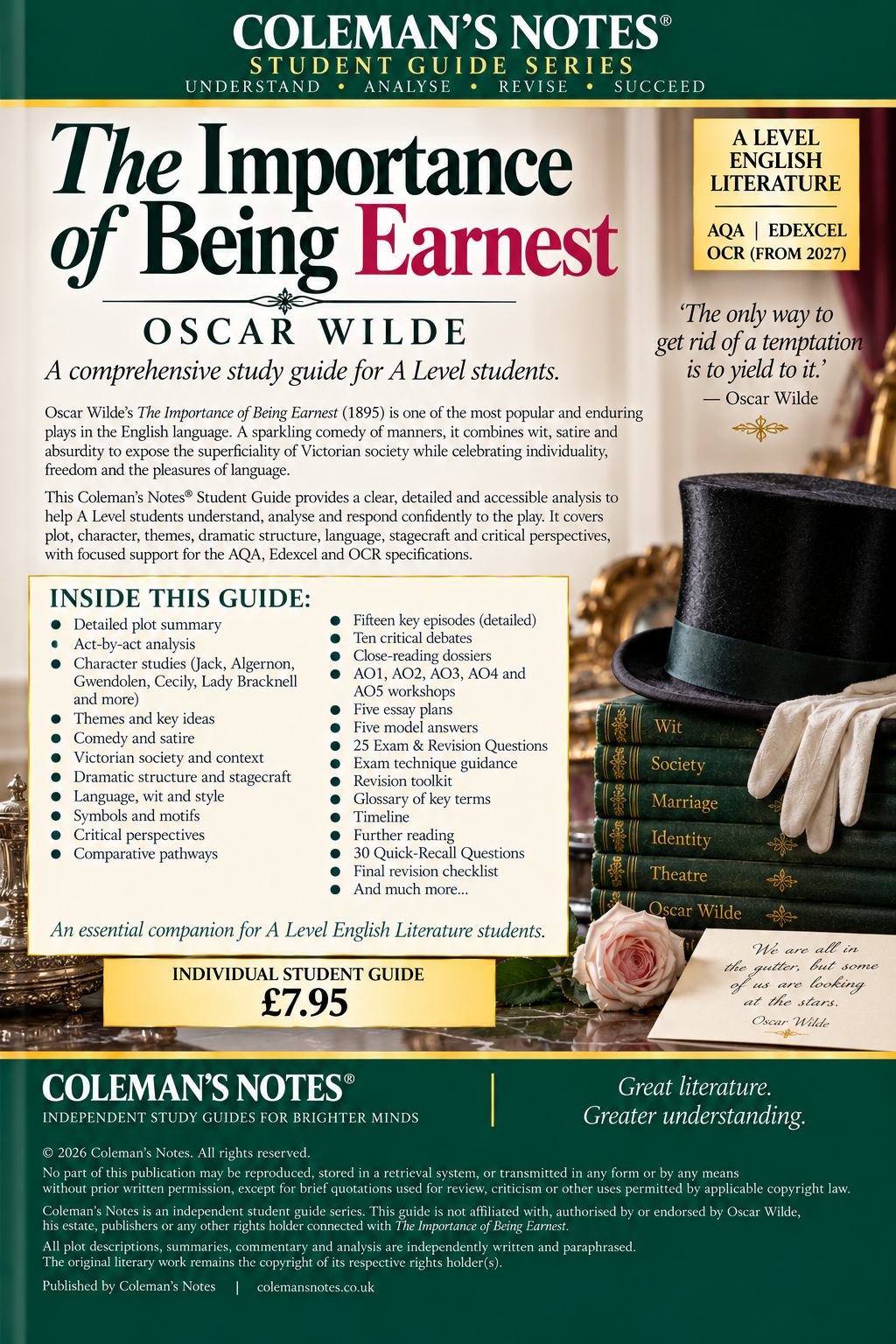


The Importance of Being Earnest — Oscar Wilde | Coleman’s Notes A Level Student Guide
Identity. Marriage. Manners. Deception. And a handbag that changes everything.
Oscar Wilde’s The Importance of Being Earnest is one of the great comedies of the English stage. Beneath its sparkling dialogue, absurd situations and memorable characters lies a sharp examination of Victorian society, class, marriage, respectability and the gap between appearance and reality.
Jack Worthing has invented a troublesome brother called Ernest to escape his responsibilities in the country. Algernon Moncrieff has created an imaginary invalid friend, Bunbury, for much the same purpose. When their invented identities collide with their romantic ambitions, Wilde creates an increasingly elaborate comedy of deception and mistaken identity.
This Coleman’s Notes® Student Guide helps A Level students examine both what makes the play funny and what Wilde achieves through its comedy, connecting character and theme with language, dramatic technique, social context and performance.
Inside This Guide
- Complete Plot Summary
- Detailed Act-by-Act Analysis
- Main Characters & Relationship Map
- Jack Worthing in depth
- Algernon Moncrieff
- Gwendolen Fairfax
- Cecily Cardew
- Lady Bracknell
- Miss Prism
- Reverend Canon Chasuble
- Lane & Merriman
- Jack & Algernon as Comic Doubles
- Gwendolen & Cecily
- Courtship & Marriage
- Identity & Double Lives
- Bunburying
- Appearance versus Reality
- Truth, Lies & Deception
- Class & Social Status
- Respectability & Reputation
- Gender & Relationships
- Money, Property & Marriage
- Education & Morality
- Family, Origins & Inheritance
- Town versus Country
- Victorian Social Conventions
- Food as a Comic Motif
- Names & Identity
- The Handbag
- Diaries, Letters & Written Evidence
- Wilde’s Use of Epigrams & Paradox
- Wit, Irony & Satire
- Farce & Comedy of Manners
- Reversal & Inversion
- Dramatic Irony
- Stagecraft & Comic Timing
- Structure & the Final Revelation
- Victorian Historical & Social Context
- Wilde, Aestheticism & Society
- Key Quotations & Analysis
- Essay Planning
- Model Answers
- 25 Exam & Revision Questions
- Quick Recall Revision
- Key Scenes for Close Analysis
- Critical Debates & Alternative Interpretations
- Exam Technique
- Final Revision Checklist
Beyond the Comedy
Why do both Jack and Algernon need alternative identities? What does Lady Bracknell reveal about class and social power? Why are Gwendolen and Cecily so determined to marry a man called Ernest? Does the play challenge Victorian attitudes towards marriage, or simply make them comic?
And what does Wilde achieve by making apparently serious subjects — love, morality, family, money and social status — seem wonderfully absurd?
The guide helps students develop these questions into strong A Level arguments while analysing Wilde as a playwright, paying close attention to dialogue, epigrams, dramatic irony, structure, stagecraft and comic technique.
Perfect For
A Level English Literature students • examination revision • essay preparation • drama and comedy study • teachers • tutors • independent learners
Coleman’s Notes® Student Guide Series
Designed to help students:
UNDERSTAND • ANALYSE • REVISE • SUCCEED