
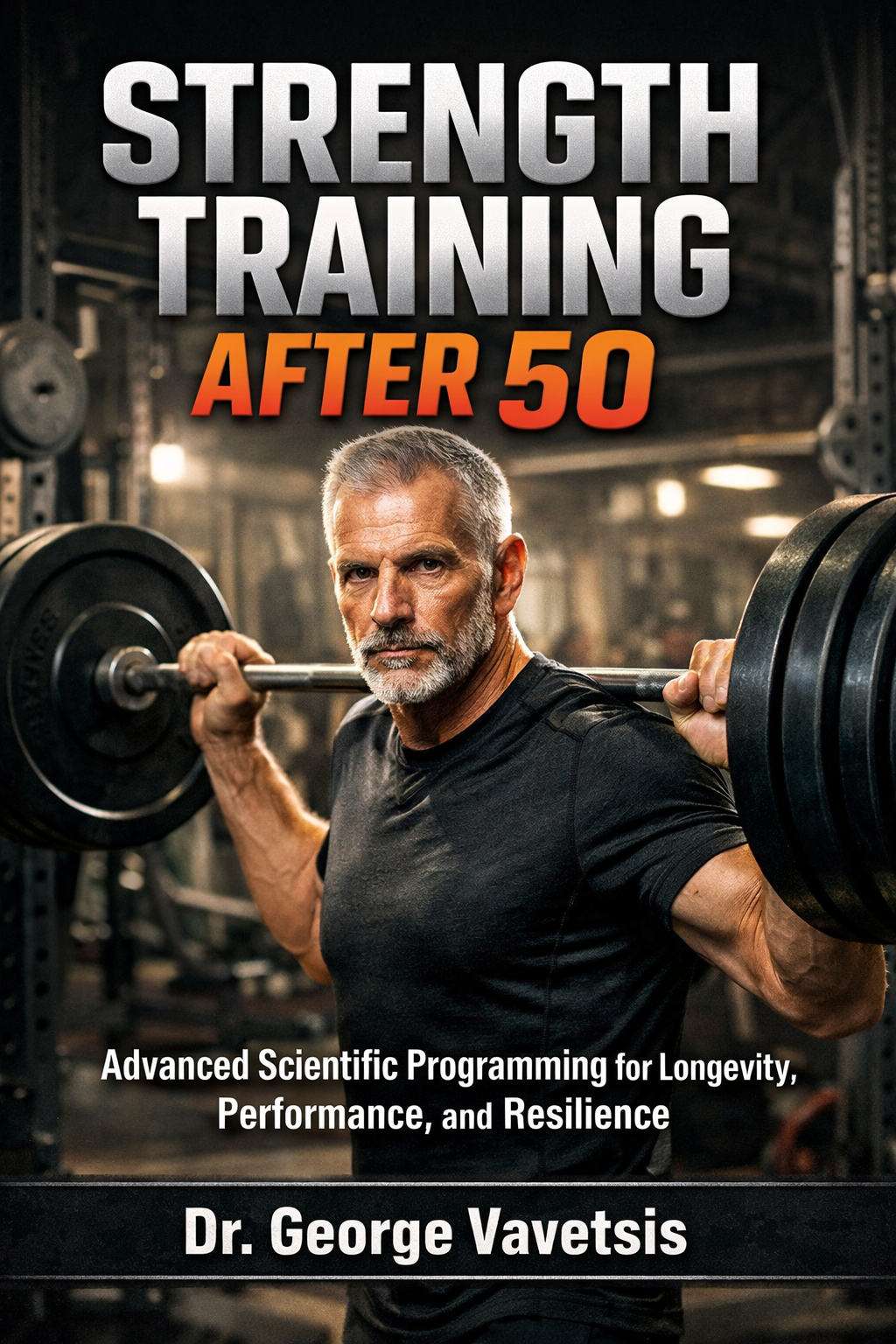
Strength Training After 50 – Advanced Scientific Programming for Longevity, Performance, and Resilience
Pages: 1637
Strength after fifty is no longer a nostalgic memory of youthful power, nor a defensive attempt to slow inevitable decline. It is a strategic, scientific, and deeply purposeful pursuit of neuromuscular preservation, biological resilience, and functional sovereignty. The fifth decade of life marks not an end, but a transition: from growth to maintenance, from accumulation to optimization, and from blind training volume to precision-engineered stimulus. This book is written for that transition.
Modern sports science has made it clear that aging is not a uniform process, nor is it a passive one. Sarcopenia, neural deconditioning, tendon stiffening, hormonal attenuation, mitochondrial decay, and central drive reduction do not occur at the same rate in all individuals, nor do they respond equally to the same training inputs. The organism after fifty is not “weaker” in a simplistic sense; it is different in its signaling priorities, recovery kinetics, mechanotransduction thresholds, and adaptive windows. The role of the strength and conditioning professional, therefore, is no longer to merely prescribe load, but to architect adaptation.
This work is built on the premise that strength training after fifty must be approached as a system of biological engineering. Muscle is not an isolated actuator but part of an integrated network that includes the nervous system, endocrine milieu, connective tissue matrix, vascular supply, and immune-inflammatory environment. Each repetition is a neural event, each set a metabolic perturbation, each session a molecular message. In the aging athlete or active individual, the clarity, timing, and specificity of that message determine whether the outcome is regeneration or regression.
The traditional paradigms of linear progression and generalized hypertrophy are insufficient for this population. What is required is an understanding of motor unit remodeling, denervation–reinnervation cycles, excitation–contraction coupling efficiency, calcium handling dynamics, satellite cell availability, and the shifting sensitivity of anabolic signaling pathways such as mTOR, MAPK, and IGF-1. Strength training becomes less about “getting stronger” and more about maintaining high-threshold motor unit access, preserving rate of force development, sustaining tendon energy storage, and protecting the integrity of the neuromuscular junction.
Equally critical is the concept of load economy. After fifty, adaptation is no longer proportional to volume alone. The organism responds to peak tension, to velocity-specific intent, to oscillations between neural demand and structural recovery. Micro-dosing, cluster organization, isometric and eccentric emphasis, velocity-based regulation, and strategic frequency become tools not of elite sport only, but of longevity performance. The same principles that protect an Olympic sprinter’s nervous system can, when intelligently scaled, preserve the explosive reserve of a 55-year-old former athlete or the functional independence of a 70-year-old active individual.
This book does not treat aging as pathology. It treats it as a phase of plasticity governed by different rules. Neural drive can be retrained. Fast-twitch fibers can be re-recruited. Tendons can regain stiffness. Bone can respond to strain. Mitochondria can proliferate. The endocrine system can be sensitized to training stimuli. But these adaptations require precision in exercise selection, intensity zoning, contraction mode, rest interval architecture, and weekly stress distribution.
The strength coach working with the over-fifty population must therefore become part physiologist, part biomechanist, part neurobiologist, and part systems engineer. The goal is not maximal numbers on a barbell in isolation, but maximal preservation of force–time characteristics, postural control under load, anti-rotation capacity, deceleration competence, and elastic recoil. It is about ensuring that the nervous system continues to “trust” the musculoskeletal system and that the musculoskeletal system remains capable of responding to high-velocity commands.
In elite sport, we speak of “career longevity.” In life, this becomes “functional longevity.” The same laws apply. Tissue that is not loaded loses its structure. Neurons that are not challenged lose their firing precision. Hormonal pathways that are not stimulated lose sensitivity. Conversely, intelligently dosed stress maintains order, coherence, and capacity. Strength training after fifty is not a compromise; it is a refined expression of training intelligence.
This text is written for coaches, therapists, physicians, and high-level practitioners who refuse to accept the simplistic narrative that aging equals unavoidable decline. It is also for experienced athletes who understand that the second half of their performance life demands more knowledge, not less. The chapters that follow integrate molecular biology, neuromechanics, endocrinology, and applied programming into a coherent framework for preserving and even enhancing strength, power, and resilience beyond midlife.
The body after fifty is not fragile; it is selective. It adapts only to signals that are clear, meaningful, and appropriately intense. This book is an attempt to define those signals, to structure them in time, and to align them with the realities of biological aging. Strength, in this context, becomes not only a physical quality but a biological strategy: a means of preserving autonomy, performance, and identity in a system that is constantly negotiating between degeneration and renewal.
To train after fifty is to train with awareness of time, but not in surrender to it. It is to respect recovery without fearing intensity, to value precision over excess, and to pursue adaptation not as a race against aging, but as a dialogue with it. This is the science and art of strength in the second half of life.