
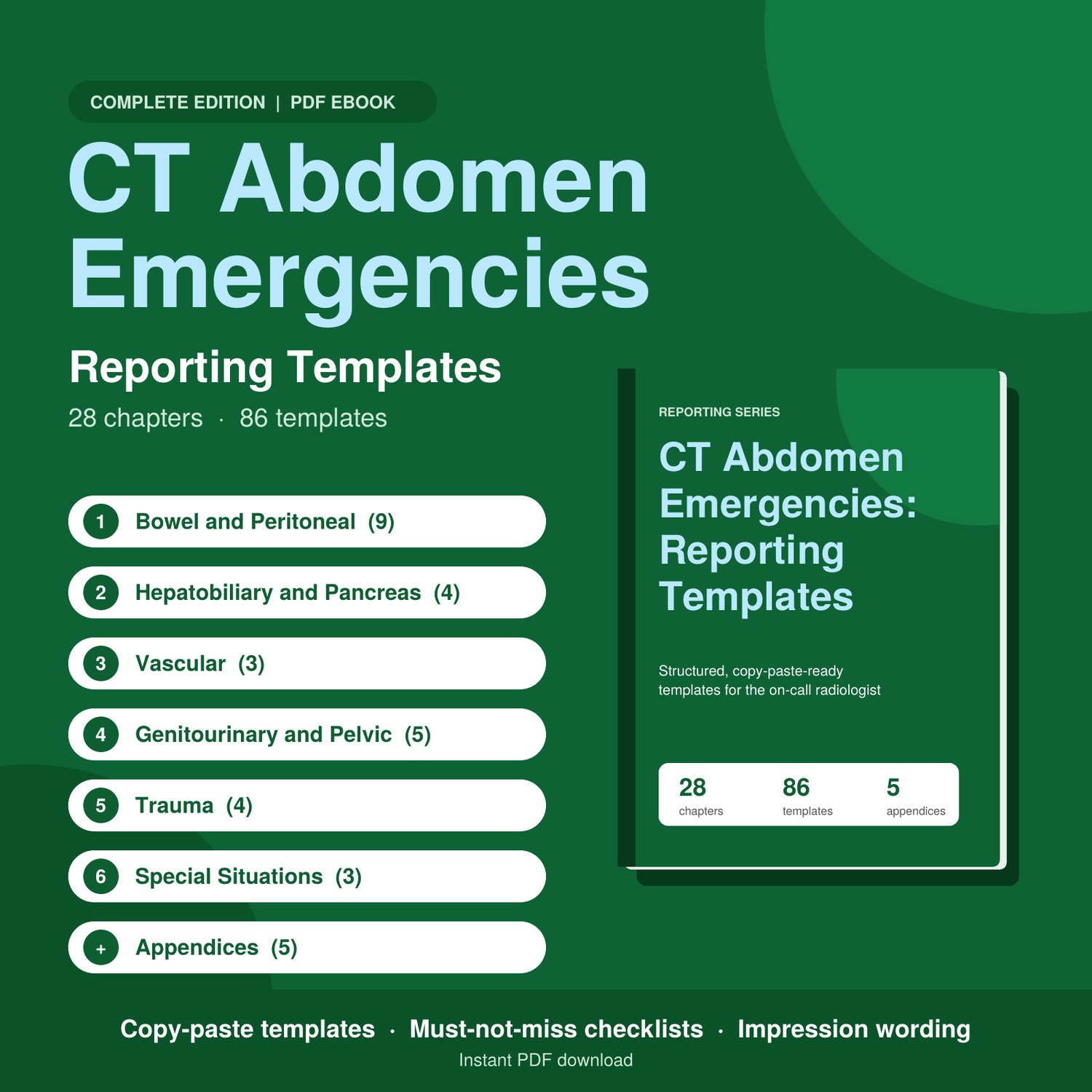
CT Abdomen Emergencies: Reporting Templates
Reporting on call is fast, high-stakes, and repetitive. This book gives you a consistent starting point for each emergency CT abdomen and pelvis case, so you can spend your time on the images and not on typing.
Who it's for
- Radiology residents and fellows on call
- Radiologists covering emergency and general work
- Trainees preparing for reporting-heavy exams
- Anyone building macros or autotext for their reporting system
What you get
- 28 chapters covering the full range of emergency CT abdomen and pelvis cases
- 86 ready-to-use report templates: positive, complicated, and negative versions for each condition
- A universal normal template and a CT protocols and contrast quick guide
- Five appendices you will keep coming back to
Every chapter follows the same layout
- Quick reminders to check before you sign
- Key CT findings and thresholds
- Templates with [bracketed] fields to fill in
- Must-not-miss findings and common mimics
- Classification and measurements
- Sample impression wording
Inside the book
Part 1: Bowel and peritoneal
Appendicitis, small bowel obstruction, large bowel obstruction, mesenteric ischemia, perforated viscus, diverticulitis, IBD complications, typhlitis and colitis, and hernias
Part 2: Hepatobiliary and pancreas
Cholecystitis, choledocholithiasis and cholangitis, acute pancreatitis, liver abscess, portal vein thrombosis, and Budd-Chiari syndrome
Part 3: Vascular
Ruptured AAA and aortic dissection, visceral artery aneurysm and dissection, and mesenteric and renal vein thrombosis
Part 4: Genitourinary and pelvic
Renal colic, pyelonephritis and renal abscess, ovarian torsion and ruptured cyst, ectopic pregnancy and PID, and scrotal and bladder emergencies
Part 5: Trauma
Blunt abdominal trauma (AAST grading), bowel and mesenteric injury, active bleeding and hemoperitoneum, and pelvic fracture with vascular injury
Part 6: Special situations
Post-operative complications, pregnancy and pediatric considerations, and incidental findings that need follow-up
Appendices
- Quick-reference measurements and HU values
- Classification cheat sheet (Hinchey, Atlanta, modified CTSI, AAST, and more)
- Critical findings communication checklist and wording
- Must-not-miss review-area checklist
- Common pitfalls and mimics
How to use it
Open the PDF, copy the template you need, fill in the [bracketed] fields, and paste it into your reporting system. Many readers save the templates as macros or autotext with a short code.
Please note
- This is a text-based reference. It does not include CT images.
- Templates and thresholds are a starting point. Adapt them to your local protocols and verify against current guidelines.
- Educational use only. It does not replace clinical judgement.
Format: PDF, 88 pages, instant download after purchase.