
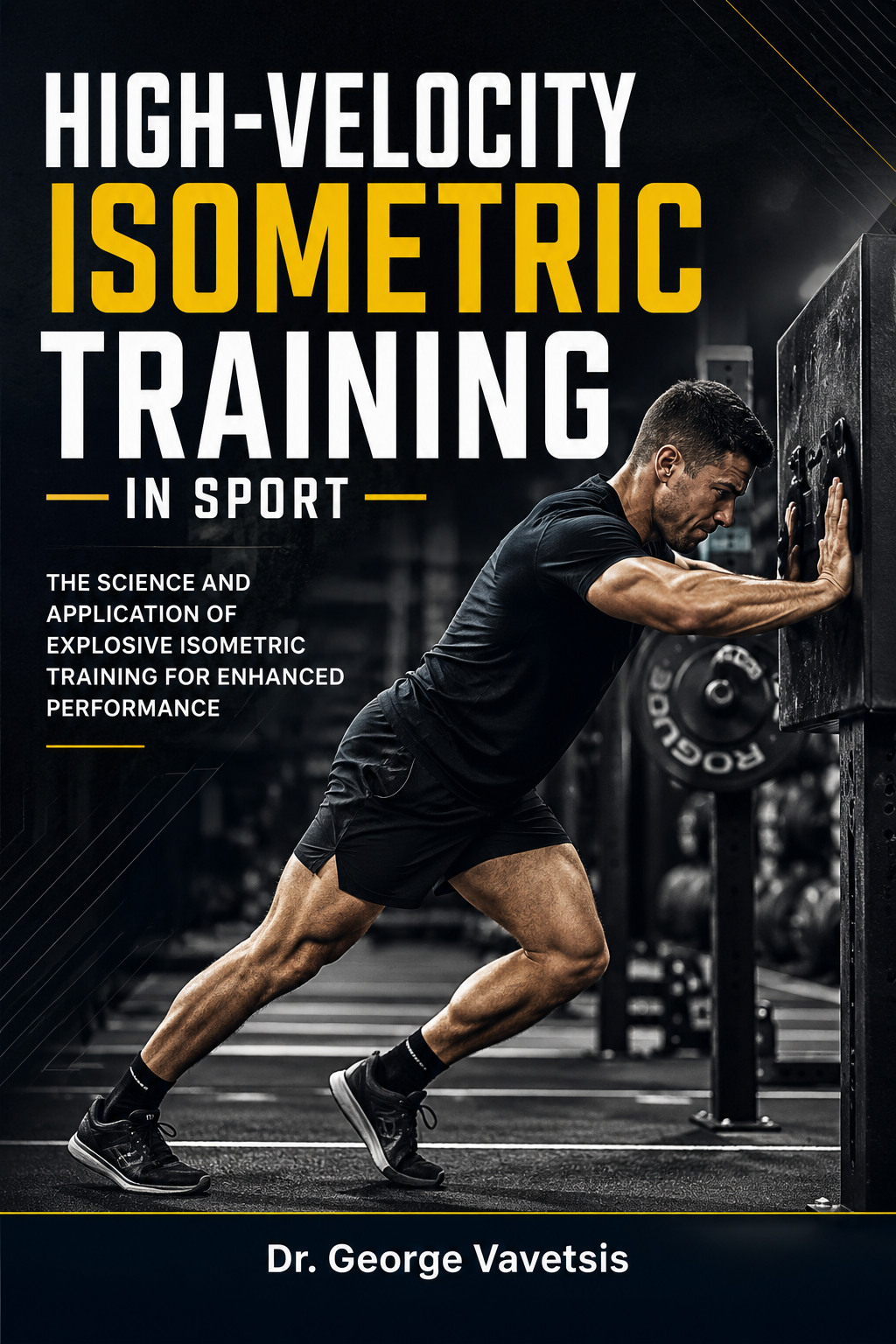
High-Velocity Isometric Training in Sport
Pages: 943
High-velocity isometric training represents one of the most misunderstood yet potentially transformative frontiers in modern strength and conditioning. For decades, isometric exercise was often reduced to static force production, rehabilitation protocols, or simplistic “holding” tasks disconnected from the explosive realities of elite sport. However, contemporary neuromechanical analysis, corticospinal research, and sport-performance modeling reveal a very different reality: isometric intent, when executed with maximal acceleration characteristics and rapid neural drive, becomes an extraordinarily sophisticated method for enhancing explosive performance, joint stiffness regulation, force transmission, and movement efficiency.
This book was written to redefine how coaches, sport scientists, rehabilitation specialists, and performance practitioners understand isometric training within high-performance sport. High-velocity isometric training is not passive. It is not slow. It is not merely rehabilitative. At the elite level, explosive isometric intent represents a highly dynamic neurophysiological event involving rapid corticospinal excitation, high-threshold motor-unit recruitment, early-phase rate-of-force-development optimization, and sophisticated neuromechanical synchronization across the kinetic chain.
In modern sport, milliseconds determine competitive success. The ability to generate force rapidly within the first 50–100 milliseconds of movement initiation often separates elite performers from sub-elite athletes. Sprint acceleration, braking mechanics, change-of-direction efficiency, collision stabilization, reactive agility, striking force, and jump propulsion all rely heavily on rapid neural recruitment and instantaneous force expression rather than prolonged force maintenance. High-velocity isometric training specifically targets these early neural and mechanical windows.
Unlike traditional resistance training, where external displacement frequently dominates coaching attention, explosive isometric methods emphasize intent, neural firing rate, motor-unit synchronization, and force application immediacy. The athlete is not simply “pushing.” The athlete is attempting to produce maximal force instantly against immovable resistance while minimizing electromechanical delay and maximizing neural drive. This distinction fundamentally changes the adaptation process. The nervous system becomes the primary target of training rather than merely the musculature itself.
One of the most important concepts explored throughout this book is that maximal intent changes physiology. The nervous system responds differently when force is expressed explosively compared to gradually. Corticospinal excitability, intracortical facilitation, reticulospinal contribution, and motor-unit recruitment behavior are all profoundly influenced by the athlete’s intent to produce force instantaneously. This means that two athletes may produce identical external force outputs while experiencing entirely different neural adaptations depending on the speed and intentionality of force expression.
Another critical dimension of high-velocity isometric training is its transferability to sport-specific positions and tactical movement environments. Isometric actions can be performed at precise joint angles corresponding to sprint starts, jump take-offs, cutting mechanics, collision positions, grappling exchanges, and reactive stabilization tasks. This specificity allows practitioners to directly target biomechanical positions associated with performance enhancement and injury resilience.
Furthermore, high-velocity isometrics provide unique opportunities for improving stiffness modulation and force-transfer efficiency across the kinetic chain. In multidirectional sports, athletes must rapidly alternate between relaxation and stiffness while maintaining movement precision under chaotic conditions. The ability to instantly regulate joint stiffness during deceleration, landing, collision absorption, or directional transition is central to elite athleticism. Explosive isometric methods offer a direct pathway to enhancing these capacities without excessive mechanical fatigue.
The integration of explosive isometric strategies within contemporary programming also opens entirely new possibilities for potentiation and neural priming. When appropriately sequenced before sprinting, Olympic lifting, plyometrics, or reactive agility tasks, high-velocity isometric contractions can acutely elevate corticospinal responsiveness and enhance subsequent explosive performance. These methods are particularly valuable in high-performance environments where maximizing neural readiness while minimizing residual fatigue is essential.
Importantly, this book does not present high-velocity isometric training as a replacement for traditional strength methods. Rather, it should be viewed as a complementary and integrative system capable of enhancing the effectiveness of dynamic training modalities. Maximal strength, eccentric capacity, plyometric efficiency, velocity-based training, and sprint development all remain critical components of elite athletic preparation. However, high-velocity isometrics occupy a unique position within this ecosystem because they specifically target the neural and mechanical transition between intention and movement execution.
Throughout these chapters, readers will explore the corticospinal neurodynamics underlying explosive intent, the role of motor-unit recruitment thresholds, intracortical inhibition-facilitation oscillation, reactive stabilization systems, reticulospinal involvement, and neuromechanical co-contraction strategies. The text also addresses practical programming models, sport-specific applications, fatigue management, potentiation sequencing, biomechanical angle selection, and monitoring strategies relevant to elite sport environments.
Special emphasis is placed on practical application for strength and conditioning coaches. Scientific theory has little value unless it can meaningfully enhance performance, reduce injury risk, improve transfer to competition, and optimize long-term athletic development. Therefore, every theoretical framework in this book is connected directly to exercise prescription, monitoring systems, and applied coaching methodology.
The future of performance training lies increasingly in precision-based neuromechanical programming. As sport evolves, coaches can no longer rely solely on generalized loading paradigms or simplistic strength metrics. Understanding how the nervous system organizes explosive force, regulates stiffness, coordinates reactive stabilization, and adapts to high-intent stimuli will become central to elite preparation models.
High-velocity isometric training offers a powerful framework for this evolution. It bridges neuroscience, biomechanics, motor control, and sport-specific performance into a unified methodology capable of addressing the increasingly complex demands of modern athletics.
This book was created for practitioners who seek more than conventional programming. It was written for coaches who recognize that explosive performance begins in the nervous system long before visible movement occurs. It was written for professionals who understand that elite sport is ultimately governed by precision, timing, intent, and the rapid orchestration of force.