
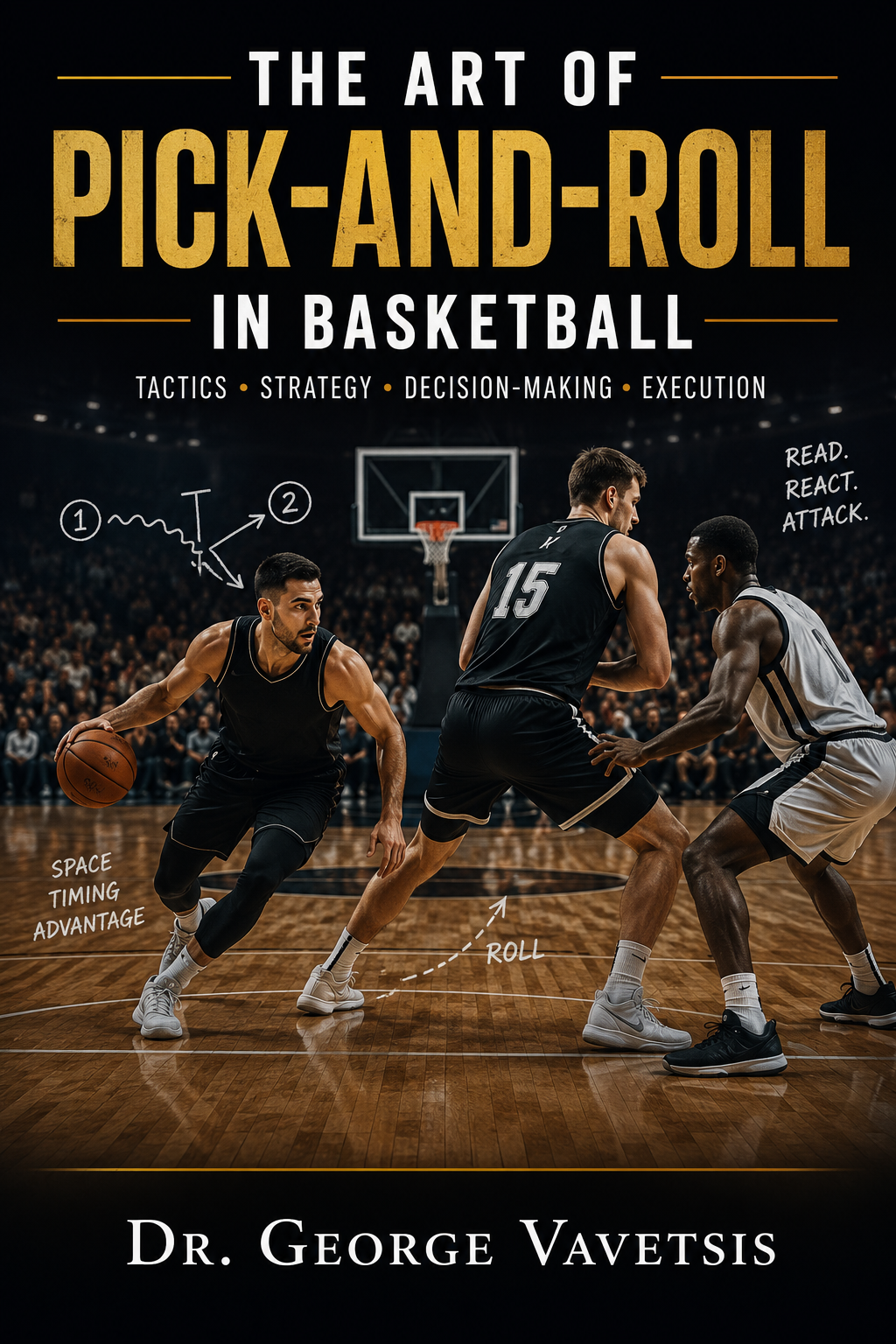
The Art of Pick and Roll in Basketball
Pages: 1061
Basketball has always been a game of space, timing, deception, and controlled chaos. Yet within the endless tactical layers of modern basketball, no offensive action has transformed the sport more profoundly than the pick-and-roll. From the street courts of New York to the structured tactical systems of the EuroLeague, from youth development academies to the highest stages of the NBA Finals, the pick-and-roll has evolved from a simple two-player cooperation into the central nervous system of modern offensive basketball. This book, The Art of Pick-and-Roll in Basketball, is an attempt to explore that evolution in its deepest tactical, biomechanical, cognitive, and strategic dimensions.
The modern pick-and-roll is no longer merely a screen followed by a roll toward the basket. It is now a living tactical ecosystem governed by spacing geometry, defensive manipulation, neurocognitive processing speed, possession-value engineering, and continuous advantage creation. Elite teams no longer execute pick-and-roll actions simply to create a shot; they execute them to force a sequence of defensive decisions that progressively destabilize the opponent’s structure. In this sense, the pick-and-roll has become a philosophy of offensive basketball rather than a single tactical action.
Throughout the pages of this book, the reader will discover that the highest-level pick-and-roll systems are fundamentally built upon the management of defensive reactions. The elite ball-handler does not merely attack space—he manipulates the anticipation of space. The screener is no longer a static obstacle but a dynamic tactical architect capable of altering defensive angles, rotational timing, and weak-side responsibilities with microscopic changes in positioning, contact, and timing. Weak-side players are not passive spacers; they are active gravitational manipulators responsible for stretching defensive decision-making beyond its functional limits.
What makes the pick-and-roll truly fascinating is its dual nature. On one side, it is deeply structured and mathematically organized. Spacing angles, timing windows, short-roll distances, and weak-side positioning can all be analyzed with remarkable precision. On the other side, the action remains profoundly creative and adaptive. Every defensive coverage—drop, hedge, switch, ICE, blitz, weak, zone-gap—creates a unique environment requiring real-time perception, decision-making, and improvisation. Thus, the elite pick-and-roll exists at the intersection of structure and freedom.
One of the central themes of this book is the contrast between NBA pace-and-space ecosystems and EuroLeague continuity-based orchestration. The NBA frequently prioritizes early advantage generation, offensive flow, paint pressure, and shot-profile optimization through high-frequency spread pick-and-rolls. EuroLeague systems, meanwhile, often rely on structured sequencing, layered screening continuity, tactical patience, and half-court timing discipline. Both systems seek offensive advantage, yet they pursue it through fundamentally different tactical philosophies. Understanding these differences allows coaches, analysts, and players to appreciate not only how elite teams execute pick-and-rolls, but why they do so.
This book also approaches pick-and-roll basketball through the lens of “advantage basketball.” Every elite possession revolves around the creation, maintenance, and amplification of advantage. The first screen forces defensive declaration. The second screen attacks the rotation. The weak-side shake manipulates the low man. The short roll collapses the nail defender. The skip pass stretches horizontal recovery. The hammer action punishes backside over-help. In elite basketball, no movement exists in isolation. Every action exists to provoke another reaction.
Another essential dimension explored in this work is the cognitive science of pick-and-roll decision-making. The greatest handlers in basketball history—whether in the NBA, EuroLeague, or FIBA competition—distinguish themselves not merely through athleticism, but through anticipatory processing. Elite handlers pre-scan coverages before the screen arrives. They identify low-man positioning before the roller moves. They process the weak-side tagger, nail defender, and backside rotation simultaneously while maintaining dribble control and pace modulation. In many ways, the elite pick-and-roll resembles high-speed chess played under physical pressure.
Equally important is the biomechanical and neuromuscular aspect of the action. The angles of the screen, the handler’s hip positioning, deceleration mechanics inside the lane, the roller’s vertical gravity, and the handler’s ability to change rhythm all determine the effectiveness of the possession. Elite pick-and-roll basketball is therefore not merely tactical—it is biomechanical warfare conducted in confined spaces under extreme time pressure.
This book was written not only for coaches, but for all serious students of basketball performance. Strength and conditioning coaches will discover how movement quality, force production, eccentric braking, deceleration control, and change-of-direction mechanics influence tactical execution. Analysts will gain deeper insight into spacing principles, shot-profile engineering, and coverage manipulation. Players will better understand the hidden logic behind elite offensive systems. Basketball thinkers will recognize how modern offenses increasingly resemble complex adaptive systems governed by interconnected reactions rather than isolated plays.
Most importantly, this book attempts to respect the artistic dimension of basketball. Despite all the analytics, tactical diagrams, and biomechanical explanations, basketball remains a creative human activity. The greatest pick-and-roll players are not simply executing systems; they are reading emotion, rhythm, fear, hesitation, fatigue, and anticipation. They manipulate time itself within the possession. They slow the game, accelerate the game, distort defensive spacing, and force defenders into impossible choices.
The “art” of the pick-and-roll therefore lies not in memorizing actions, but in understanding principles. True mastery emerges when players and coaches internalize spacing, timing, tempo, and advantage creation so deeply that the game becomes instinctive. At that level, the pick-and-roll stops being a play and becomes a language.
It is my hope that this book contributes meaningfully to the ongoing evolution of basketball knowledge. The game continues to evolve at extraordinary speed, and the pick-and-roll remains at the center of that evolution. Whether you are a coach searching for deeper tactical sophistication, a player seeking greater decision-making clarity, a performance specialist integrating movement science into basketball, or simply a passionate student of the game, this work was written for you.
Basketball is ultimately a game of decisions under pressure. The pick-and-roll is where those decisions are most exposed, most punished, and most rewarded. To study it deeply is to study the very architecture of modern basketball itself.