

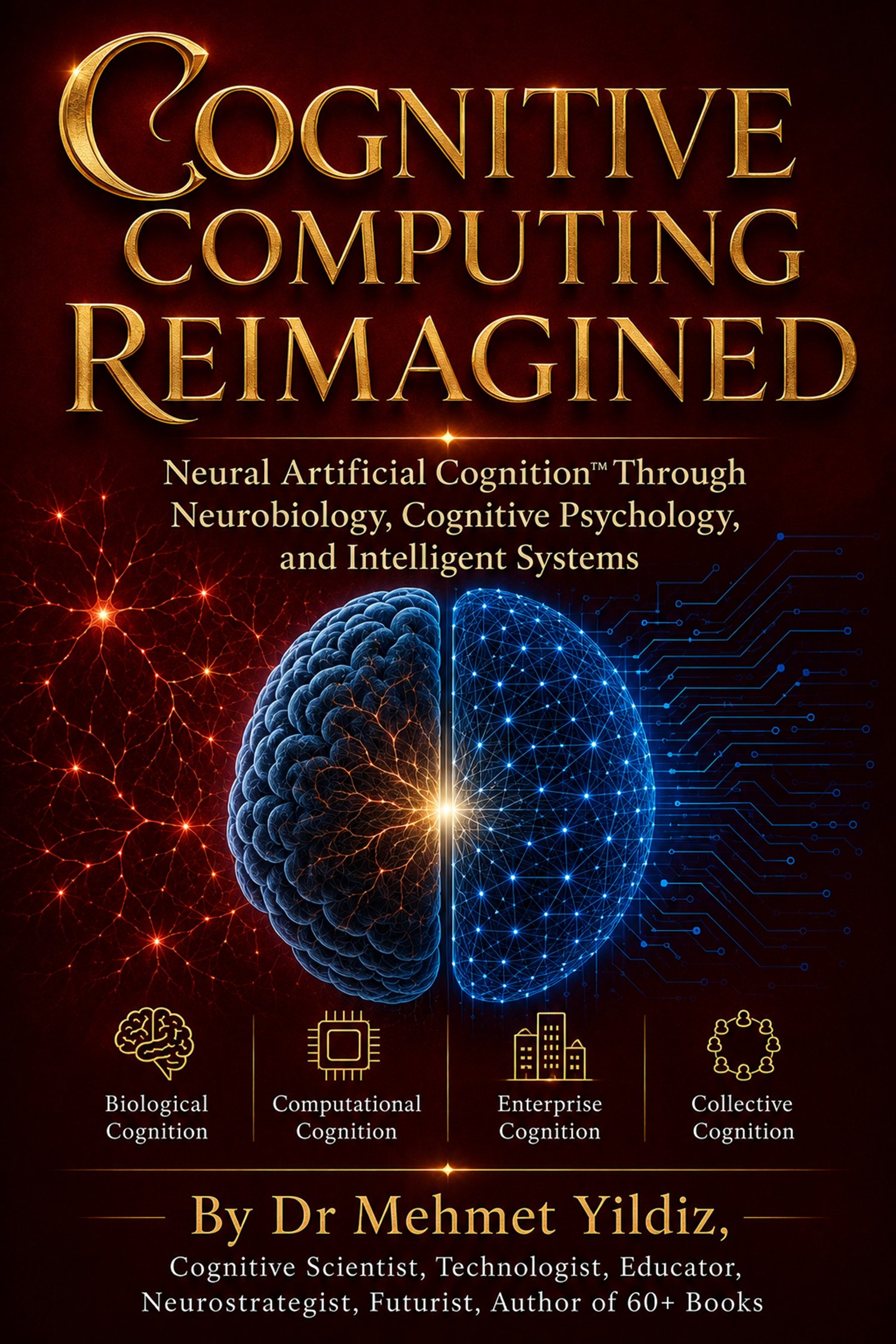
Cognitive Computing Reimagined: Neural Artificial Cognition™ Through Neurobiology, Cognitive Psychology, and Intelligent Systems
This product includes EPUB and PDF
Book Description
What Makes a System Truly Cognitive?
Artificial intelligence has advanced at an extraordinary pace, yet our scientific understanding of cognition has not progressed at the same speed. Many books on cognitive computing concentrate on algorithms, architectures, machine learning, natural language processing, and the history of AI. These resources explain valuable technologies, but they often leave a more fundamental question unanswered: What makes a system cognitive?
In Cognitive Computing Reimagined, I reposition cognitive computing within the broader scientific study of cognition itself. Rather than treating it as simply another branch of artificial intelligence, I introduce Neural Artificial Cognition™ (NAC), an integrative meta-framework for examining the processes that produce intelligent behavior across biological organisms, computational systems, enterprises, and collaborative human–AI ecosystems.
The book begins with a crucial distinction. Intelligence is generally recognized through observable performance: solving problems, detecting patterns, generating language, making recommendations, or adapting to change. Cognition concerns the processes that make those abilities possible. Perception, attention and task switching, memory, learning, knowledge representation, reasoning, prediction, decision-making, adaptation, communication, and metacognition form the cognitive architecture from which intelligent behavior emerges.
Instead of organizing the discussion around technologies that may soon be replaced, this book adopts a cognition-centered structure. Each foundational capacity is examined through relatable human experiences, current scientific understanding, contemporary AI, organizational applications, and emerging human–machine collaboration. This approach helps readers understand how biological and artificial systems differ while revealing the cognitive principles they may share.
Across 32 chapters, the discussion progresses through three connected stages. Part I establishes a new scientific foundation for cognitive computing and introduces NAC™. Part II explains how cognition emerges through interacting capacities across biological, computational, enterprise, and collective systems. Part III looks ahead to human–AI cognitive collaboration, Cognitive Digital Twins, agentic AI, neuromorphic hardware, responsible cognition, future cognitive enterprises, and the possibility of Artificial General Cognition.
The book also draws upon my previous work in neurocomputing, neural architectures, noetic intelligence, enterprise architecture, metacognition, and long-range technology horizons. These perspectives allow cognition to be examined beyond algorithms and benchmark scores. The discussion includes judgment, context, wisdom, ethics, institutional memory, collective learning, and the long-term consequences of capable intelligent systems.
Although grounded in scholarship, the book is written in clear and relatable language. Real-life examples make complex ideas accessible without reducing their scientific significance. It is intended for graduate students, researchers, AI practitioners, enterprise architects, engineers, educators, entrepreneurs, executives, philosophers, and intellectually curious readers seeking a deeper understanding of cognition beyond technical implementation.
The final chapters bring the discussion back to everyday life. They explore how cognitive technologies may influence learning, healthcare, work, leadership, creativity, decision-making, and personal knowledge management. Future generations may develop trusted digital cognitive partners or “second brains” that help them remember, learn, connect ideas, and make more informed choices without surrendering human judgment.
More than a book about artificial intelligence, this is a book about the emerging science of cognition. Cognitive Computing Reimagined argues that larger models, faster processors, and more autonomous systems will represent only part of the next technological era. A deeper understanding of cognition may prove even more influential. By studying cognition wherever it emerges, we may build more responsible intelligent systems, create wiser organizations, improve human–AI collaboration, and gain a richer understanding of our own minds.
The greatest contribution of artificial cognition will not be that machines become more like us. It may be that, through the effort of building them, we finally begin to understand ourselves more deeply.