
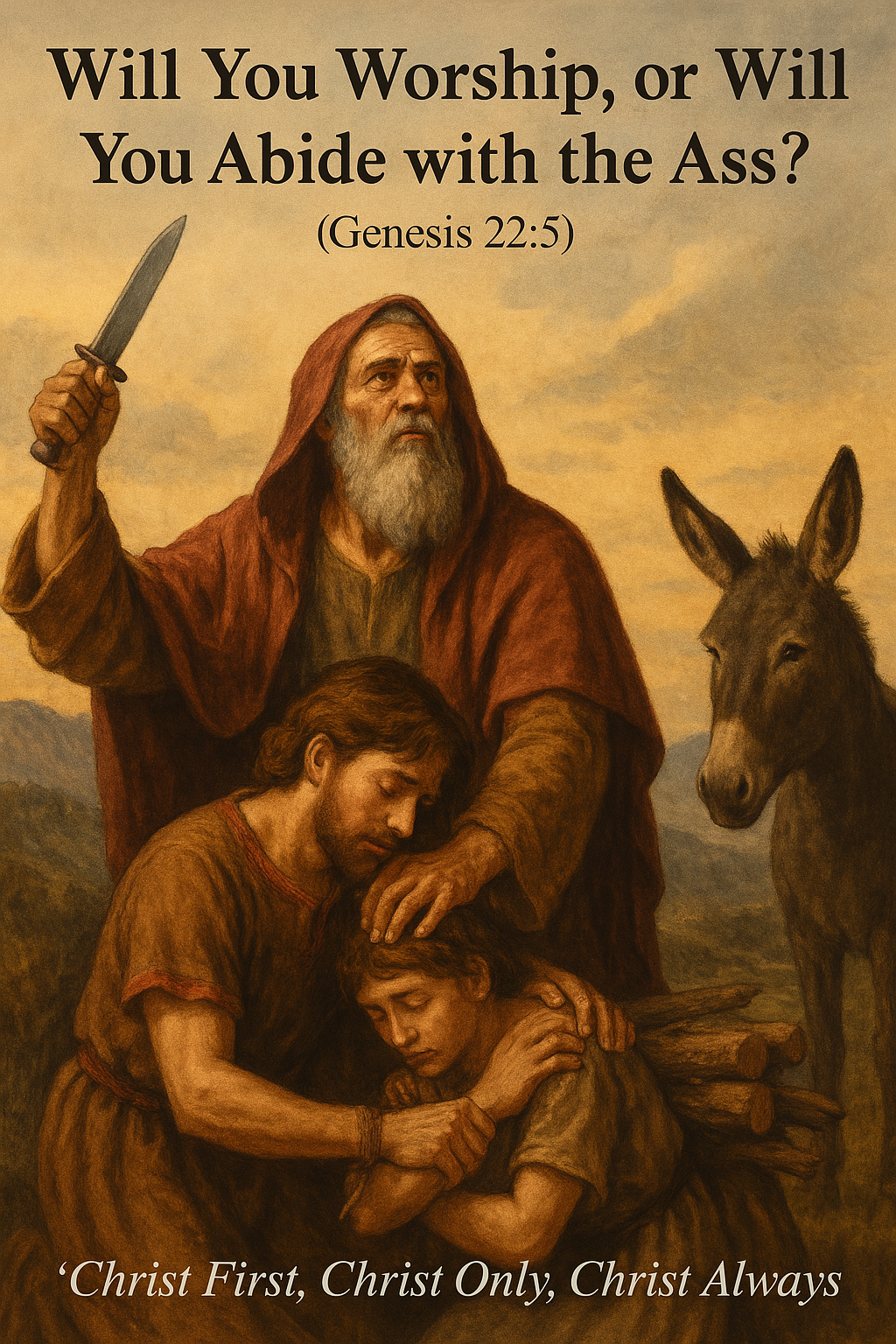
“Will You Worship, or Will You Abide with the Ass?”
“Will You Worship, or Will You Abide with the Ass?”
(Genesis 22:5)
This historical event took place over 4,000 years ago. Most of us are very familiar with this passage. Yet it remains one of the most misinterpreted or under interpreted passages in the book of Genesis. There are two reasons for this.
First, the passage comes to us clothed in the Old English of the King James Version. The modern reader immediately discounts what he reads because the language is not one that he uses every day.
The recounting of this event is also steeped in the symbols and types of the Old Testament sacrificial system. An accurate understanding the Old Testament requires an understanding of the entire Bible.
To put it plainly, it is quite difficult at times for the modern reader to draw conclusions for his life based on facts that are quite ancient and clothed in a language and religious system that he does not understand.
Why, after all, the modern mind reasons, would God even ask Abraham to sacrifice his son? The modern mind views child sacrifice as proof of our pagan past. In the historical setting of Genesis chapter 22, God was testing or proving Abraham. God had given Abraham something or somebody of great value. In their old age (Abraham was 100 and Sarah was 90), God blessed them with Isaac.
Isaac was called the “child of promise.” God promised Abraham in Genesis 12:2 that He would make him “a great nation.” The Lord also promised Abraham in Genesis 15:5 that his descendants would rival the number of stars in the heavens.
According to Genesis 18:11, at the time these promises were made Abraham and Sarah were “old and well stricken with age, and Sarah was long past the age of child-bearing.” In fact, according to Genesis 18:12, Sarah laughed within herself, and asked the question, “How could a worn-out woman like me have a baby?”
God heard her and asked the question of Genesis 18:14, “Is anything too hard for the Lord?” God then said: “About a year from now, Sarah will have a son.” So Isaac was the child of promise and was born right on schedule.
Now fast forward twenty-five years from the birth of Isaac. Abraham, now 125 years old, and his 25-year-old son Isaac are headed to what presumably will be Isaac’s death. It was the testing ground of Abraham’s faith.
He was being asked to sacrifice his child of promise in an act that was reserved, not for the people of God, but for their pagan neighbors. That is the historical setting. Now consider the following four points from the contemporary setting.
- Modern day men and women will not sacrifice for God.
- a. God asked Abraham to sacrifice, which means to give something of value to God (Genesis 22:2).
- b. The word “sacrifice” means “to make holy.” Its etymology is from the Latin “sacrificium” which is a compound word comprised of “sacer” – which means set apart; and “facere” – which means to make.
- Sacrifice exalts Christ.
- a. Isaac was a type of Christ.
- i. He was the child of promise; just as Jesus is the Messiah that was promised so long ago (Isaiah 9:6).
- ii. At the time of this sacrificial offering, Isaac was no mere child. Scholars estimate that he had to be at least 25. This would mean that he would have had to have given his consent to be sacrificed, just as Jesus gave His consent (John 10:18).
- iii. Abraham was 125 years old. He could not bind the younger man without his consent. Note that it was Isaac who carried the wood in Genesis 22:6 on which he would be sacrificed. Jesus carried the cross on which He would be sacrificed (John 19:17).
- b. God will never let His children go without due to their devotion to Him through sacrifice.
- i. Abraham told his servants in Genesis 22:5 in the NLT, “we will worship and we will come right back.”
- ii. When Isaac asked the question about the lamb in Genesis 22:7, it was because he and his father never expected him to be slain or if he were slain, he would have been immediately raised.
- Sacrificial giving demonstrates a radical trust in God.
- a. Abraham trusted God enough to leave his ancestral homeland and his father’s house (Genesis 12:1).
- b. Abraham trusted God enough to believe what He said about an inheritance (Genesis 15:6).
- c. Abraham trusted God with Isaac’s life (Genesis 22:10-12).
- True sacrifice results in others being brought to the Faith.
- a. Josephus, the first century Jewish historian wrote that there were some pagans who stopped the practice of sacrificing their children when they heard that Abraham was going to sacrifice Isaac, but Jehovah stopped him. They were impressed with the God of Abraham and Isaac (Antiquities).
- b. Abraham’s example has led to many being brought to the Faith (Galatians 3:7).
“Christ First, Christ Only, Christ Always”