



List of Power Generation and Transmission Projects Opportunity in North Sumatra 2026-2034
List of Power Generation and Transmission Projects Opportunity in North Sumatra 2026-2034
Indonesia's power sector is on the cusp of a transformative era, driven by national commitments to net-zero emissions by 2060, accelerated renewable development, and robust economic growth. At the heart of this revolution lies North Sumatra Province, a resource-rich powerhouse with untapped hydropower, geothermal, solar, biomass, and more, poised to fuel industrial expansion, job creation, and sustainable progress.
But navigating this landscape requires more than just headlines; it demands insider intelligence, precise data, and strategic foresight. That's where our comprehensive report, "Indonesia Power Generation and Transmission Projects Opportunity List 2026-2034: Focus on North Sumatra Province," comes in. This isn't just a report, it's your roadmap to seizing opportunities in a market projected to add over 3,200 MW of new capacity through diverse projects, alongside extensive transmission and substation expansions.
Why North Sumatra? The Epicenter of Indonesia's Energy Transition
North Sumatra isn't just another province; it's a strategic gateway to Indonesia's energy independence. With a current peak load exceeding 2,180 MW and interconnections spanning 150 kV to 275 kV systems (plus isolated grids like Nias Island), the region is primed for explosive growth. The report delves into the province's abundant primary energy sources: scattered hydropower from rivers and mountains, world-class geothermal fields already hosting operational plants, indigenous oil and gas reserves, and coal for transitional baseload. Under PT PLN's Accelerated Renewable Energy Development (ARED) program, North Sumatra is accelerating clean energy deployment to align with national decarbonization goals, reducing greenhouse gases while bolstering grid resilience.
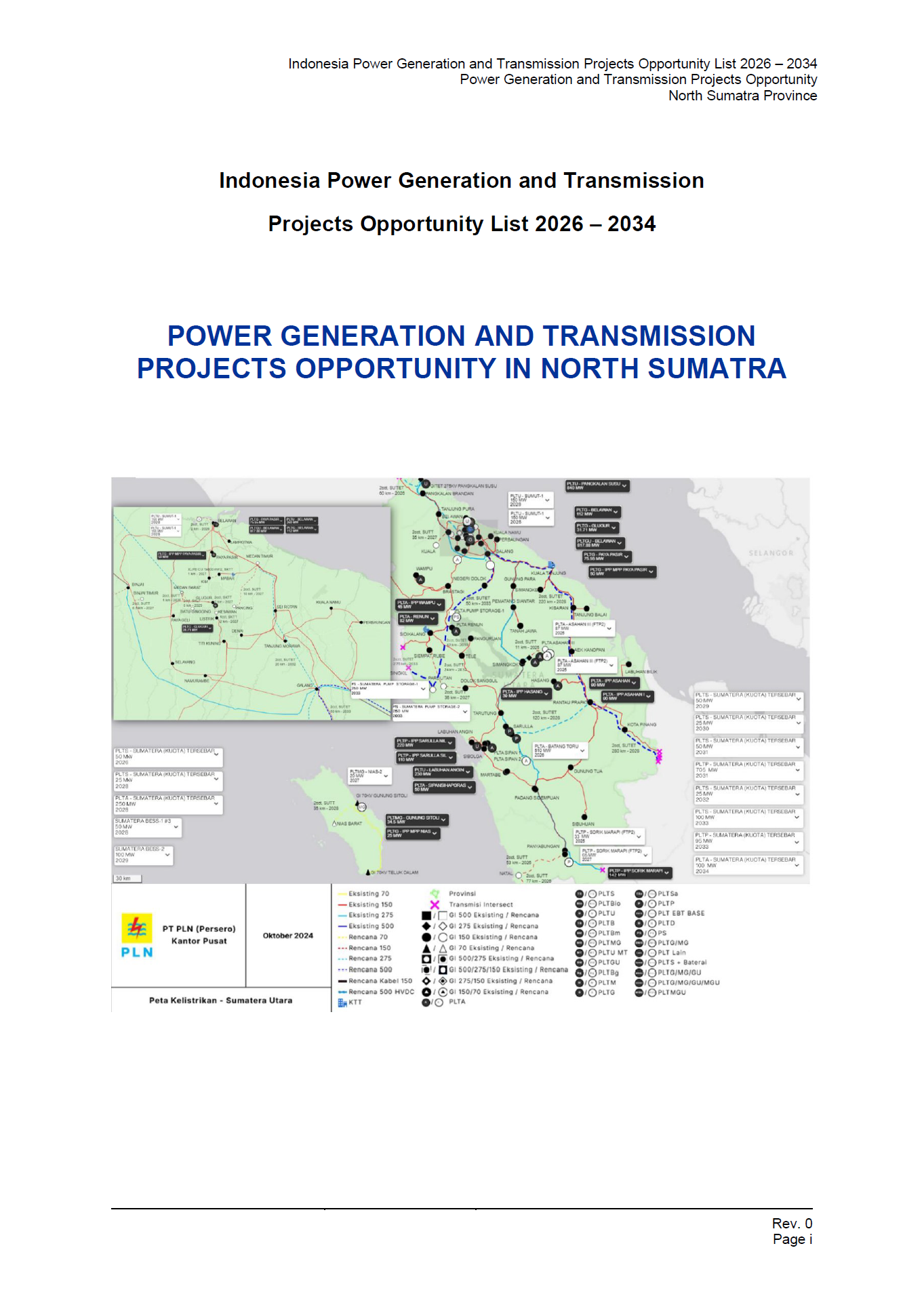
This report paints a vivid picture of the current electricity system, complete with maps and analyses of interconnections, peak loads, and supply from PLN, IPPs, and excess power sources. It highlights how the province's diverse resources, renewables for sustainability and fossils for reliability, create a balanced pathway to energy security, economic value, and alignment with global climate targets.
Inside the Report: Actionable Insights for Maximum ROI
Crafted from official sources like the RUPTL 2025-2034 and PLN's strategic plans, this report is packed with exclusive, up-to-date details you won't find elsewhere.
Here's what you'll discover:
a. Power Plant EPC and Investment Prospects: A exhaustive lineup of 77+ projects, from geothermal (PLTP) to hydropower (PLTA), mini-hydro (PLTM) sites, solar PV (PLTS), biomass (PLTBm), biofuel (PLTBio), and innovative Battery Energy Storage Systems (BESS). Each entry includes capacity, target Commercial Operation Dates (COD) under RE Base and ARED scenarios, status (construction, financing, planned, committed), and developers (IPPs, PLN, SH-PLN). Learn about quotas for distributed projects, flexibility in gas-fired capacities (±20% tolerance), and hybrid PLTS+BESS setups for grid stability.
b. Transmission EPC and Investment Opportunities: Dive into 40+ planned lines, including high-voltage 500 kV connections like Galang to Rantau Prapat (440 km) and 275 kV links such as Sarulla to Rantau Prapat (240 km). Details cover voltages, conductor types, circuit kilometers, COD timelines, and statuses, perfect for EPC contractors eyeing green enabling transmission, smart grids, and emission reduction tech like CCS/CCUS.
c. Substation Development Plans: Over 79 initiatives for new builds, extensions, and upratings, totaling 8,020 MVA. From 500 kV giants like Rantau Prapat (1x500 MVA) to 150/20 kV locals like Medan Barat (1x60 MVA), the report outlines capacities, voltages, and CODs to support industrial hubs, renewable integration, and demand growth.
d. Strategic Analysis and Potentials: Beyond lists, gain expert insights into potential energy sources, quota frameworks for renewables (e.g., hydropower up to 650 MW transferred to Java), development criteria (feasibility studies, grid connections, tariffs), and alignment with downstream processing (hilirisasi) for smelters and National Strategic Projects. Explore opportunities for government financing, soft loans, grants, and partnerships.
This isn't generic data, it's a thorough, forward-looking assessment that factors in regulatory approvals from the Ministry of ESDM, flexible siting for distributed projects, and adaptations for high-confidence industrial demands like INALUM's smelter expansion.
The Competitive Edge: Why This Report is Your Must-Have Investment Tool
In a market where timing is everything, this report equips you to act decisively. Investors who secure early insights into these opportunities, totaling gigawatts of capacity and billions in investments, will dominate. Whether you're an IPP scouting PPAs, an EPC firm bidding on transmission builds, a financier evaluating risks, or a consultant advising on sustainability, you'll uncover:
a. High-Return Prospects: Identify under-the-radar gems like Nias Island's isolated solar and biomass projects, or massive pump storage hydro (250 MW) for grid flexibility.
b. Risk Mitigation: Understand statuses to avoid stalled projects and leverage committed ones for quick wins.
c. Market Intelligence: Align with Indonesia's push for renewables (EBT), reducing emissions while tapping into incentives for clean tech.
d. Economic Impact: Contribute to regional growth, creating jobs and supporting industries in agriculture, manufacturing, and tourism.