
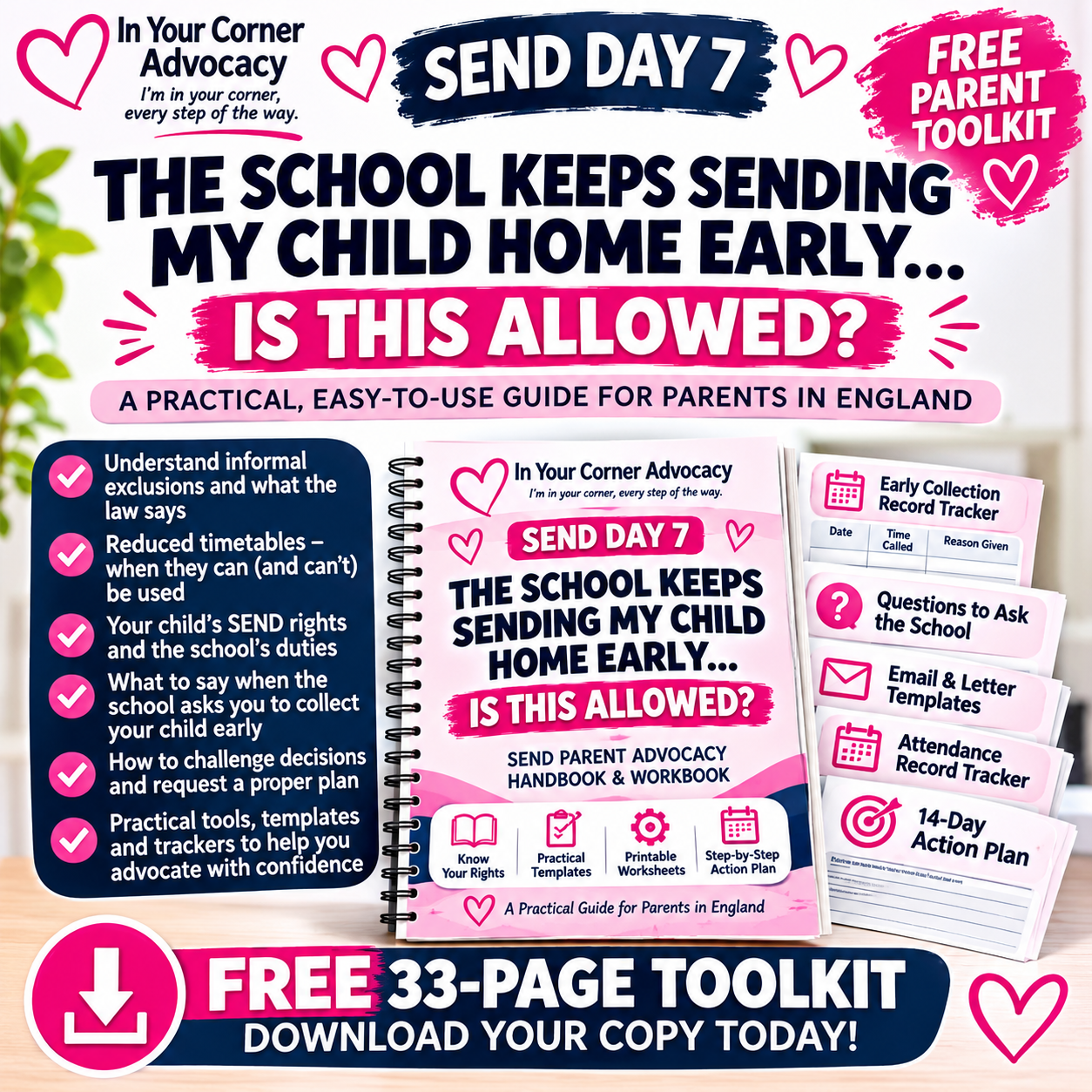
SEND DAY 7 The School Keeps Sending My Child Home Early - Is That Allowed?
💗 FREE SEND DAY 7 PARENT ADVOCACY TOOLKIT
🚨 “The School Keeps Sending My Child Home Early… Is This Allowed?”
A FREE 33-page practical handbook and workbook for parents and carers in England.
🌸 Price: £0.00 — Completely FREE!
🚨 DOES YOUR CHILD'S SCHOOL KEEP ASKING YOU TO COLLECT THEM EARLY?
Have you ever received a phone call saying:
❌ “Your child isn't coping today. Can you come and collect them?”
❌ “They've become dysregulated, so they need to go home.”
❌ “We think it's best if they only attend mornings for now.”
❌ “We can't manage their behaviour for the rest of the day.”
❌ “It's not an exclusion — we're just asking you to collect them.”
Perhaps you're receiving these calls repeatedly.
Perhaps your child is missing lessons, friendships and important support.
Or perhaps you've been asked to agree to a reduced timetable without understanding what it means or how long it will continue.
💗 You deserve to understand the rules, your child's rights and what questions you can ask.
That's why I've created this completely FREE toolkit.
🌸 WHAT WILL THIS TOOLKIT HELP YOU UNDERSTAND?
Schools have responsibilities towards children with SEND, including duties relating to special educational provision and, where applicable, reasonable adjustments.
There are also important differences between:
💗 A child genuinely needing to go home because they're unwell.
💗 A formal suspension, which must follow the relevant legal procedures.
💗 An informal or unofficial exclusion, which must not be used to avoid those procedures.
💗 A temporary part-time timetable agreed in exceptional circumstances to meet a pupil's individual needs.
These situations are not interchangeable, and understanding the difference can help parents ask informed questions.
📚 WHAT'S INCLUDED IN YOUR FREE 33-PAGE TOOLKIT?
✅ Understanding informal exclusions — What they are, why they matter and the difference between informal arrangements and formal suspensions.
✅ Reduced and part-time timetables — When they may be appropriate, the importance of parental agreement, regular reviews and a clear plan to return to full-time education.
✅ SEND responsibilities and reasonable adjustments — Understanding how a child's needs should be considered when difficulties arise at school.
✅ Attendance records — Why accurate recording matters and what information parents can request.
✅ Questions to ask when school calls — Practical prompts to help clarify why you're being asked to collect your child.
✅ 6 fictional family examples — Realistic scenarios to help you recognise different situations and consider possible next steps.
✅ 10 ready-to-adapt letters and emails — Including requests for clarification, attendance information, SEN support reviews, timetable reviews and complaints.
✅ 10 printable worksheets and trackers — Helping you record early collections, organise evidence, prepare for meetings and document agreed actions.
✅ A practical 14-day action plan — Step-by-step guidance to help you organise your concerns and move forward.
✅ Official guidance and useful links — So you can explore the relevant information yourself.
🌸 WHO IS THIS RESOURCE FOR?
This toolkit may be especially useful if:
💗 Your child is regularly being sent home early.
💗 School keeps calling you to collect your child because they're distressed or struggling with behaviour.
💗 Your child has been placed on a reduced timetable.
💗 You aren't sure whether an arrangement is a suspension or an informal exclusion.
💗 Your child is missing education because their needs aren't being adequately supported.
💗 You want to understand what questions to ask the SENCO or headteacher.
💗 You need help putting your concerns into writing.
💗 You want to organise evidence before a meeting or complaint.
✉️ WHAT IF YOU DON'T KNOW WHAT TO SAY TO SCHOOL?
You don't have to start with a confrontation.
Sometimes the most effective first step is asking clear questions and requesting information in writing.
For example:
“Please could you confirm the reason my child was asked to leave school early, how the absence has been recorded, what support or reasonable adjustments were considered, and what steps will be taken to help them access their full education?”
This toolkit provides adaptable wording and practical tools to help you communicate your concerns confidently.
💗 YOUR CHILD'S EDUCATION MATTERS
A child struggling at school should prompt careful consideration of their needs, the support available and the appropriate next steps.
Parents should not be left confused about why their child is missing education or whether an arrangement is being properly recorded.
Being informed can help you ask better questions, keep accurate records and advocate more effectively for your child.
🌸 WHY AM I OFFERING THIS FOR FREE?
At Inyour-corner Advocacy, I believe that access to practical information shouldn't depend on a family's financial circumstances.
Navigating SEND processes can feel complicated, exhausting and isolating.
My aim is to make these systems easier to understand by sharing practical resources that parents can use themselves.
💗 No payment required.
💗 No obligation to use paid services.
💗 Just useful information, templates, worksheets and guidance.
📥 DOWNLOAD YOUR FREE COPY TODAY!
SEND DAY 7 — THE SCHOOL KEEPS SENDING MY CHILD HOME EARLY… IS THIS ALLOWED?
📚 33 pages of FREE practical parent advocacy support.
Download your PDF, save it to your device and print whichever worksheets or templates you need.
💗 JOIN OUR FACEBOOK COMMUNITY!
We're building a supportive community of over 4.2K people on Facebook.
🌸 Follow: Inyour-corner Advocacy
For more:
💗 FREE SEND parent advocacy resources.
💗 Children's Services information and guidance.
💗 Practical letter templates and worksheets.
💗 Information to help you navigate complex processes.
💗 A community where families can learn, share experiences and support one another.
Please share our free resources with families who may benefit by directing them to the original download page.
🌸 I'm in your corner, every step of the way.
Inyour-corner Advocacy 💗
Important information: This toolkit provides general educational information and practical self-advocacy guidance for families in England. It does not constitute individual legal advice or legal representation. The appropriate procedures and options depend on the circumstances of each case. For specialist legal advice, contact an appropriately qualified professional.