
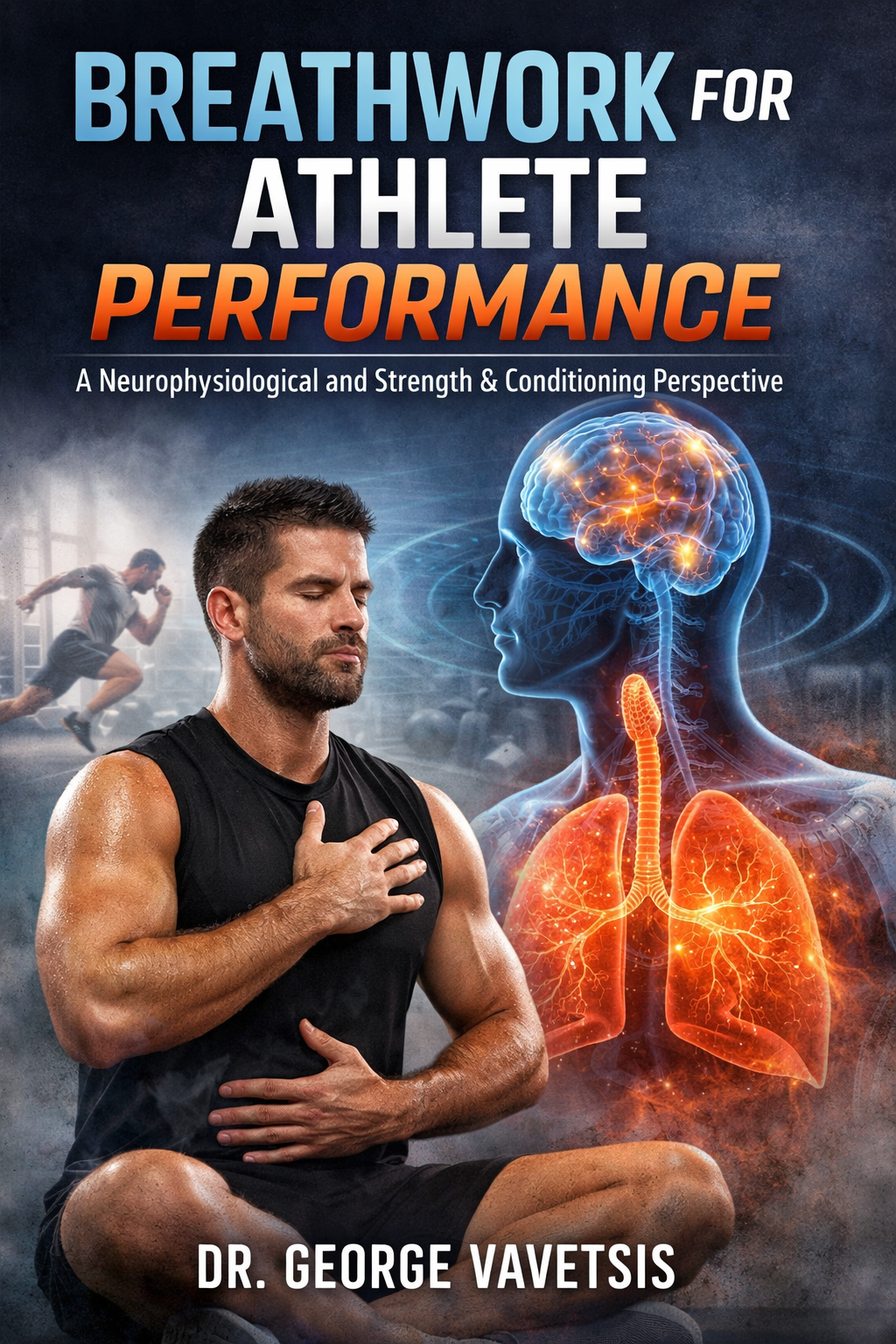
Breathwork for Athlete Performance
Pages: 667
In the modern era of high-performance sport, the pursuit of marginal gains has extended beyond traditional domains of strength, speed, and endurance into the nuanced regulation of physiological systems that were once considered largely autonomous. Among these, respiration stands as a uniquely accessible yet profoundly underutilized performance variable. Breathwork, when reframed through the lens of neurophysiology, biomechanics, and applied strength and conditioning, emerges not merely as a recovery modality or relaxation technique, but as a central integrator of human performance.
Respiration is not simply a gas exchange mechanism; it is a dynamic, rhythm-generating system deeply embedded within the central nervous system, interfacing with motor control, autonomic regulation, metabolic demand, and cognitive function. As outlined in the foundational concepts of this work, breathing operates through a dual-control system—simultaneously governed by autonomic brainstem centers and modifiable through higher cortical input . This duality renders it uniquely trainable, allowing practitioners to influence physiological state, movement efficiency, and performance outcomes through targeted interventions.
From a strength and conditioning perspective, breathing must be reconceptualized as a primary motor pattern—one that precedes and modulates all other movement patterns. The synchronization of respiratory cycles with locomotor and force-production tasks is not incidental; it is a fundamental determinant of neuromechanical efficiency. The central pattern generators responsible for rhythmic respiration are intricately linked with locomotor circuits, creating a unified system where breathing timing influences force application, stabilization, and energy transfer across the kinetic chain . Consequently, any disruption in this rhythm—whether due to fatigue, stress, or dysfunctional breathing patterns—can propagate inefficiencies throughout the entire movement system.
Elite athletes operate at the edge of physiological capacity, where small perturbations in internal regulation can produce disproportionate effects on performance. Under conditions of high metabolic stress, the body prioritizes survival-driven autonomic responses, often overriding optimal breathing strategies. This shift manifests as increased respiratory frequency, reduced tidal volume, and compensatory recruitment of accessory musculature, leading to elevated energy cost and premature fatigue. The transition from diaphragmatic to apical breathing, commonly observed under stress, reflects not only a mechanical inefficiency but also a breakdown in neuromuscular coordination and interoceptive awareness.
Interoception—the ability to sense and interpret internal physiological signals—plays a central role in breath regulation and performance optimization. The cortical representation of respiratory signals within the insular and somatosensory cortices enables athletes to consciously modulate breathing patterns, provided that sufficient attentional resources are available . Through systematic training, this interoceptive accuracy can be enhanced, allowing for more precise regulation of breathing under varying task demands. Such adaptations are underpinned by neuroplastic changes that improve the efficiency of neural networks responsible for respiratory perception and control.
This book is grounded in the premise that breathwork must be integrated into the broader framework of strength and conditioning, rather than treated as an isolated or ancillary practice. The objective is to provide coaches and practitioners with a scientifically rigorous, practically applicable system for assessing, training, and optimizing respiratory function in athletes. This includes the development of breath awareness protocols, CO₂ tolerance training, rhythm coupling strategies, and diaphragmatic re-patterning interventions—all aligned with the principles of exercise prescription and performance periodization.
A key theme throughout this work is the concept of adaptability. High-level performance demands the ability to transition seamlessly between controlled and automatic states of breathing. While conscious regulation can enhance parasympathetic activation, improve heart rate variability, and facilitate recovery, it is neither feasible nor desirable to maintain such control under all conditions. Instead, athletes must develop the capacity to modulate their breathing strategy in response to task complexity, intensity, and environmental constraints. This dynamic interplay between volitional control and autonomic regulation represents a cornerstone of advanced breathwork training.
Moreover, breathing serves as a bridge between physiological and psychological domains. The modulation of respiratory patterns can influence emotional state, cognitive function, and attentional focus, thereby impacting decision-making and execution in high-pressure environments. Slow, controlled breathing has been shown to enhance vagal tone and promote a shift toward parasympathetic dominance, creating a physiological state conducive to precision, composure, and resilience. Conversely, dysregulated breathing can amplify stress responses, impair coordination, and degrade performance.
From a methodological standpoint, this text adopts an integrative approach, combining insights from neuroscience, respiratory physiology, biomechanics, and applied coaching practice. Each chapter is designed to translate complex scientific principles into actionable strategies that can be implemented within training environments. Emphasis is placed on specificity, progression, and individualization—key tenets of effective strength and conditioning programming.
In practical terms, the implementation of breathwork within athletic training requires systematic assessment and monitoring. This includes the identification of breathing patterns, evaluation of diaphragm function, and analysis of breathing–movement coupling. Technologies such as respiratory monitors, force plates, and motion analysis systems can provide valuable data, but equally important are the observational and palpatory skills of the coach. The ability to detect subtle deviations in breathing behavior and intervene appropriately is a hallmark of high-level coaching.
Ultimately, the integration of breathwork into athletic preparation represents a paradigm shift—one that recognizes respiration as a central determinant of performance rather than a passive background process. By harnessing the trainable aspects of the respiratory system, coaches and athletes can unlock new dimensions of efficiency, resilience, and control.
This book is intended for practitioners who seek to operate at the highest level of performance science—those who understand that excellence is not achieved through isolated improvements, but through the optimization of interconnected systems. Breathwork, when approached with scientific rigor and applied precision, offers a powerful tool for enhancing human performance in its most complete and integrated form.