
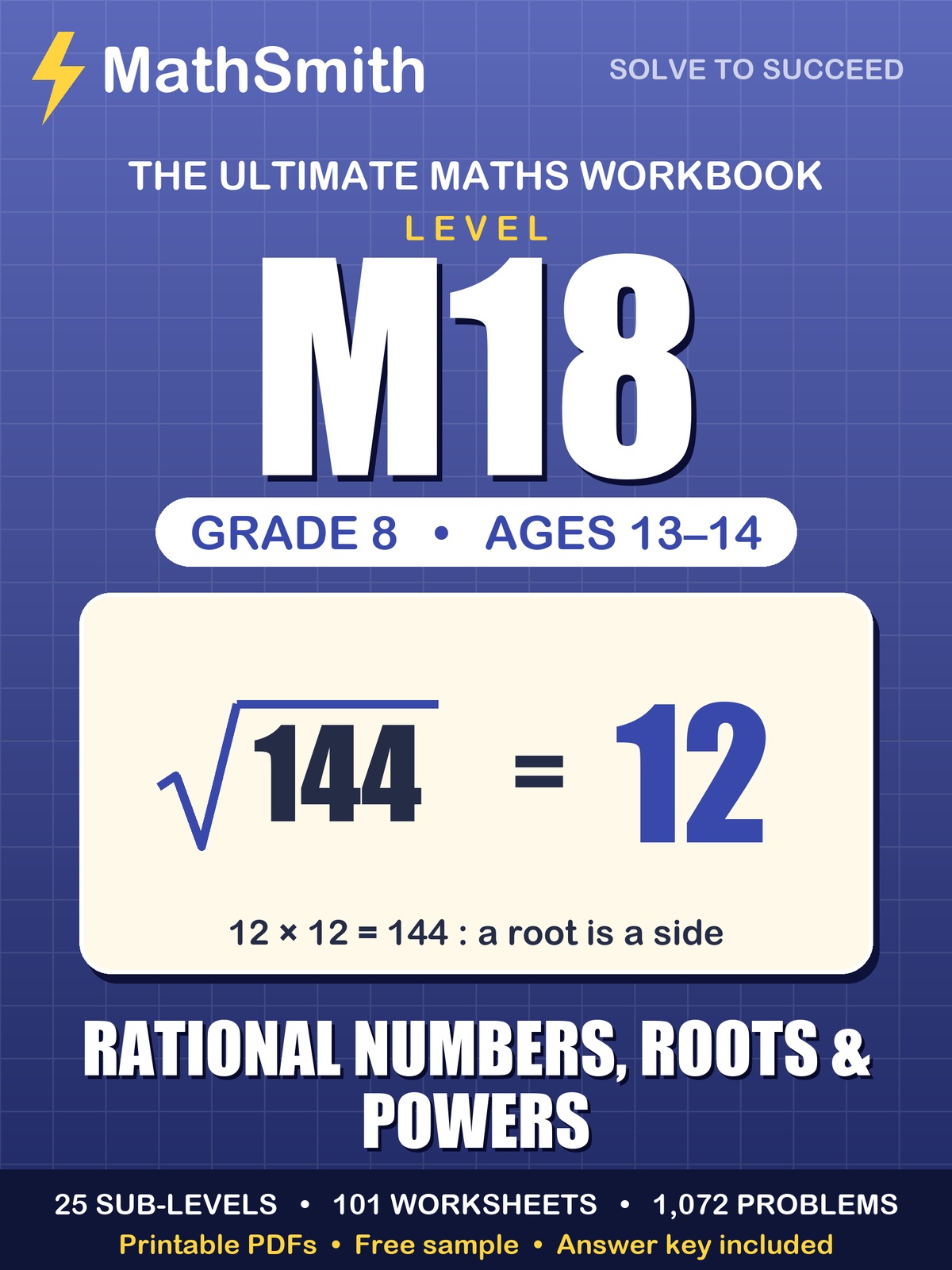
Gr 8 Maths Worksheets (Ages 13-14) | Level M18: Rational Numbers, Roots & Powers
🎓 Launch offer: 80% OFF every MathSmith workbook with code LAUNCH80 (first 1000 orders). Click Add to Cart, then enter LAUNCH80 in the discount box before you pay.
Not sure which level your child needs? Take the free 40-question placement test: https://ebooks.thecodecrafters.net/placement
See free sample pages first: https://ebooks.thecodecrafters.net/
Help your child build absolute confidence and mastery in mathematics. This comprehensive workbook from MathSmith takes a highly structured, "one-rung-at-a-time" approach to Rational Numbers, Roots and Powers, ensuring students fully understand concepts before moving forward.
Instead of overwhelming learners with random equations, this workbook uses a carefully scaffolded, predictable learning ladder. It is perfect for homework, structured independent study, or mastery practice.
📊 What Is Included?
1 Complete Level (Level M18)
25 Structured Sub-levels for gradual progression
101 Printable Worksheets
1,072 Total Problems for thorough practice
Full Answer Key online, unlocked by the order ID on your Payhip receipt, for quick, stress-free marking
🗺️ Curriculum Breakdown
This collection focuses deeply on mastering Rational Numbers, Roots and Powers through a carefully curated system:
What the rational numbers can and cannot do (7 Sub-levels): Eight rungs about a SET rather than about numbers, which is a new kind of question. Adding, subtracting and multiplying two rationals always gives another one; dividing does too, except by nought - and that one hole turns up again two rungs later as the only number with no multiplicative inverse. Then the order and the grouping, where half the questions are the two that FAIL, because a child who believes subtraction can be turned round will write 8 - 3 = 3 - 8 without blinking. The strand ends on the property that separates the rationals from the whole numbers: between 1 and 2 there is no whole number at all, and between any two fractions there are more than anybody can count.
Squares, and what they cannot end in (3 Sub-levels): A square number is what a square number of things makes, and the two facts worth knowing about one are both checks a child can run without arithmetic: a square never ends in 2, 3, 7 or 8, and the square of an odd number is odd. Then the patterns that give a square without multiplying - the gap between one square and the next is the two numbers added - and finally the recipe for Pythagorean triplets, which turns the list M17 used into something a child can make more of.
The sign, and five ways to find a side (6 Sub-levels): Because that is what a square root is. The mark itself arrives here - three rungs have found roots without writing one - and the bar over it is the half that matters: it says how much of what follows the root is taken of, so the root of 9 plus 16 is 5 and the root of 9, plus 16, is 19. Taking the odd numbers away is the slowest method in the book and the one that explains all the others; pairing off prime factors says why a root is what it is, since the number was one thing multiplied by itself; and the long division finds the side one digit at a time, which is why its digits are paired - each pair gives exactly one digit of the answer. Then the decimal, where the pairs are counted from the POINT and counting them from the left instead makes the answer ten times too big. The strand closes on the roots that do not come out at all, where "between seven and eight" is a complete and useful answer.
One more dimension (2 Sub-levels): The same two ideas with a three in place of the two, taught a rung apart so that the difference is visible rather than blurred: a cube's prime factors come in threes because the number is one thing multiplied by itself twice over, and the little 3 in the crook of the sign is the whole of what distinguishes it on paper - a root written with no index at all is a square root. The arithmetic is where it bites - a child who knows 12 squared is 144 will guess 12 cubed and be out by a factor of twelve.
Powers below nought, and the numbers they make readable (4 Sub-levels): A negative exponent is not decreed, it is forced: go down the powers of two and every step halves, so the step after the power of nought has to be a half. Once that is accepted the laws do not change at all, which is the next rung - and a child who was told the laws rather than shown the factors will not believe that adding the exponents can make something smaller. Then what the whole thing was for: nobody can count the noughts in 0.000 004 7 reliably, and anybody can read 4.7 times ten to the minus six.
Three tricks, explained rather than performed (3 Sub-levels): A two-digit number written 10a + b, which is M16's algebra used on something a child already knows: reverse it, subtract, and the b's cancel, so the difference is always a multiple of nine - obvious rather than magic. Then the divisibility tests they have used for years, explained by one fact: ten leaves one when divided by three or by nine, so every ten is worth one and the number is worth its digits added. And finally a letter standing for a digit, which is the only algebra in the book whose answer can be found by trying all ten possibilities.
🎯 Who Is This For?
Parents looking to provide structured math support at home.
Homeschoolers searching for a sequential curriculum to guarantee zero gaps in math skills.
Teachers & Tutors looking for bite-sized, scaffolded printables for classroom morning work or targeted intervention.
📖 How To Use This Workbook
Print the workbook, read each rung's method page, and let your child work inside the printed frame. Then check the answers your way: in the printable answer-key PDF included in this download, or online, one page at a time, with the order ID on your Payhip receipt (valid for six months). Please keep the answer key for the adult marking the work and do not share it with your child: the workbook only works if they have worked each answer out for themselves.
Step-by-step manual and video guide: https://ebooks.thecodecrafters.net/manual/
Check the answers: https://ebooks.thecodecrafters.net/answers
⚙️ Digital Delivery Details
Format: four instant-download PDFs (free sample, sample answers, workbook, full answer key). The answer key is also available online.
Print Ready: Easily printable on home or school printers.
Usage: Licensed for individual family or single-classroom use.