
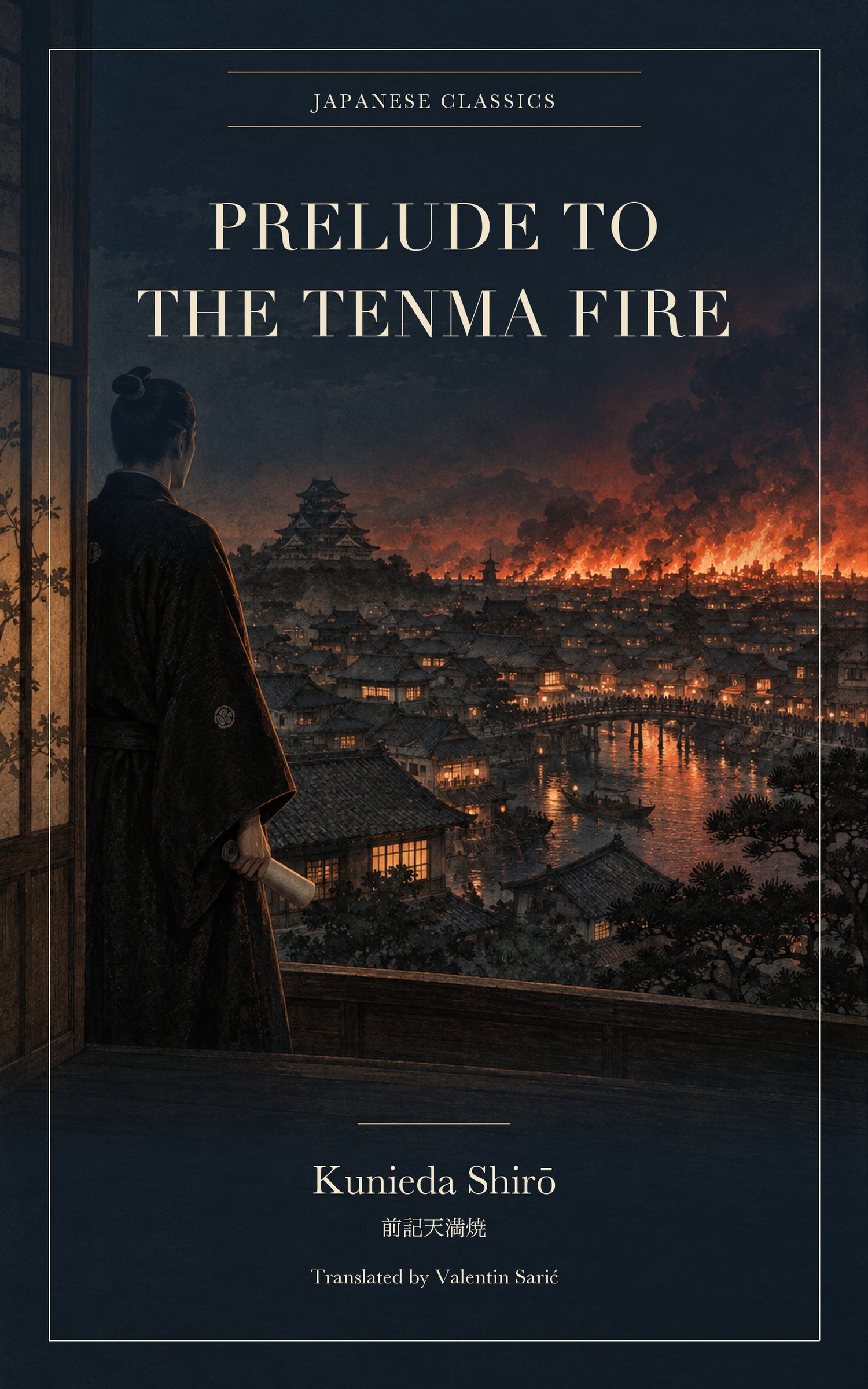
Prelude to the Tenma Fire
Ōsaka in the seventh year of Tenpō, the year before the rising. In an academy on Tenma Street, Ōshio Chūsai lectures his disciples on Wang Yangming, and then, in his private room, tells his retainer Utsugi Norinojō what he means to do: the famine has no bottom, the Shogunate will not feed the starving, and a valuable object the merchant house of Hiranoya is sending up to Edo will be taken and turned into relief money. Norinojō agrees with the anger and not with the method. Walking home he is ambushed by three fellow students who turn out to be spies, kills one of them, and decides that the disgrace of the word robber must fall on him instead of on his master. He takes another name and disappears.
What follows is not the rebellion but the year in front of it. Outside a Hiranoya villa a young swordsman beats down three masked men with the back of his blade and is then offered ten ryō a day by a courteous, chattering villain in black named Samejima Daigaku, who founds his offer on a Mijin-school stance called the Twisted Screw and on the promise to kill him if he declines. The chase moves to Edo: the Kagaya inn, a guest who vanishes out of a locked night, the okappiki Matsukichi — Polite Matsu — reasoning on an abacus he works inside his own coat, and a sealed detached building in a garden that the town calls the room that is never opened.
Inside it is a chapel of the forbidden creed, and its mistress is Okumi, the one follower of the shrine woman Mitsugi who slipped through Chūsai's hands years ago when he was still a yoriki. Around her the book gathers the rest: a merchant father and son found bloodied in their own strongroom with a planted sword, a wet nurse and a daughter driven briefly out of her mind, an opium room in the Shanghai manner, and two Japanese members of a Chinese secret society, the White Tuft, who came home for the same woman. Kunieda ties every thread in the last two chapters, in his own voice, and then lets his hero step back from history: Chūsai burns Ōsaka, and Norinojō, having failed to talk him out of it, withdraws and keeps himself whole.
First English translation, complete and unabridged, with the author's terminology and his own inconsistencies kept and footnoted rather than corrected.
English-language digital edition. Translated by Valentin Sarić.
You receive: a 111-page PDF and an EPUB edition.
Digital download only. No physical book is shipped.