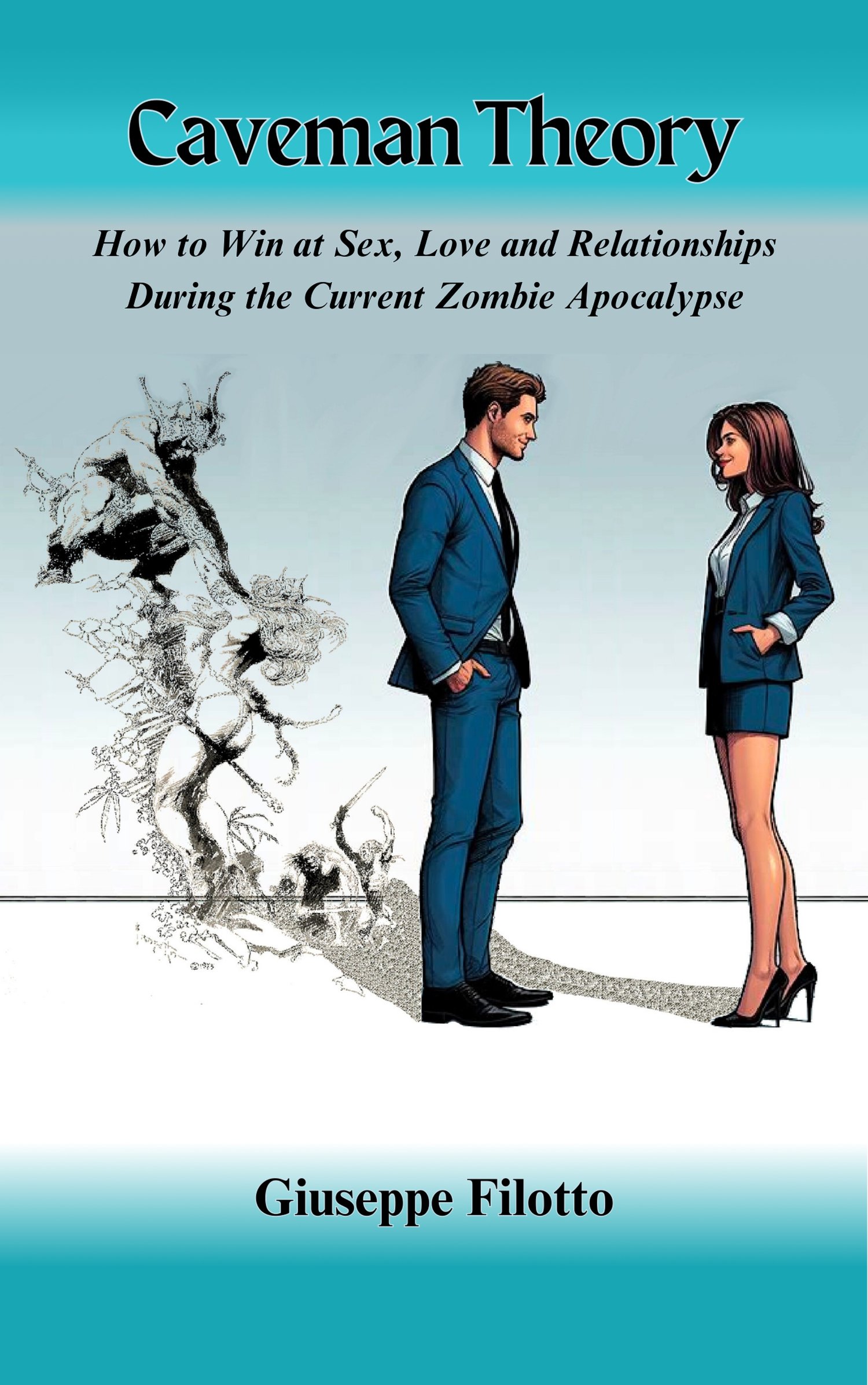
Caveman Theory is a book I think a great many men should read, particularly younger men trying to make sense of a dating culture that often feels confusing, adversarial, and strangely dishonest. It is also worth reading for the curious woman who wonders why so many men seem frustrated, checked out, or simply unable to understand what women are looking for. Filotto’s language is deliberately provocative, and at times he swings a rhetorical axe where some might have used a scalpel. But underneath the colorful rhetoric (which is indeed funny and sardonic at times) is a serious attempt to recover some of the practical wisdom about men, women, courtship, marriage, character, and family that modern life has largely stopped transmitting. You do not have to agree with every premise to find the model useful. The central goal is to understand men and women as they actually behave, rather than as ideology tells us they ought to behave, and then use that understanding to build relationships that are better, more stable, and more humane.
The book places a premium on observing reality, rather than living in fantasy land. There is a hierarchy in the world of men, and a very different one in the world of women. This is the basis of the book’s examples, theory, model of reality, and advice.
I actually like the fact that Giuseppe uses evolutionary psychology as one of the lenses for his model, even though I am as skeptical of the ultimate metaphysical truth of Darwinian evolution as he is. A model does not have to answer every question about human origins in order to be useful. The interesting question is whether it helps explain recurring patterns in attraction, courtship, conflict, sex, loyalty, status and family formation. Filotto spends a lot of time on the differing “basic needs” of men and women: sex, variety, companionship and love on the male side; safety, security, variety, companionship, sex and love on the female side. You can quarrel with the order, the universality, or some of his explanations, but the framework is useful precisely because it forces the reader to ask a question most modern relationship advice avoids: What if men and women are not interchangeable psychological units with different bodies, but overlapping and complementary creatures with different default pressures, fears and desires?
One of the things I love about the book is the ironic, acerbic, and witty asides. These break up an otherwise serious subject matter with some real chuckles, and humanize the author. The author also admits that he has made most of the mistakes in the book himself (well, at least a few of them). Unlike a lot of books from the so-called manosphere, he never comes across as holier-than-thou or supercilious. You have a sense that if you ran into him on the street or in a bar, he would listen to your situation, make a joke about it, and then tell you to stop making those dumb mistakes over and over again, wise up, and read Caveman Theory.
Caveman Theory is not simply another Red Pill or pick-up-artist manual wearing heavier philosophical clothing. Filotto is often just as contemptuous of those movements as he is of feminism. He argues that PUAs reduce women to mechanisms and tricks, that MGTOW can become a refuge for bitterness, and that men who make “all women are terrible” into a worldview are often protecting themselves from the much harder task of becoming better men. That is important because it changes the emotional center of the book. The end goal is not racking up sexual conquests, “winning” against women, or retreating from them. The goal is a lasting relationship, marriage, children if possible, and the difficult achievement he repeatedly calls Sacrificial Love.
The criticism of Protestantism makes up an important part of the book, and this will probably be one of the harder sections for many American readers. I grew up Lutheran, so I am not approaching the subject as someone raised inside Filotto’s Catholic worldview. Still, his broader criticism of the mechanization of life is worth taking seriously even if you reject his theology. I remember reading Max Weber in college and encountering the “Protestant work ethic” as a historical force. Filotto pushes the argument much further: modern life increasingly turns human beings into economic units, consumers, workers, demographic categories and replaceable parts. Whether Protestantism deserves as much blame as he assigns it is something for the reader to think about. The dehumanizing tendency itself is much harder to deny, and it matters to relationships because love, marriage, children, loyalty, duty and sacrifice are exactly the kinds of things that resist being reduced to transactions.
In the introduction, Giuseppe states that “Caveman Theory is based on the relatively simple concept that for the vast majority of Human history, the survival pressure against human males has mostly been the objective Universe…” From there he builds the basic model: men historically faced more pressure from nature, danger, work, violence and other men, while women faced a different mix of biological vulnerability, mate selection and social competition. Whether every historical claim survives academic scrutiny is not really the most interesting point. What matters is that the model gives him a way to explain why men and women can look at the exact same relationship problem and sincerely experience it as two different problems. Anyone who has been married, divorced, dated for any length of time, or simply listened carefully to both sexes knows that this phenomenon is real enough.
As the author notes, “The social hierarchy of men is therefore pretty rigid and enforced, while the social hierarchy of women is far more flexible…” His treatment of the male and female socio-sexual hierarchies is one of the most entertaining parts of the book, but also one of the easiest to misunderstand if you treat the categories as sacred taxonomy. Filotto himself repeatedly says these are models: tools for prediction and observation. Used that way, the categories can be useful. The point is not to run around announcing that you are an Alpha, Sigma, Delta or anything else. The useful question is much less flattering: How do other people actually react to you, and what does that tell you about who you really are?
Giuseppe also brings in Imago Theory, which is something I had not studied closely before reading the book. The basic claim is that childhood wounds and patterns can help determine whom we later find intensely attractive, because part of us is trying to replay and finally resolve an old emotional story. The disturbing implication is that “chemistry” is not always evidence that you have found your soulmate; sometimes it may be evidence that you have found the person best equipped to reopen an old wound. That is a valuable idea for men and women alike. Filotto’s practical conclusion is not that difficult relationships should always be abandoned, nor that suffering is automatically noble, but that we ought to understand our own patterns and choose someone with enough character to face the inevitable difficulties of a real relationship rather than simply disappearing at the first unpleasant emotion.
Filotto does not describe women as the only sex needing safety and security. He argues that men need a different kind of safety: the emotional and psychic knowledge that the woman beside them is actually on their side. A man may be expected to provide materially, solve problems and stand between his family and danger; what can keep him going when he fails, loses money, suffers humiliation or has the rest of the world telling him he is finished is a partner who still believes in him. This is one of the places where the book becomes much less about domination and much more about reciprocity. Men and women may need different things at different moments, but each can either strengthen or slowly destroy the other.
Here’s a quote that I highlighted, because it struck home: “By and large, the problem we have is one of constitution. Neither men nor women are very willing to push through whatever difficulties they may encounter, which usually require a change in their own character and behavior more than in that of others.”
Caveman Theory really stresses something that I agree with completely, despite the fact that it is brutally difficult to implement in practice, because of our own prejudices and biases: “Realise reality as it is. Not as you or someone else wishes it were.”
He also points to “a higher truth, also based in objective reality, far more difficult to discern, but real nonetheless, that against most of the worldly evidence you can see, hear, and touch, actually informs the worldly reality, and sits in a higher position to it.” It is obvious that the author’s conversion to Sedevacantist Catholicism has had a profound effect on him. As someone who has interacted with the author, and who has been personally aided by him in a number of difficult situations, I can attest to the fact that his faith is real and his character is impeccable.
Filotto also goes after modern feminism, and he does it with a flamethrower. This is the section most likely to make a progressive or feminist reader throw the book across the room, which would be unfortunate because some of the questions underneath the rhetoric are worth asking. Have we sometimes confused equality before the law with the claim that men and women are psychologically identical? Has useful concern about genuinely destructive male behavior expanded into a suspicion of ordinary masculinity itself? Do slogans such as “happy wife, happy life” sometimes teach men appeasement rather than love? Do both men and women now receive terrible advice about sex, marriage, commitment and what they should expect from one another? Filotto’s answers are often much harsher than the mainstream, but the value of the book is that he forces the questions into the open. Even on the especially delicate issue of sexual consent, his practical advice is safer and simpler than the surrounding rhetoric might lead you to expect: do not push stated boundaries, and when in doubt, ask.
Once the author has laid out the model, he turns increasingly toward practical questions: what men and women actually need from one another, how attraction can go wrong, how resentment grows, how people test boundaries, and why modern relationships collapse so quickly. “The Interplay Between the Hierarchies” is a critical chapter because it stops treating male and female needs as isolated lists and asks what happens when they collide. A man may experience sex as reassurance, closeness and love while a woman may need safety and security before she can relax into sexual intimacy. A woman may experience a man’s steadiness as attractive while the same man, trying too hard to please her, can gradually erase the very independence that attracted her in the first place. Filotto states some of this in deliberately brutal language, including his theory of female “solipsism,” but the more useful takeaway is less inflammatory: many apparently irrational conflicts become more understandable once we stop assuming that the other sex is experiencing the situation through the same priorities we are.
The book goes into interesting depictions of how the various male types in the SSH react in various situations. All of it is a must-read. The author himself is a Sigma/Scout type, which of course everyone finds fascinating, and every Gamma imagines himself to be. Well, Filotto explains how “fascinating” in theory may not be even likeable in reality.
The wonderfully titled chapter “Choose Your Settings, Player One” makes a serious point beneath the funny gimmick: a great many people drift into a relationship without ever deciding what kind of relationship they are trying to build. Casual sex, serial monogamy, a trophy partner, cohabitation, marriage, children and lifelong fidelity are not just different stops on one automatic escalator. They are different choices with different incentives and likely outcomes. Filotto asks the reader, especially the male reader, to stop pretending that he can choose one set of behaviors indefinitely and somehow wake up at the destination produced by another. Even readers who reject his Catholic moral framework can profit from that. Decide what you are aiming at before desire, loneliness or inertia makes the choice for you.
For me, the main reason men should read this book is that, beneath all the jokes and provocation, it is a call for self-knowledge and self-improvement. Filotto does not merely tell men that women are difficult and send them away feeling vindicated. He repeatedly turns the knife back toward men: know yourself, stop lying to yourself, stop pedestalizing women, stop being bitter, become competent, become useful, become physically and psychologically stronger, control your impulses, choose carefully, and accept responsibility for the kind of life you are building. Women can profit from the book for a parallel reason. They do not have to accept every generalization about female psychology to ask whether modern dating culture encourages status chasing, endless comparison, disposable partners, and unrealistic expectations that make durable love harder to recognize when it appears.
His discussion of weak male behavior is one of the book’s strongest correctives to the worst parts of the so-called manosphere. Filotto has little patience for the man who turns rejection into a philosophy, who blames women for his lack of success, or who adopts a social label as an excuse to stop developing himself. His chapter “The Bitterness of Weak Men” has a hard-to-swallow title, but the underlying message is useful: resentment is not strength, self-deception is not insight, and merely learning a vocabulary for female behavior does not make a man worthy of a good relationship. He also encourages women to examine their own habits and assumptions and to recover forms of femininity that modern culture sometimes treats as weakness: warmth, nurture, loyalty, grace and the ability to make a shared life feel like a home rather than a negotiation.
A female reader who makes it past the book’s abrasive language may also be surprised by some of Filotto’s most affectionate passages. He writes admiringly of motherhood, childbirth, nursing, feminine tenderness, the exhausted mother who still cares for the people she loves, and the wife who turns a house into a home. He is not arguing that women are defective men. Quite the opposite: he is arguing that the distinctively feminine virtues are civilization-forming virtues and that men have a duty to create the conditions in which those virtues can flourish. Likewise, he insists that men and women need one another and that the highest form of their union is not a permanent battle for leverage but a family built around mutual sacrifice, loyalty, tenderness and joy.
I found the discussion of “mechanization” one of the most interesting parts of the book. Filotto is warning against turning human life into systems, formulas, markets and techniques. That criticism applies not only to corporations and bureaucracies, but also to modern dating itself: apps turn people into profiles, “the market” turns desirability into a score, pornography turns sexuality into consumption, and some corners of the manosphere turn courtship into a set of manipulative procedures.
In “Selecting a Wife,” Filotto makes another important point: before he tells a man what to look for in a woman, he tells him to look at himself. What exactly is he offering? Is he actually ready for children? Is he prepared to remain faithful to one woman for life? Is he choosing a wife for character and family, or choosing the woman who will impress his friends? This is where the book’s emphasis on objective reality becomes personal rather than ideological. It is easy to make a list of what the opposite sex is doing wrong. It is much harder to ask whether you are the sort of person that the partner you say you want would be wise to choose. Caveman Theory is at its most useful when it forces that question.
You should read this book more than once. Men, especially younger men who feel that nobody has ever explained the rules of the game to them, are likely to find parts of it clarifying, infuriating and liberating in roughly equal measure. Women who are curious about how at least one unapologetically male observer interprets modern dating may find it equally revealing, even when they disagree with him. Give it to sons and grandsons who are old enough to read it critically. Argue with it. Test its models against reality. Keep what proves useful and reject what does not. That is, in fact, close to Filotto’s own advice about models. The hopeful message underneath the “zombie apocalypse” humor is that men and women are not doomed to hate, exploit or misunderstand one another. They can learn to see more clearly, choose more wisely, grow in character, and build something durable together. That is a much more interesting ending than simply acquiring ammunition for another culture-war argument.