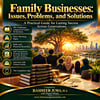
Family Businesses-Issues, Problems and Solutions with the app
Is your family business ready for the next generation?
Most family businesses do not survive beyond the second generation. The causes are rarely commercial. They are weak governance, unclear ownership, avoided conversations, and unplanned succession.
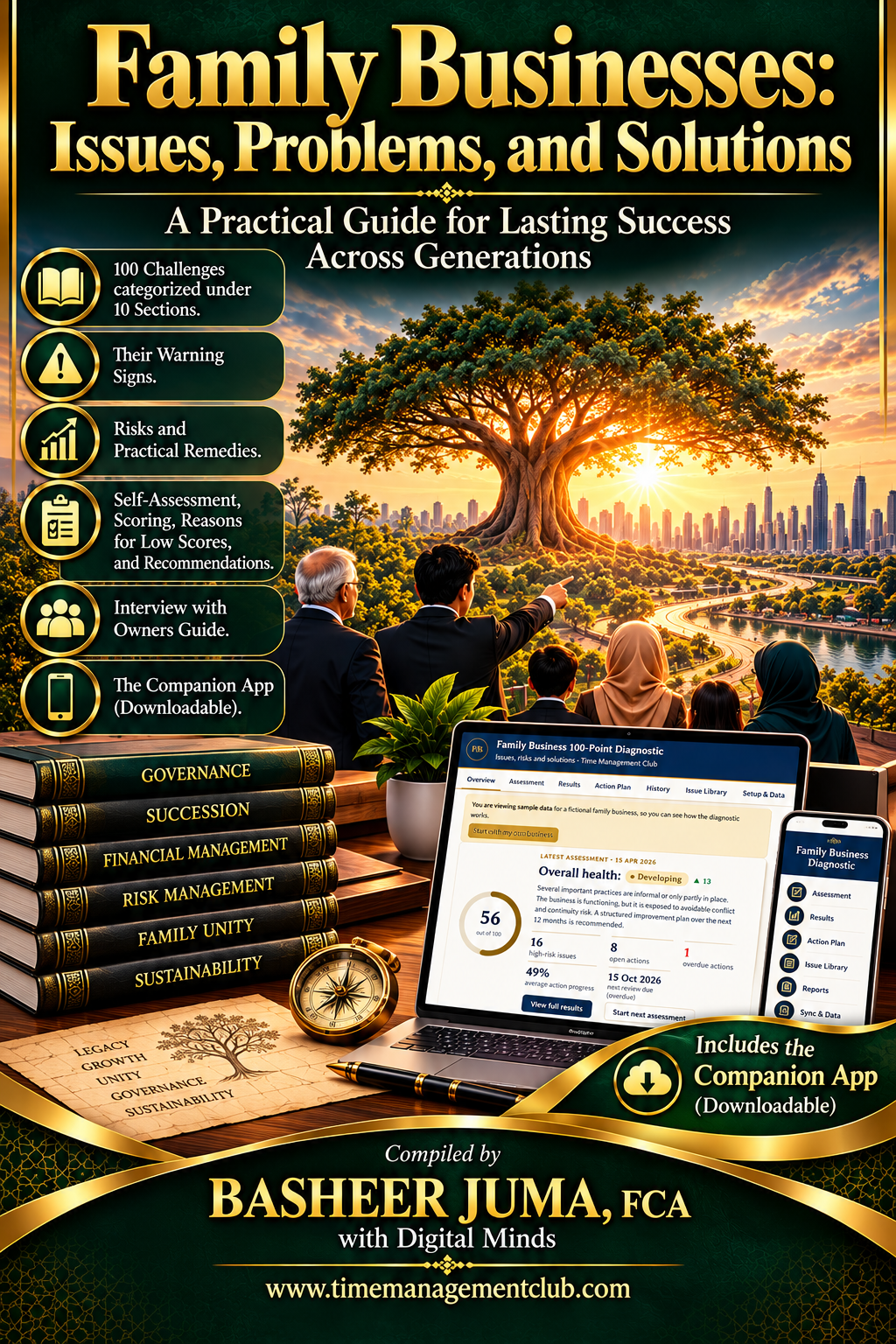
Family Businesses: Issues, Problems and Solutions by Basheer Juma FCA is a practical guide to finding and fixing these problems early.
Inside you will find:
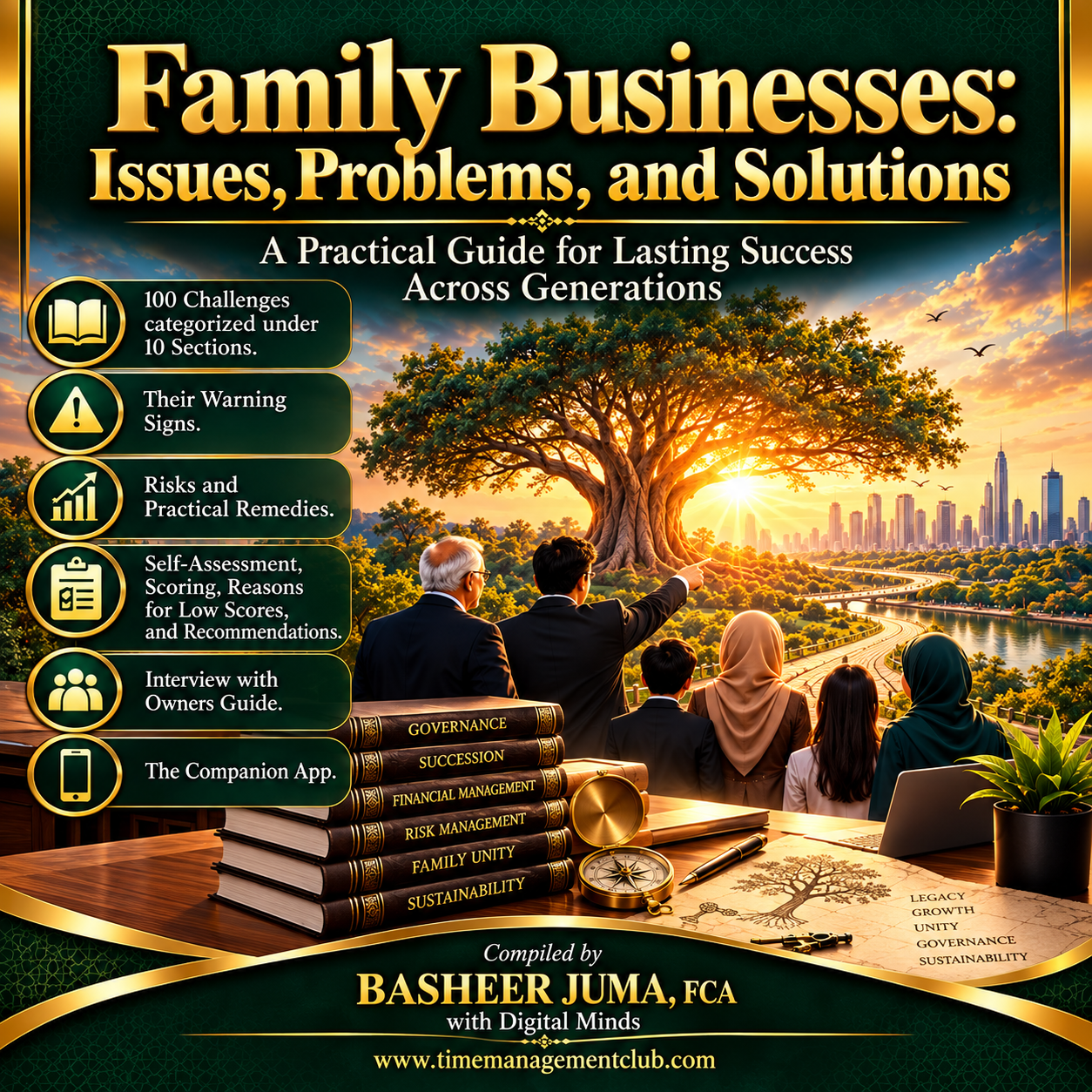
- 100 issues across ten areas: governance, family dynamics, ownership, management, finance, strategy, communication, succession, philanthropy and legacy
- For each issue: warning signs, risks, practical solutions and the lead role
- A 100-point self-assessment with a simple scoring method and five interpretation bands
- A stakeholder interview guide with 100 questions
- An illustrative assessment report and an action plan framework
Ideal for founders, next-generation leaders, family councils, boards, non-family executives, and the advisers, accountants, and lawyers who serve family businesses.
Protect your family's legacy. Start your diagnosis today.
How to use it
Use the book in seven steps, and repeat the cycle every six or twelve months.
- Read Part One. Go through the 100 issues, area by area. Each issue covers the problem, warning signs, risk, solutions, a good-practice standard and the lead role.
- Complete the self-assessment (Chapter 11). Rate each of the 100 statements from 1 (not in place) to 5 (fully embedded), or N/A. Note the evidence or reason for every rating of 1 to 3.
- Involve several people. Ask family members, a senior non-family manager and, if possible, an independent director to rate separately. Then compare and discuss the differences.
- Calculate and interpret scores (Chapter 12). Work out the average rating for each area, convert it to a score out of 100, and find your band: Strong, Sound, Developing, Vulnerable or Critical.
- Understand the low scores. For each issue rated 1 to 3, return to Part One to see the likely reasons, the risk and the recommended solutions.
- Build the action plan (Chapter 15). Turn each high- and medium-risk issue into an action with a responsible person, role, start date, target date and progress measure.
- Review and repeat. Review progress monthly at the family council or board. Repeat the full assessment every six or twelve months and compare results.
Practical tips
- Use the Stakeholder Interview Guide (Chapter 13) to understand the reasons behind the ratings.
- Start with the two weakest areas instead of trying to fix everything at once.
- Use an independent facilitator for sensitive topics such as succession and inheritance.
- Advisers can use the Illustrative Assessment Report (Chapter 14) as a template for client reports.
The companion app
The Family Business 100-Point Diagnostic app uses the same 100 statements. It calculates scores automatically and explains the reasons and risks behind each low score. It also builds the action plan with owners, dates and progress, and keeps the history of every review so you can see improvement over time.
family business, family-owned business, family business issues, family business problems and solutions, family business succession, succession planning, family business governance, family constitution, family council, family business board, ownership transfer, shareholder agreement, next generation leadership, family business conflict, family business assessment, family business health check, family business consultant, family business adviser Pakistan, family business in Pakistan, Muslim family business, Islamic inheritance and business, family philanthropy, family legacy, business continuity planning