
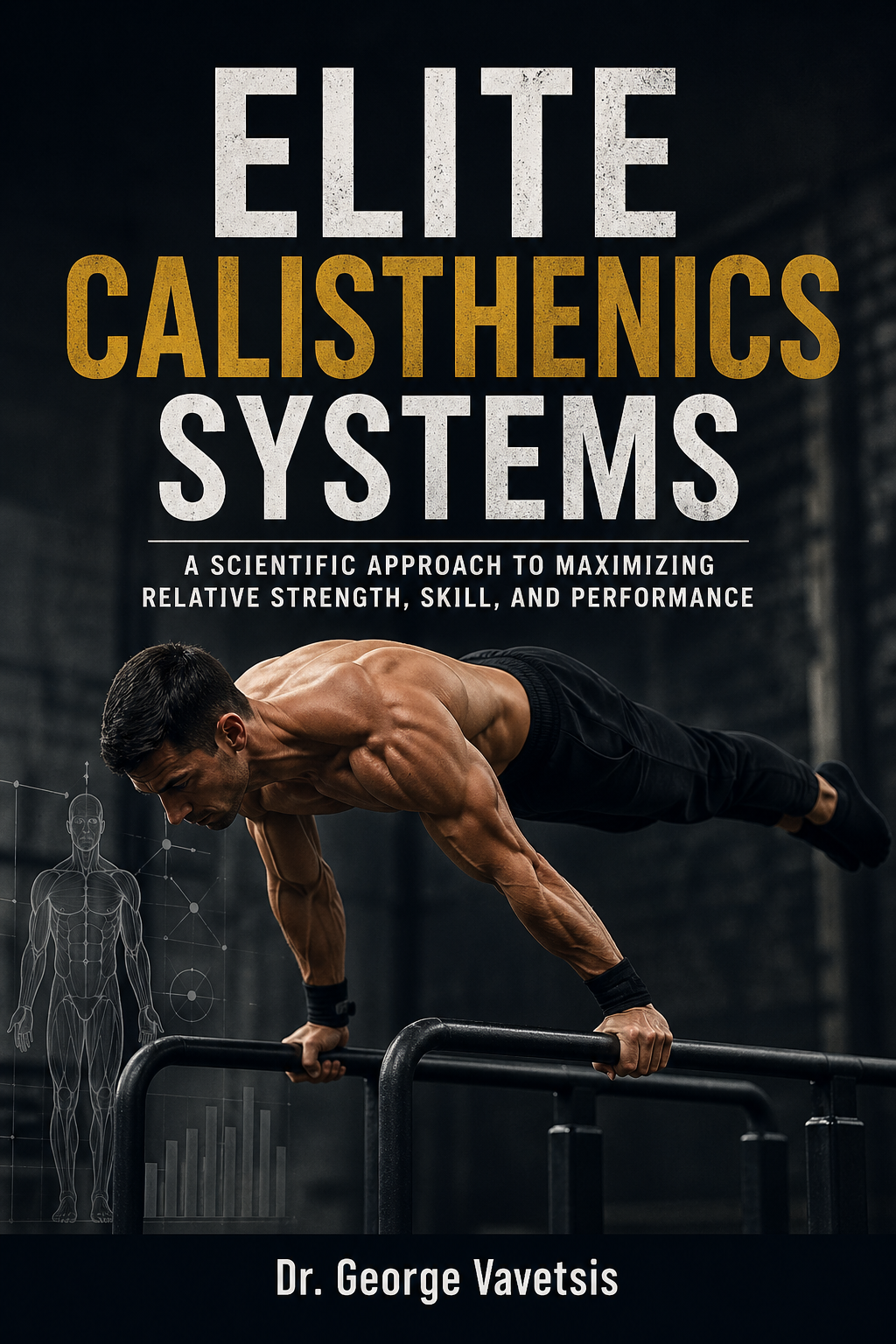
Elite Calisthenics Systems
Pages: 1349
In the evolving landscape of strength and conditioning, calisthenics has undergone a profound transformation—from a rudimentary form of bodyweight exercise into a sophisticated, high-performance training discipline governed by principles of neuromechanics, motor control, and force expression. Elite Calisthenics Systems emerges as a response to this evolution, offering a structured and scientifically rigorous framework for understanding, programming, and optimizing bodyweight-based performance at the highest level.
At its core, calisthenics is not merely the manipulation of body mass through space; it is the precise orchestration of neural drive, intermuscular coordination, and mechanical efficiency under varying constraints. Each movement—whether a planche, front lever, or muscle-up—represents a complex interaction between the central nervous system (CNS) and the musculoskeletal system, where success is determined not only by muscular strength but by the quality, timing, and synchronization of force production.
The foundational premise of this book is that relative strength is a neuro-mechanical phenomenon. It is not simply the ratio of force to body mass, but rather the athlete’s capacity to recruit high-threshold motor units, modulate firing frequency, and coordinate force vectors across the kinetic chain with minimal energy leakage. As outlined in the early sections of this work, the ability to generate maximal tension in bodyweight tasks depends heavily on neural efficiency and corticospinal excitability, reinforcing the idea that strength is as much a product of the nervous system as it is of muscle tissue .
Traditional strength training paradigms have often emphasized external loading as the primary driver of adaptation. While effective, this perspective underestimates the adaptive potential of internally generated tension and the role of closed-chain mechanics in developing high levels of force output. Calisthenics, by contrast, places the athlete in a system where the body itself becomes both the load and the instrument of force transmission, requiring an advanced level of proprioceptive awareness, structural alignment, and neuromuscular control.
This book bridges the gap between classical strength training methodologies and the unique demands of advanced calisthenic performance. It integrates principles from biomechanics, neurophysiology, and motor learning to construct a comprehensive model of training that prioritizes neural intent, technical precision, and force transfer efficiency. Concepts such as rate of force development (RFD), motor unit synchronization, and intermuscular coordination are not treated as abstract variables but as trainable qualities that directly influence performance outcomes.
A critical theme throughout this work is the distinction between central and peripheral determinants of performance. In high-level calisthenics, failure is rarely a function of local muscular exhaustion alone. Instead, it often reflects a breakdown in neural output, coordination, or stability under load. Recognizing and programming around these limitations requires a nuanced understanding of fatigue—one that differentiates between metabolic accumulation and central nervous system inhibition. This distinction allows practitioners to design training sessions that preserve neural quality while strategically manipulating volume and intensity.
Equally important is the role of motor learning and skill acquisition. Unlike conventional resistance training, where movement patterns are relatively stable, calisthenics demands continuous refinement of complex motor skills. The acquisition of these skills depends on high-frequency, low-fatigue exposure—what this book defines as microdosing of technical practice. By maintaining a high signal-to-noise ratio within the nervous system, athletes can encode efficient movement patterns, reduce unnecessary co-contraction, and achieve a level of automatization that enhances both performance and durability.
From a programming perspective, Elite Calisthenics Systems introduces a multi-layered approach that integrates strength, skill, and neural adaptation into a unified model. Training is not viewed as a linear progression of load but as a dynamic system of interacting variables, including intensity, density, complexity, and recovery. The manipulation of these variables is guided by clearly defined performance indicators—such as force consistency, tremor amplitude, and velocity profiles—ensuring that each session contributes meaningfully to long-term adaptation.
Furthermore, this book emphasizes the importance of force transfer and kinetic chain integrity. In calisthenics, the body must function as a cohesive unit, where force generated in one segment is efficiently transmitted across multiple joints and tissues. Any disruption in this chain—whether due to poor alignment, insufficient stability, or delayed activation—results in energy loss and compromised performance. Therefore, a significant portion of this work is dedicated to developing strategies that enhance structural connectivity and optimize force pathways.
Beyond the physiological and mechanical dimensions, Elite Calisthenics Systems also addresses the psychological and perceptual aspects of performance. The ability to express maximal intent, overcome neural inhibition, and operate under high levels of perceived threat is integral to mastering advanced bodyweight skills. Training, therefore, must not only build physical capacity but also cultivate confidence, control, and resilience within the athlete.
Ultimately, this book is designed for coaches, practitioners, and athletes who seek to move beyond generalized training approaches and embrace a precision-based model of performance development. It challenges conventional assumptions, introduces advanced methodologies, and provides practical tools for implementing a system that is both scientifically grounded and performance-driven.
In a field where simplicity often masks complexity, Elite Calisthenics Systems aims to reveal the intricate mechanisms that underpin elite-level performance. By doing so, it offers a new perspective on what is possible when the human body is trained not just to move, but to express force with intelligence, efficiency, and purpose.