
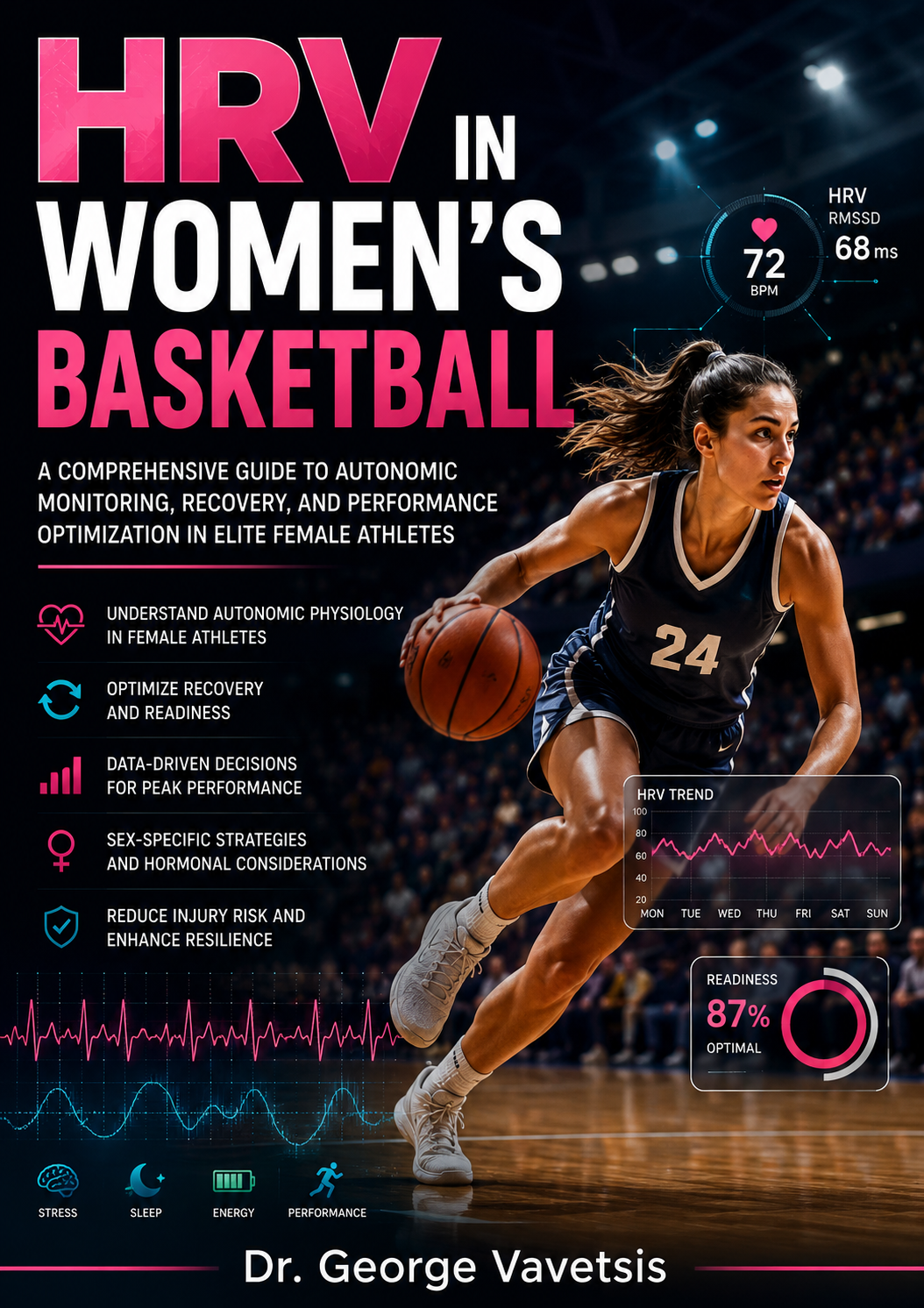
Heart Rate Variability in Elite Women’s Basketball
Pages: 737
Heart rate variability (HRV) represents one of the most powerful non-invasive biomarkers available for monitoring the interaction between physiological stress, autonomic regulation, recovery capacity, emotional state, and performance readiness in elite sport. Yet despite the exponential expansion of HRV-related literature during the past two decades, the application of autonomic monitoring in elite women’s basketball remains substantially underdeveloped. Much of the existing sport science literature has historically focused on male athletes, endurance sports, or laboratory-controlled conditions that fail to reflect the chaotic, collision-dominant, cognitively overloaded, and hormonally dynamic environment of elite female basketball competition. This book was written to address that gap.
Elite women’s basketball presents a uniquely complex physiological ecosystem. Athletes are simultaneously exposed to repeated high-velocity accelerations and decelerations, multidirectional braking loads, neuromuscular collisions, tactical uncertainty, cognitive decision-making stress, hormonal fluctuations, congested travel schedules, sleep disruption, emotional pressure, and cumulative autonomic fatigue. Unlike traditional aerobic sports where physiological load may progress in relatively predictable patterns, basketball imposes intermittent surges of sympathetic activation interspersed with incomplete parasympathetic restoration. This creates a continuously fluctuating autonomic landscape in which readiness, recovery, and performance can change dramatically within hours.
HRV provides an unprecedented window into these processes.
The autonomic nervous system functions as the invisible regulator of athletic adaptation. Sympathetic dominance facilitates survival, intensity, aggression, acceleration, and explosive output, while parasympathetic regulation governs recovery, emotional stabilization, neurocognitive restoration, sleep quality, inflammatory modulation, and physiological resilience. Elite performance in women’s basketball depends not merely on maximizing training stress, but on strategically orchestrating the oscillation between sympathetic activation and parasympathetic restoration across training sessions, microcycles, menstrual phases, competitive tournaments, travel demands, and seasonal periodization structures.
This text approaches HRV not as a simplistic recovery metric, but as an integrative neurophysiological framework for understanding athlete adaptation.
The modern female basketball athlete competes in an environment characterized by unprecedented physiological density. WNBA, EuroLeague Women, NCAA Division I, and international FIBA competition schedules impose repeated 30–40 minute high-usage exposures, congested 48–72 hour recovery windows, long-haul travel, circadian disruption, emotional volatility, and elevated neuromuscular demand. Repeated transition sequences, defensive press actions, chaotic small-sided tactical environments, and high-braking deceleration loads exceeding 3.5 m·s⁻² generate significant autonomic perturbations that extend far beyond traditional conditioning concepts.
Consequently, understanding HRV in women’s basketball requires a multidimensional perspective integrating cardiovascular physiology, neurobiology, endocrinology, biomechanics, psychophysiology, sleep science, load management, tactical stress analysis, and cognitive neuroscience.
This book was developed specifically for strength and conditioning coaches, sport scientists, performance directors, physiologists, rehabilitation specialists, basketball coaches, and applied practitioners working in elite women’s basketball environments. Its purpose is not only to explain HRV physiology, but to translate autonomic science into actionable basketball-specific performance strategies.
Throughout this text, special emphasis is placed on the sex-specific physiology of female basketball athletes. Hormonal fluctuations associated with the menstrual cycle influence autonomic regulation, vagal tone, thermoregulation, substrate metabolism, sleep stability, cardiovascular strain, and recovery dynamics. Follicular-phase RMSSD elevations, luteal-phase sympathetic dominance, hormonal modulation of HF power, and menstrual-phase-specific recovery adaptations are examined not as theoretical abstractions, but as practical variables influencing programming, conditioning density, tactical exposure, and athlete monitoring decisions.
Equally important is the recognition that HRV cannot be interpreted in isolation.
A reduction in RMSSD may indicate accumulated neuromuscular fatigue, emotional stress, poor sleep, travel fatigue, cognitive overload, inflammatory responses, or insufficient nutritional recovery. Conversely, elevated HRV values are not universally positive and may sometimes reflect parasympathetic saturation or maladaptive autonomic compensation. Context therefore becomes the foundation of intelligent HRV interpretation.
This book repeatedly emphasizes ecological validity.
Rather than relying exclusively on laboratory-derived models, the physiological realities of women’s basketball competition are prioritized. Topics such as autonomic drift during repeated transition waves, HRV suppression during defensive press sequences, parasympathetic rebound kinetics during timeout intervals, cognitive-autonomic coupling during pick-and-roll decision-making, and sympathetic elevation during EuroLeague road trips are explored through the lens of real basketball performance environments. The athlete is viewed not as an isolated cardiovascular system, but as a dynamically adaptive neurobiological organism interacting continuously with tactical, emotional, hormonal, environmental, and competitive stressors.
One of the central themes of this text is that HRV should not merely monitor fatigue; it should guide performance architecture.
Autonomic monitoring can inform conditioning density ratios, eccentric load sequencing, recovery interventions, tactical rotation strategies, breathing protocols, readiness assessment, travel management, sleep restoration, and even cognitive preparation before competition. HRV becomes a decision-support system for optimizing adaptation while minimizing maladaptive overload.
Importantly, this book does not promote technological dependency or data obsession. Numbers without context can mislead coaches into reductionist thinking. HRV should complement—not replace—expert coaching observation, athlete communication, psychological awareness, and sport-specific understanding. The most effective performance systems integrate physiological data with human interpretation, contextual intelligence, and practical coaching wisdom.
The future of elite women’s basketball performance lies in precision physiology.
As wearable technologies, machine learning systems, real-time autonomic analytics, and individualized athlete monitoring continue to evolve, the integration of HRV into basketball performance systems will become increasingly sophisticated. However, technology alone cannot optimize athletes. The true advancement of performance science lies in understanding the biological individuality of the female athlete and respecting the complexity of human adaptation under competitive stress.
This book was written with the belief that elite female basketball athletes deserve scientific models designed specifically for their physiology, their competitive demands, and their performance realities.
The autonomic nervous system is not merely reacting to basketball performance—it is shaping it.
Every sprint, every transition, every defensive rotation, every emotionally charged possession, every travel schedule, every hormonal fluctuation, every sleep disruption, and every recovery strategy leaves an autonomic signature. Understanding those signatures provides coaches and practitioners with the opportunity to optimize readiness, preserve resilience, enhance recovery, and ultimately elevate performance.
The purpose of this book is to help bridge the gap between autonomic science and elite women’s basketball practice.